
The USVI Problem: Corruption, Settlements, and the Politics of Epstein’s Island
“The question isn’t why Epstein chose the USVI; it’s why the USVI kept choosing Epstein.”

If the Epstein Transparency Act reveals how federal institutions failed, the U.S. Virgin Islands reveal how local political ecosystems can become financially dependent on a predator while claiming to police him.
USVI:
took Epstein’s money,
granted him tax privileges,
allowed him operational freedom,
and only pursued him aggressively after he became politically useless and financially exploitable as a cash settlement target.
This is not speculation — this is documented in:
federal court filings,
settlement agreements,
USVI tax program records,
depositions from the JPMorgan and Deutsche Bank cases,
public statements from former Virgin Islands officials.
The USVI case is not an outlier.
It shows how small jurisdictions with limited oversight and heavy financial dependency can protect predators — and later profit from prosecuting them.
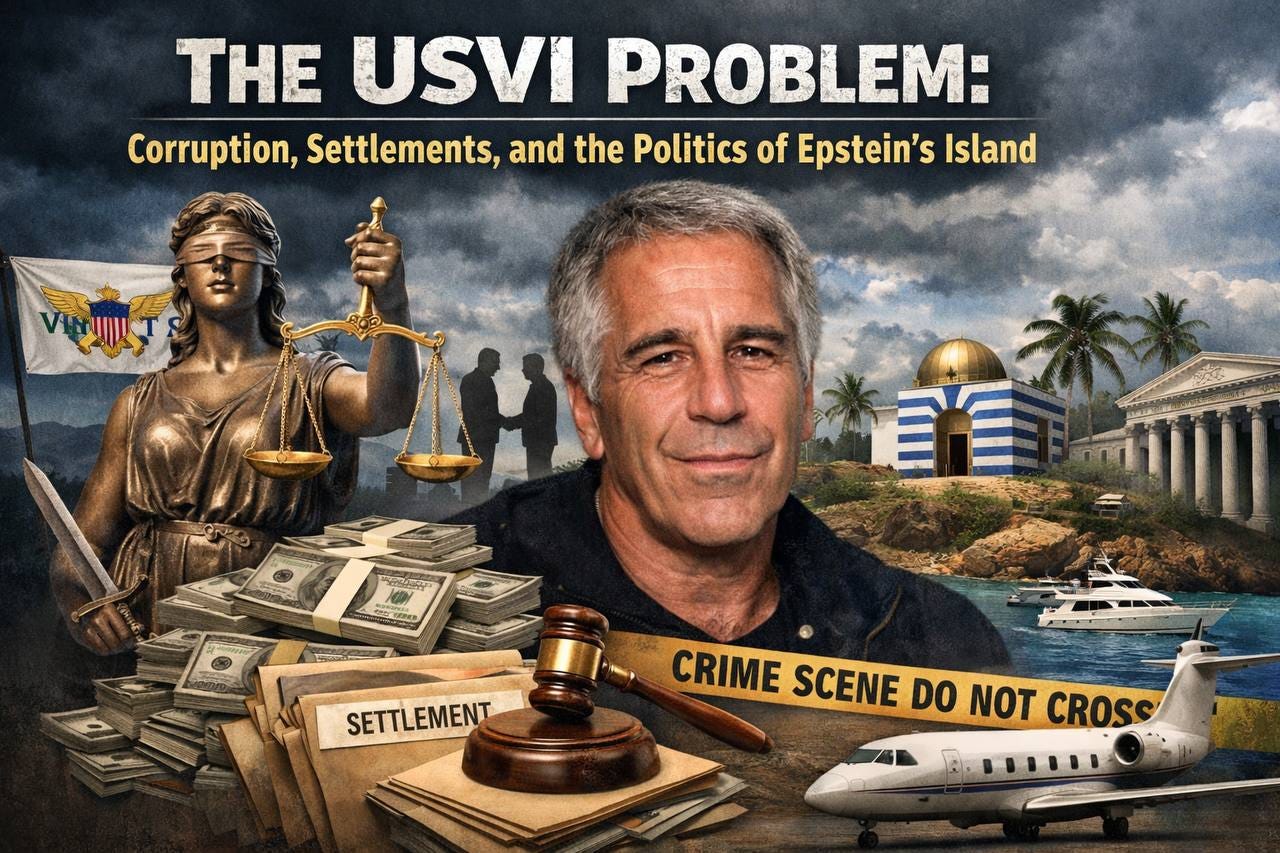
I. Epstein Was Not Merely “Living” in the USVI — He Was an Economic Asset
Epstein didn’t randomly choose Little St. James.
The USVI government actively encouraged him to reside and operate there.
1. Epstein entered the USVI through the Economic Development Commission (EDC)
This program grants enormous tax breaks to wealthy individuals who “invest” in the island’s economy.
Epstein received:
up to 90% tax reductions,
exemptions on business taxes,
exemptions on import duties,
and near-zero effective income taxation.
Jeffrey Epstein got $300 million tax breaks, paid US Virgin Islands police, JPMorgan says
(Expanded detail: According to JPMorgan Chase’s court filings, the USVI provided Epstein with over $300 million in tax incentives through the EDC program, including a 90% reduction on income taxes, excise taxes, and gross receipts taxes, in exchange for establishing businesses and residences in the territory, as revealed in unredacted documents from June 2023.)
2. Why did he get these privileges?
Because:
He was donating to officials.
He was hiring local employees.
He was spending money on island services.
He was seen as an economic engine.
Former officials testified that Epstein was considered a “valuable contributor” to USVI revenue.
This is the textbook foundation of the USVI problem.
U.S. Virgin Islands cozied up to Jeffrey Epstein. Now they’re profiting from his sex crimes
(Expanded detail: JPMorgan’s filings allege that the USVI government, through the EDC, viewed Epstein as an economic asset, granting him privileges despite knowledge of his activities, with tax breaks estimated at hundreds of millions, as part of a pattern where local officials benefited from his contributions.)
II. USVI Officials Maintained Personal and Political Ties With Epstein
This is not rumor — it is memorialized in depositions and filings.
1. Former USVI First Lady Cecile de Jongh
She:
managed Epstein’s companies in the USVI,
handled payroll for his island staff,
coordinated tax filing matters,
and served as a liaison with government officials.
Emails show she asked Epstein for:
tuition assistance for her children,
political support,
campaign donations (direct and indirect).
Epstein obliged. JPMorgan alleges wife of U.S. Virgin Islands' ex-governor aided Jeffrey Epstein’s criminal activity The largest bank in the U.S. made the accusations in a filing as part of its defense in a civil suit brought by the territory last year.
(Expanded detail: In JPMorgan’s court filings from May 2023, Cecile de Jongh is accused of aiding Epstein by managing his companies, facilitating student visas for victims, and soliciting donations, including tuition payments for her children, as evidenced by emails and documents in the sex trafficking lawsuit.)
2. Elected officials had consistent communication with Epstein
The JPMorgan litigation unearthed emails and memos showing:
officials updated Epstein on tax program changes,
asked for guidance on regulatory issues,
and sought his endorsement or financial assistance. U.S.V.I. Government Complicit in Trafficking, JPMorgan Chase Says
(Expanded detail: JPMorgan’s filings detail Epstein’s corrupt relationships with USVI officials, including gifts, favors, and communications where he courted them with money, as part of allegations of government complicity in his activities.)
This is not casual interaction — it is structural dependency.
III. USVI Only Turned Against Epstein After His 2019 Arrest — And Even Then, The Motive Was Money
Until Epstein became globally toxic, USVI institutions:
renewed his tax privileges,
allowed unrestricted movement,
maintained business relationships,
ignored complaints from employees and visitors.
Once he died in 2019, everything changed.
USVI sued Epstein’s estate for $105 million — and won.
The settlement included:
a massive cash payment,
transfer of assets,
additional financial concessions.
But note the timing:
They did not sue when Epstein was alive.
They did not sue when victims first came forward.
They sued only when Epstein could not fight back — and when suing became politically safe.
The lawsuit used trafficking claims that spanned years when USVI itself was granting him privileges. U.S. Virgin Islands Attorney General Settles Sex Trafficking Case Against Estate Of Jeffrey Epstein And Co-Defendants For Over $105 Million
This is not accountability — it is opportunism.
IV. The USVI Problem Is Not an Outlier — It Is a Pattern
The same mechanics that allowed Epstein to thrive in the USVI exist across:
small jurisdictions, tax havens,
dependent economies,
local governments with limited resources.
When a wealthy individual becomes an economic anchor:
oversight weakens,
ties deepen,
corruption normalizes.
This mirrors the broader NGO and contractor ecosystem:
financial dependency creates silence,
institutional incentives align against accountability.
The next chapters in this series will make this explicit:
The same institutional dynamics in USVI appear in:
USAID-funded contractor networks,
ORR shelters and sponsor pipelines,
CPS subcontractors,
major NGOs whose boards overlap with political and philanthropic elites,
university philanthropy systems,
bank compliance failures.
USVI is the microcosm.
The system is the macrocosm.
NEXT ARTICLE (#9):
“What the Epstein Files WILL Expose About Institutions: The Seven Categories of Failure Congress Can’t Avoid Anymore.”
Call to Action: Stand With Us. Protect Children. Change the System.
Project Milk Carton is a federally recognized 501(c)(3) organization dedicated to exposing systemic failures, rescuing at-risk children, and educating the public on how to reform a child-protection system that too often protects institutions instead of families.
Every investigation, every report, every tool we build — including the Project Milk Carton Guardian Decision Intelligence System exists for one purpose: to defend children who cannot defend themselves.
We don’t answer to corporations.
We don’t take money from political actors.
We survive because people like you believe that the truth is worth fighting for.
If you want to help us keep producing uncompromising watchdog journalism, expanding our intelligence systems, and supporting families in crisis, we need you in this movement.
And because we are a 501(c)(3), every contribution is fully tax-deductible.
These final weeks of the year are your last chance to make a 2025 gift that immediately fuels our work saving children in 2026.
It takes 30 seconds.
It changes lives.
It keeps the lights on for the only team willing to confront this system head-on.
Become a 2025 Mission Partner today.
Your donation protects children, strengthens our investigations, and helps transform a broken system.
👉 Make a Tax-Deductible Gift to Project Milk Carton Now
You can contribute by becoming a paid subscriber now:
Share with family and friends:
Make a onetime donation on or website: Project Milk Carton Guardian Decision Intelligence System
Join Our Telegram: Shinning Light on the Missing Children missing children,” “child protection,” “CPS statistics,” and “foster care awaren
137 super elite frequent flyers, still free.
Thank you for your excellent work.