
The Untested Case: Due Process for Sale and the Constitutional Fight No One Has Forced Into Court
The legal theory that could expose America’s child welfare funding model as a constitutional conflict of interest

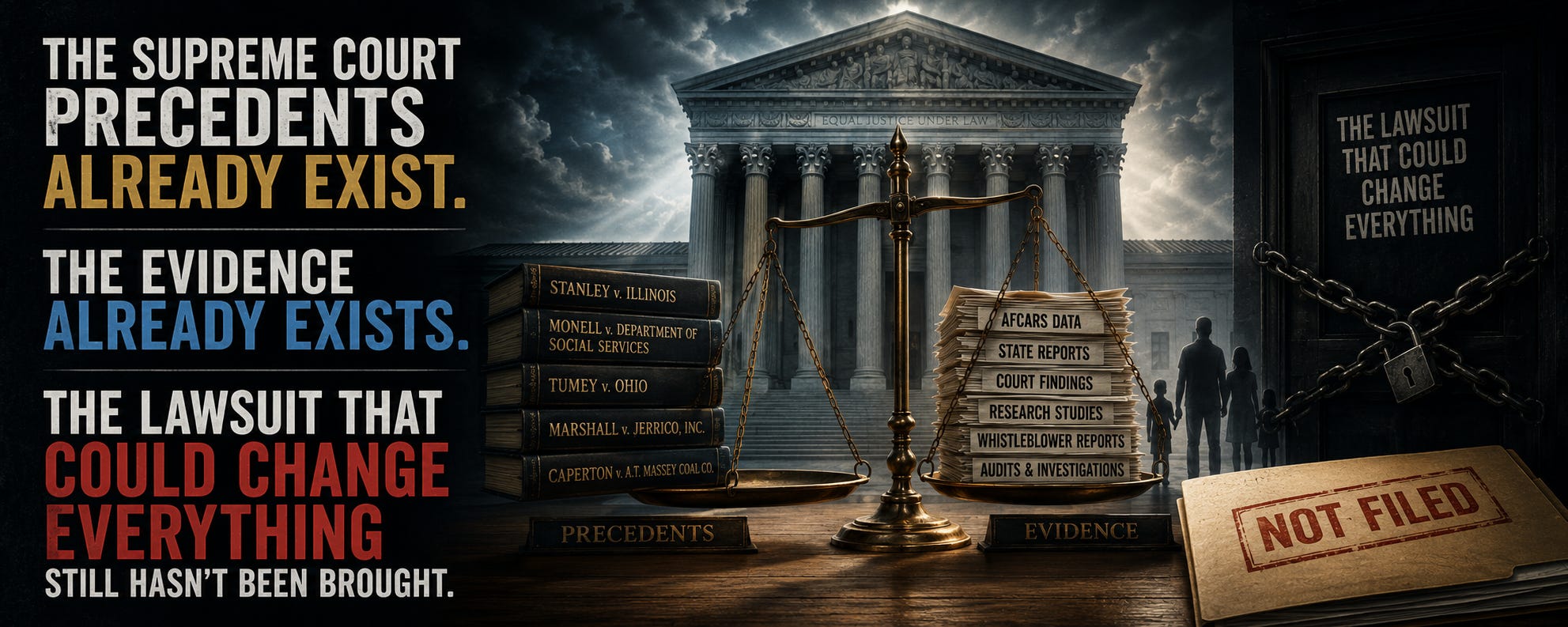
There is a lawsuit that America has been avoiding for more than a quarter century. Not because the facts are hidden. Not because the law is empty. Not because the families are unharmed. The lawsuit has not happened because the people most injured by the system are usually the least able to fight it, and the institutions powerful enough to bring the case have too often been captured, constrained, conflicted, or looking in another direction.
At the center of that unfiled lawsuit is a question so simple it almost sounds impossible that no court has been forced to answer it directly: can the federal government constitutionally pay states more money for terminating parental rights and finalizing adoptions while offering no comparable reward for safely preserving families, then allow county and state agencies operating under that incentive structure to decide whether parents receive the individualized fitness determinations the Fourteenth Amendment requires?
That is the case this investigation calls “The Untested Case.” It is not a theory built from thin air, activist outrage, or moral discomfort alone. It is built from established constitutional law that has been sitting in separate legal silos for decades. One silo is Stanley v. Illinois, the Supreme Court’s landmark parental-rights case holding that the state cannot presume a parent unfit and take children without an individualized hearing. Another silo is Monell v. Department of Social Services, the case that allows municipalities and agencies to be sued under Section 1983 when constitutional injury flows from official policy or custom. A third silo is the due process neutrality line of cases beginning with Tumey v. Ohio and extending through Caperton v. Massey, where courts have said proceedings are constitutionally tainted when the decision-maker or institution has a financial stake in the outcome.
Individually, these doctrines are powerful. Together, they form something far more explosive: a constitutional challenge to the financial architecture of the Adoption and Safe Families Act, known as ASFA, and specifically its adoption incentive payment structure under 42 U.S.C. § 673b. this investigation’s central argument is that this federal bonus system may operate as the official policy, or at least the financial engine behind official county and state child welfare policy, that becomes the moving force behind systematic violations of parents’ fundamental rights.
The case has not been tried. That is the scandal. The building blocks exist. The damage exists. The incentive structure exists. The court record from earlier cases shows child welfare agencies violating constitutional rights through policies, customs, warrantless practices, coercive procedures, and due process failures. Yet no plaintiff has fully assembled the Monell-plus-Stanley-plus-financial-bias challenge and forced a federal court to decide whether ASFA’s one-directional reward system places an unconstitutional thumb on the scale against families.
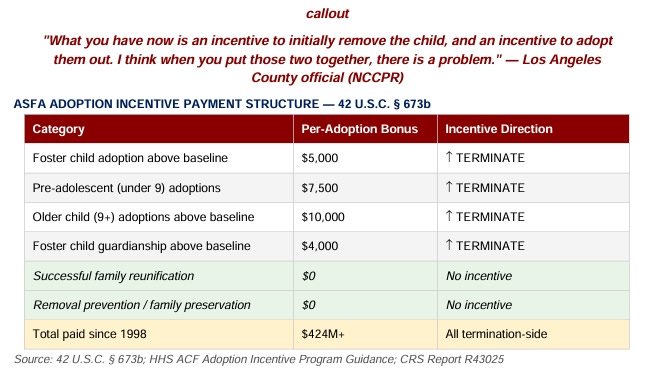
To understand why this matters, start with the money. ASFA’s adoption incentive structure pays governments for certain adoption and guardianship outcomes above baseline. Foster child adoptions above baseline can generate federal bonus payments. Pre-adolescent adoptions can generate larger bonuses. Older child adoptions can generate still larger bonuses. Guardianships can generate payments too. But successful family reunification gets no comparable federal bonus. Removal prevention gets no comparable federal bonus. Poverty-based family preservation gets no comparable federal bonus. A state can safely return a child home after intensive support and receive no equivalent reward under that incentive architecture, while termination-side outcomes are financially recognized.
That asymmetry is the constitutional smoke. The fire is what happens when agencies operating under that asymmetry make decisions about whether to pursue reunification or file petitions to terminate parental rights. The government does not need to say the quiet part out loud for incentives to matter. Bureaucracies respond to what they measure, what they reward, what they report, and what they are pressured to produce. If a system pays on one side of the decision and not the other, the decision-maker is not neutral in the constitutional sense that matters most when fundamental family rights are on the line.
This is where Stanley v. Illinois enters the room. Peter Stanley was the unmarried father of three children. When the children’s mother died, Illinois law automatically made his children wards of the state without any hearing on whether he was actually a fit parent. The Supreme Court rejected that categorical presumption. The state could not simply assume unmarried fathers were unfit. It had to provide an individualized parental fitness hearing before interfering with the parent-child relationship. The Court recognized the parent’s liberty interest in the companionship, care, custody, and management of his children.
Stanley’s power lies in its rejection of government shortcuts. The state cannot replace individualized fitness determination with a broad legislative presumption. That principle should haunt every ASFA case involving the 15-of-22-month termination timeline. Under ASFA, states are generally required to move toward termination when a child has been in foster care for fifteen of the most recent twenty-two months, subject to exceptions. On paper, this is a permanency rule. In practice, this investigation argues, it can function like a near-irrebuttable presumption: once the clock runs long enough, the machinery starts treating termination as the expected path, regardless of whether the delay was caused by agency failure, poverty, service scarcity, caseworker turnover, court backlog, or conditions that have little to do with actual parental fitness.
That is the Stanley analogy. In Stanley, the state presumed unfitness based on marital status. In the ASFA context, the state risks presuming termination-worthiness based on time in foster care, while operating under a financial structure that rewards adoption-side outcomes. The constitutional violation is not merely that a timeline exists. The constitutional problem is that a categorical system, when fused with financial incentives, can erode the individualized fitness judgment that due process requires before the state permanently destroys the parent-child legal relationship.
Monell supplies the vehicle. Under Monell, municipalities and local agencies can be sued when an official policy or widespread custom causes a constitutional deprivation. This matters because child welfare harm is often wrongly framed as individual misconduct. One bad caseworker. One bad supervisor. One bad county. One bad mistake. But this investigation is not interested in chasing only the lowest-level actor. It asks whether the policy architecture itself is unconstitutional when implemented through state and county child welfare agencies.
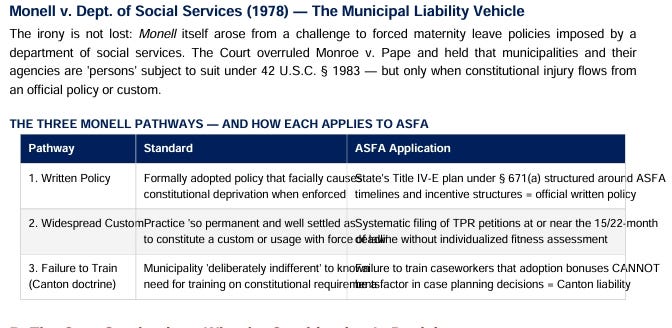
There are multiple Monell pathways. A written policy can cause the violation. A widespread custom can become so permanent and well settled that it carries the force of law. A municipality can be liable for failure to train when it is deliberately indifferent to a known constitutional risk. this investigation applies all three to ASFA. A state’s Title IV-E plan structured around ASFA timelines and incentive payments may become the official written policy. A systematic practice of filing termination petitions at or near the 15-of-22-month deadline without serious individualized fitness assessment may become the widespread custom. A failure to train caseworkers that adoption bonuses and permanency metrics must not influence case planning may become the deliberate indifference.
That is the synthesis. The claim is not that ASFA’s § 673b itself creates an individual right that parents can enforce directly under Section 1983. That route runs into the Supreme Court’s modern spending-clause cases, especially Gonzaga University v. Doe, which requires spending statutes to unambiguously confer individual rights before they can be enforced through Section 1983. this investigation carefully avoids that trap. The right does not come from § 673b. The right comes from the Fourteenth Amendment. Section 673b is the factual predicate showing the official policy and incentive structure that allegedly drives the constitutional injury.
That distinction is the whole ballgame. If a plaintiff says, “ASFA gives me an individual statutory right,” the case likely dies under Gonzaga. If a plaintiff says, “the Fourteenth Amendment gives me a fundamental parental right, and ASFA’s incentive structure is the official policy or financial architecture that corrupted the agency process and caused the violation,” the claim moves into different territory. It becomes a constitutional claim, not a spending-statute enforcement claim.
The financial-bias doctrine makes the theory sharper. In Tumey v. Ohio, the Supreme Court held that due process is violated when a judge has a financial interest in convictions. In Ward v. Village of Monroeville, the Court rejected a mayor-judge system where the municipality benefited from fines. In Gibson v. Berryhill, the Court found unconstitutional bias where a state board had a financial stake in proceedings it supervised. In Marshall v. Jerrico, the Court addressed financial incentives in enforcement. In Caperton v. Massey, the Court held that due process can require recusal when the probability of bias is too high, even without proof of actual bias in a specific decision. In Williams v. Pennsylvania, the Court treated certain bias defects as structural errors rather than harmless mistakes.
The lesson from those cases is devastating when applied to child welfare. Due process does not wait for a plaintiff to prove that a biased structure changed the outcome in one particular case. The problem is the structure. If the process is infected by a financial stake, the proceeding itself becomes constitutionally suspect. this investigation’s insight is to apply that logic not merely to a judge taking money or a mayor collecting fines, but to a child welfare institution that receives financial rewards tied to adoption-side outcomes while participating in decisions about whether to terminate parental rights.
The analogy to the “Kids for Cash” scandal in Luzerne County, Pennsylvania, is impossible to ignore. Judges accepted money connected to a private juvenile detention facility while sending children into detention. The Pennsylvania Supreme Court ultimately vacated thousands of juvenile adjudications because no one who appeared before the corrupted judge received a truly impartial hearing. The constitutional principle was not that every juvenile was factually innocent. The principle was that a financially biased process cannot be trusted to deliver justice.
The ASFA version is not a personal bribery scheme. That must be said clearly. No one needs to allege that caseworkers are pocketing federal adoption bonuses in envelopes. The claim is more structural and, in some ways, more dangerous. Personal corruption is easier to condemn and isolate. Institutional incentive bias can be legalized, normalized, budgeted, audited, defended by counsel, and praised as policy. The money does not need to enter an individual official’s bank account to influence the institution. It only needs to shape metrics, expectations, budgets, performance reviews, permanency goals, and agency culture.
That is why this investigation calls the challenge untested, not imaginary. Courts have seen pieces of it. Nicholson v. Williams showed that systematic child welfare policies can violate parental rights on a mass scale. Dupuy v. Samuels showed that systemic Illinois DCFS procedures violated due process and required structural injunctive relief. Tenenbaum v. Williams showed agency practice problems around warrantless medical examinations. But those cases stopped one step short. They did not connect Monell liability to ASFA’s federal financial incentive architecture. They treated the policies as unconstitutional agency practices, not as downstream manifestations of a federal reward system that may be warping decision-making at the root.
The missing step is the case no one has forced the courts to decide: whether ASFA’s adoption bonus architecture, when implemented by state or county child welfare agencies, constitutes the official policy that drives systematic violations of Stanley parental rights. If that claim were tested and proven, the implications would be enormous. It would not merely expose bad practices inside one agency. It could challenge the constitutional legitimacy of the incentive structure that helps steer the national child welfare machine.
So why has no plaintiff closed the gap? this investigation identifies four barriers, and together they explain why the most powerful case can remain unfiled even when the evidence is sitting in public law.
The first barrier is the Gonzaga and Suter wall around Section 1983 enforcement of spending-clause statutes. Suter v. Artist M. and Gonzaga University v. Doe made it extremely difficult for plaintiffs to enforce federal child welfare spending statutes directly through Section 1983 unless the statute clearly creates an individual right. ASFA’s adoption incentive provisions do not do that. They are programmatic funding conditions, not individual rights language. Many advocates likely looked at that wall and concluded ASFA was untouchable through civil rights litigation.
But this investigation argues that this is a false obstacle for the Monell-Stanley theory. The plaintiff does not need ASFA to create the right. The Fourteenth Amendment already does. ASFA supplies the policy architecture, the financial motive, and the causal evidence. Gonzaga blocks one doorway but not the whole building. The problem is that advocates may have been so trained to see ASFA through spending-clause enforceability that they missed the constitutional route around it.
The second barrier is standing, and it is brutal. Parents with active termination cases have standing, but they are often fighting for their children in state court, overwhelmed, poor, terrified, and unable to risk a federal constitutional lawsuit that might be used against them. Parents whose rights have already been terminated have the injury, the outrage, and sometimes the time to fight, but they may lose standing to seek prospective relief because the case is considered final or moot. The controversy is capable of destroying a family faster than federal courts can review it.
This is the perfect timing trap. Before termination, the parent is in the storm. After termination, the parent may be told the storm is legally over. That trap protects the system from the very people it harms most. The exception for issues capable of repetition yet evading review rarely helps because courts often require a reasonable expectation that the same complaining party will face the same action again. A parent whose rights have been permanently terminated may not fit that standard, even though thousands of other parents will face the same machinery.
The solution would likely require a carefully structured class action involving current-case parents, possibly joined by organizational plaintiffs, with standing preserved through the litigation. But that requires money, sophistication, legal courage, data experts, and plaintiffs willing to fight a federal structural case while their family future is still at risk. That is a staggering burden.
The third barrier is economics. Litigation at this level is not a courthouse complaint scribbled on principle. It requires years of funding, statistical experts, AFCARS data analysis, discovery battles, Daubert-proof methodology, appellate strategy, and organizational capacity. Legal Services Corporation restrictions have historically limited class actions and major impact litigation. Private legal aid groups are already overwhelmed. Major child welfare litigation organizations have often focused on foster children’s rights, where standing can be cleaner and public sympathy easier to obtain, rather than parents facing termination, where the constitutional theory may be stronger but the political optics are harder.
This is one of the cruel realities of constitutional law. Rights do not enforce themselves. Someone must pay to turn them into precedent. When the injured class is poor parents accused by the child welfare system, the market for vindicating their rights is thin. The very stigma of an abuse or neglect accusation makes funders hesitate, politicians hide, and institutions choose safer cases.
The fourth barrier is political capture. this investigation is blunt about this. State attorneys general defend ASFA-compliant systems rather than attack them. Adoption industry interests have shaped federal child welfare policy. The Department of Justice has not taken a major parental-rights position against ASFA’s incentive structure. Congress receives pressure from adoption-aligned stakeholders and has repeatedly revised child welfare law without confronting the constitutional incentive problem. Judges, especially after reversals in structural reform cases, may be wary of broad injunctions against state systems.
The result is a locked room. The people with standing often lack resources. The people with resources often lack appetite. The people with power often benefit from the current system or fear the political cost of challenging it. The legal theory sits there, assembled but unused, like a key no one has been willing to put in the door.
If the case were filed, what would it look like? this investigation maps the architecture with unusual precision.
The first claim would be substantive due process under Stanley and Troxel. Plaintiffs would argue that official policies structured around ASFA incentive payments systematically deprive parents of their fundamental liberty interest in the care, custody, and control of their children without the individualized parental fitness assessment the Constitution requires. This is not a claim that no child should ever be removed or no parental rights should ever be terminated. It is a claim that the decision must be individualized, neutral, and uncorrupted by a financial architecture that favors termination-side outcomes.
The second claim would be procedural due process under Tumey and Caperton. Plaintiffs would argue that the financial incentive structure embedded in official case-planning policies creates a structural conflict of interest that renders termination proceedings constitutionally inadequate when the agency participating in those decisions benefits from the outcome path. The core point is not actual bias in one case. The point is probability of bias built into the machinery.
The third claim would be equal protection. this investigation references racial disparity evidence, including the theory that Black and Native American families experience termination at significantly higher rates than similarly situated white families. If the incentive structure produces or amplifies racial disparities in fundamental family rights, the constitutional stakes intensify. Equal protection could provide a parallel route to strict scrutiny, especially where data show that incentive-driven policies fall hardest on protected communities.
The fourth claim would be a Spending Clause challenge under South Dakota v. Dole. Dole says federal spending conditions cannot require states to engage in independently unconstitutional conduct. If ASFA’s incentive structure pressures or conditions state behavior in a way that systematically violates fundamental parental rights, then the spending condition itself may be unconstitutional. NFIB v. Sebelius adds another angle by recognizing that federal spending conditions can become coercive. this investigation treats this as the most novel and potentially transformative argument because a successful challenge could threaten the federal incentive program itself.
The hardest obstacle would be the facial challenge standard from United States v. Salerno, which says a challenger must show that no set of circumstances exists under which the law would be valid. Applied rigidly, that standard would make an ASFA facial challenge nearly impossible because one could imagine cases where adoption incentives exist but do not influence a specific termination decision. But this investigation argues that parental-rights doctrine and structural-bias doctrine offer a path around that trap.
Troxel v. Granville struck down a grandparent visitation statute as infringing parental rights without mechanically applying the strictest Salerno formulation. Washington State Grange distinguished between contingent applications and structurally defective designs. Tumey, Caperton, and Williams focus on bias in the process itself. If the constitutional defect is structural financial conflict, then the plaintiff does not need to prove every individual outcome was wrong. The poisoned process is the injury.
That is the “every application” argument. In every case where an agency subject to ASFA incentive flows is deciding whether to pursue termination or reunification, and the parent has a fundamental liberty interest in the child relationship, the agency faces a constitutionally impermissible structural conflict because one route is financially rewarded and the other is not. The incentive operates as a thumb on the scale. The parent is entitled to a neutral individualized process. The state cannot provide that neutrality while its institutional policy architecture rewards one outcome.
The government’s defenses would be predictable. It would argue Gonzaga bars the claim because § 673b does not create individual rights. Plaintiffs would respond that the claim arises directly under the Fourteenth Amendment, with § 673b serving only as evidence of policy and causation. The government would argue counties do not directly receive the incentive funds. Plaintiffs would target county-administered systems where counties function as direct Monell defendants and where state funds, federal reimbursements, and performance structures can be traced through policy implementation. The government would argue that supplement-not-supplant rules neutralize the incentive. Plaintiffs would answer that accounting rules do not cure decision-making bias. The problem is not whether dollars are segregated on paper. The problem is whether the institution has a financial and performance stake in the termination pathway.
The government would also say ASFA can be applied constitutionally in some cases. Plaintiffs would answer that the structural-bias theory is not about whether every child adoption is bad or every termination is unjustified. It is about whether the agency process is constitutionally neutral when the institution is financially rewarded for one side of the decision. A biased judge does not get to keep convictions by arguing some defendants were guilty anyway. A financially interested juvenile court judge does not get to preserve adjudications by arguing detention may have been appropriate in some cases. Structural bias voids the process because due process protects the integrity of the decision-making forum itself.
this investigation draws an important lesson from M.D. v. Abbott, the massive Texas foster care litigation. Judge Janis Graham Jack found systemic constitutional violations in Texas’s foster care system, including insufficient caseworker numbers, inadequate placement array, excessive placement instability, and inadequate oversight. The case showed that courts can make large-scale constitutional findings in child welfare. But the Fifth Circuit’s later narrowing and remedy reversals show the danger of broad structural injunctions that are not tightly tied to specific constitutional violations.
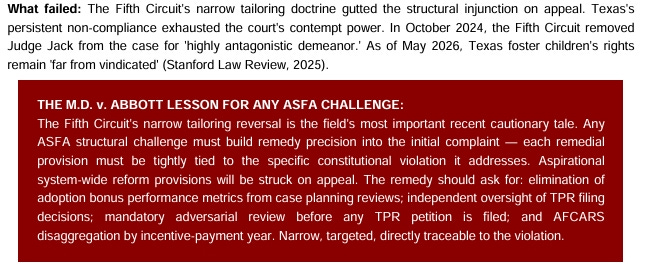
That lesson is critical. Any ASFA challenge cannot simply ask a court to fix child welfare. That is too broad, too vulnerable, and too easy for appellate courts to cut apart. The remedy must be surgical. It should target the incentive-corrupted decision points: remove adoption bonus metrics from case planning reviews, require independent review before termination petitions are filed, mandate adversarial screening of termination decisions, require AFCARS data disaggregation by incentive-payment year, and establish procedures ensuring that financial incentives cannot enter reunification-versus-termination decision-making. The remedy must trace directly to the violation.
This is where the strategy becomes as important as the theory. this investigation recommends starting in the Ninth Circuit, especially in a county-administered child welfare state. The Ninth Circuit has stronger family-integrity doctrine than many circuits and includes states such as California, Oregon, and Washington, where county-level administration and data availability may make Monell causation easier to establish. County-administered systems matter because counties can be direct Monell defendants. That avoids some of the sovereign-immunity and state-level barriers that often frustrate structural litigation.
The ideal jurisdiction would have five traits. First, a county-administered child welfare system where the county is the direct defendant. Second, documented receipt of ASFA adoption incentive payments above baseline. Third, measurable spikes in termination filings near the 15-of-22-month deadline. Fourth, significant racial disparities in termination rates. Fifth, evidence that termination orders outrun actual adoptions, creating legal orphans and undermining the government’s claim that the incentive structure reliably serves child welfare.
The data backbone would be AFCARS, the federal Adoption and Foster Care Analysis and Reporting System. AFCARS is crucial because it is the government’s own data system. The same federal apparatus that calculates adoption incentive payments also collects foster care and adoption outcome data. That creates an evidentiary opportunity. Plaintiffs could analyze state-by-state termination rates before and after ASFA implementation, spikes at month fifteen, correlations between higher incentive-payment years and later termination rates, racial disparities, and gaps between termination orders and completed adoptions.
That last point matters more than most people realize. If termination of parental rights reliably led to adoption and stable permanency, the government would at least have a stronger compelling-interest argument. But scholars such as Martin Guggenheim have warned about the “legal orphan” problem, where parental rights are terminated but children are not adopted. The child loses the legal family without gaining a new permanent one. If ASFA incentives help produce termination without permanency, the system is not merely violating parents. It may be injuring children under the banner of helping them.
The legal orphan problem cuts through the public relations language. Permanency sounds compassionate. Adoption sounds final and safe. But termination without adoption is not permanency. It is legal severance followed by uncertainty. It can leave children disconnected from parents, kin, culture, siblings, and identity while still drifting in state care. If federal incentives accelerate terminations that do not become adoptions, the government’s justification starts to collapse under its own data.
The scholarship supporting this investigation’s theory is not fringe. Kendra Huard Fershee has argued that ASFA provisions, including the 15-of-22-month rule, can systematically violate procedural and substantive due process. Martin Guggenheim’s work on legal orphans undermines the assumption that termination automatically serves children. Josh Gupta-Kagan has identified the current child welfare legal structure as infringing fundamental liberty interests and pointed to financial incentive asymmetry as a core structural problem. Dorothy Roberts has documented the racialized civil rights dimensions of child welfare intervention and the disproportionate surveillance and disruption of Black families. Christine Gottlieb has addressed systematic parental due process deprivations in New York, the same state where Monell itself originated.
The deeper scandal is that the courts have already supplied the vocabulary needed to describe the problem. Meyer v. Nebraska and Pierce v. Society of Sisters laid the foundation for parental rights as protected liberty interests. Stanley required individualized parental fitness hearings. Santosky v. Kramer required clear and convincing evidence before termination of parental rights. Troxel reaffirmed parental rights against overbroad state intrusion. Tumey and Ward condemned financial stake in adjudication. Caperton recognized probabilistic bias. Williams treated bias in the process as structural error. Monell provided municipal liability. Canton and Pembaur explained policy, failure-to-train, and final-policymaker theories. Dole limits unconstitutional spending conditions. The tools are in the shed. The case has not been built.
That should disturb anyone who believes constitutional rights are more than museum pieces. We have a system where the government can permanently sever the legal relationship between parent and child, a punishment-like civil death of the family bond, while the agency moving the case may operate under federal rewards tied to adoption outcomes. We would never tolerate that structure in criminal court. We would not accept a prosecutor’s office receiving bonus payments for convictions above baseline while claiming each plea bargain remains neutral. We would not accept judges whose court budgets increased based on guilty verdicts. We would not accept juvenile courts rewarded for detention numbers after Kids for Cash showed where that logic leads.
Yet in child welfare, the moral framing of child protection has allowed the incentive question to hide in plain sight. The public hears “adoption incentive” and imagines children rescued from danger and placed into loving homes. Sometimes that happens. But constitutional analysis cannot stop at the best case. It must ask what the structure does across thousands of cases, including marginal cases, poverty cases, neglect cases rooted in service gaps, cases involving domestic violence victims, cases where parents are delayed by the agency’s own failures, and cases where the child never reaches adoption after termination. The Constitution is not written for the agency’s press release. It is written for the family standing alone against state power.
The phrase “due process for sale” is provocative, but this investigation’s argument is more precise than a slogan. It does not claim every adoption is bought. It does not claim every termination is illegal. It claims that when a government system financially rewards one outcome in a fundamental-rights decision, while denying equivalent reward for the rights-preserving alternative, the neutrality of the process becomes constitutionally suspect. Due process is not merely a hearing date and a stack of forms. It is the right to a decision-making process that is not structurally biased against you before you walk in.
The human reality behind this doctrine is unbearable. A parent does not experience ASFA as an abstract statute. They experience it as a clock. Fifteen months. Twenty-two months. Service plans. Missed visits. Caseworker turnover. Housing requirements. Drug tests. Therapy waitlists. Transportation problems. Hearings continued. Reports filed. A petition arrives. The state says permanency requires termination. The parent says they are not unfit. The agency says time has run out. The court sees a case plan history built by the same institution that may benefit from moving the child toward adoption. Somewhere inside that process, the individualized Stanley hearing can become a ritual rather than a safeguard.
That is the danger this investigation identifies. Once the system is structured to reward termination-side outcomes, the parent’s burden becomes heavier than the Constitution intended. The parent is not merely proving fitness against evidence. They are fighting the clock, the metrics, the funding architecture, the agency’s internal incentives, and the political fear of returning a child home. The agency, meanwhile, can present termination as compliance with federal permanency policy. The financial incentive does not need to be mentioned in court to shape the path that led there.
A properly litigated case would need to prove that path with data. It would need to show that termination filings cluster around ASFA deadlines, that incentive-payment years correlate with termination behavior, that county policies track adoption metrics, that case planning reviews incorporate permanency measures in ways that preference termination, that reunification success lacks comparable institutional reward, and that racial disparities or legal orphan outcomes reveal the system’s failure to serve its stated goals. This cannot be a vibes-based lawsuit. It has to be an evidence machine.
That is why AFCARS matters. Data can move the argument from moral outrage to constitutional causation. If plaintiffs can show mechanical spikes near the 15-month mark, the government’s individualized-assessment defense weakens. If higher bonus years correlate with higher termination rates, the financial-bias claim strengthens. If termination orders exceed actual adoptions, the child-welfare justification weakens. If racial disparities persist after controlling for relevant variables, equal protection becomes harder to dismiss. The case must turn the government’s own records into the witness.
The most important tactical recommendation in this investigation may be to begin as an as-applied Monell challenge rather than charging immediately into the full facial attack. That is smart. Courts are often allergic to broad facial challenges, especially against major federal-state spending programs. An as-applied case against a specific county-administered system can build the factual record first. It can show how the incentive structure operates on the ground. It can survive initial procedural attacks. It can generate discovery. It can create expert reports. It can reveal internal policies. Once the record exists, the broader facial challenge becomes less theoretical.
That sequence matters because constitutional revolutions often begin with narrow records. The goal is not to walk into court and ask a judge to declare the entire national child welfare incentive structure unconstitutional on day one. The goal is to prove that in one jurisdiction, with one agency, under one set of policies, ASFA-linked incentives distorted the process in ways that violated fundamental rights. Then expand. Build the doctrine. Force appellate courts to confront the bias theory. Make the government defend the one-directional incentive structure in the language of due process.
The remedy should be equally disciplined. Do not ask the court to run the child welfare system. Ask it to remove the unconstitutional bias from the decision points. Require independent termination review insulated from adoption incentive metrics. Require written findings that the termination recommendation was not influenced by financial or performance incentives. Require disclosure of relevant agency metrics. Require adversarial process before termination filing when ASFA deadlines are invoked. Require data reporting on terminations, adoptions, legal orphans, reunifications, and racial disparities. Require training that adoption incentives cannot be considered in case planning. Tie every remedy to neutrality, individualized fitness assessment, and structural bias.
This is not anti-child protection. It is pro-constitutional child protection. Children are not served by a system whose incentives make wrongful termination more likely. Children are not served by becoming legal orphans. Children are not served when poverty is converted into neglect and neglect into termination because the clock expired. Children are not served by agencies whose decisions cannot be trusted because the process is structurally tilted.
The defenders of ASFA will say adoption incentives help children leave foster care. Sometimes they do. They will say permanency matters. It does. They will say children cannot wait forever. They cannot. But none of those arguments answer the financial-bias problem. A constitutional system can pursue permanency without rewarding only the termination side of the ledger. It can fund reunification with the same intensity it funds adoption. It can reward prevention. It can reward kinship stability. It can reward safe return home. It can reward constitutional compliance. The current asymmetry is a policy choice, not a natural law.
That policy choice has consequences. If the government pays more for adoption outcomes than for reunification outcomes, then poor families, families of color, disabled parents, domestic violence survivors, parents struggling with housing, and parents trapped in service deserts all face a system whose structural gravity pulls away from them. The more vulnerable the family, the harder it is to resist that gravity. By the time the case reaches termination, the agency can present the outcome as inevitable. But inevitability is often just policy pressure with enough time behind it.
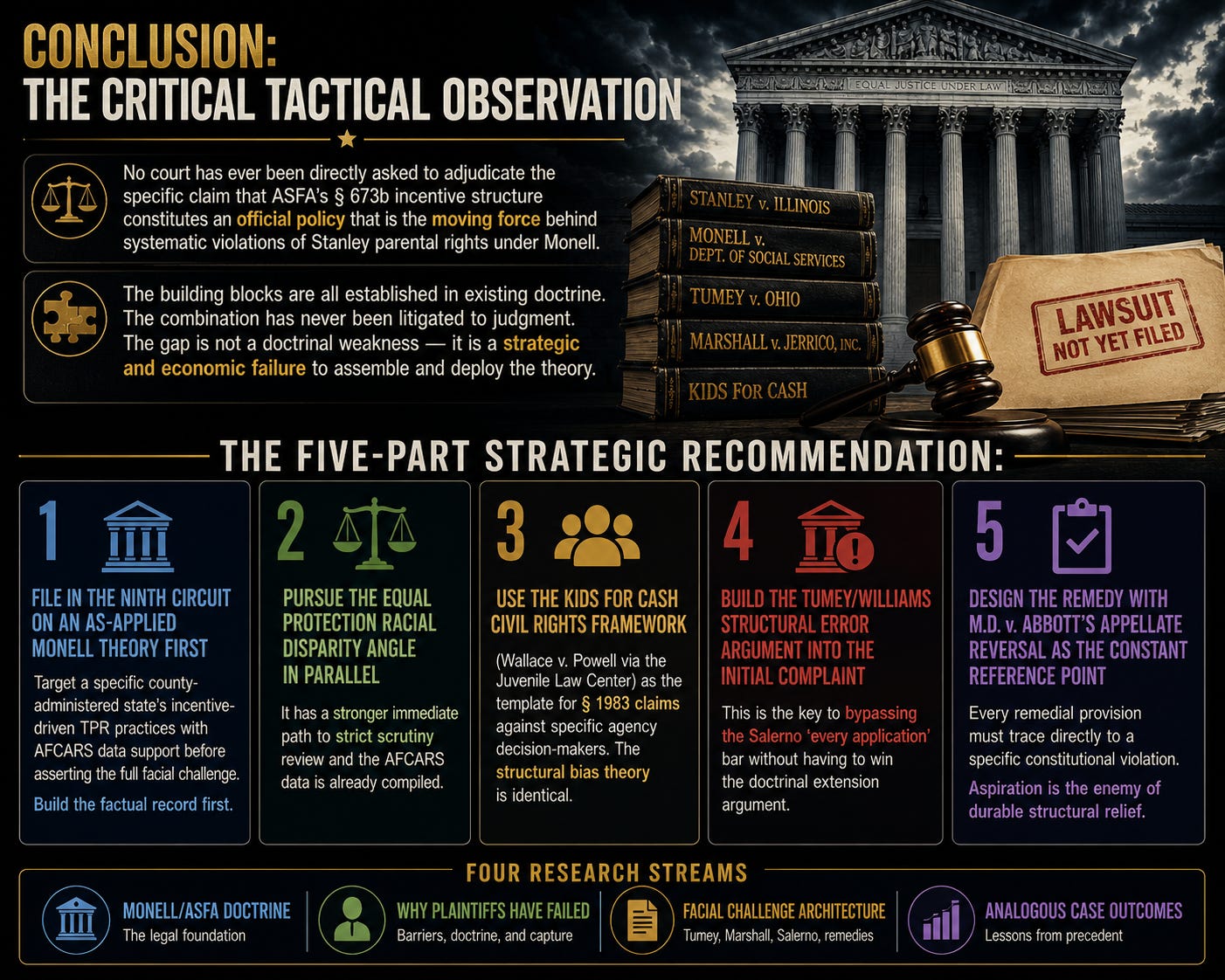
This investigation’s most powerful claim is not that the lawsuit would be easy. It would not be. The government would fight with everything it has. Standing, abstention, sovereign immunity, Rooker-Feldman, Younger, Gonzaga, Salerno, causation, qualified immunity, class certification, Daubert, narrow tailoring, federalism, child safety rhetoric, and political pressure would all come crashing into the case. This would be heavyweight constitutional litigation. But hard is not the same as impossible. And untested is not the same as weak.
The gap exists because no one has assembled the right plaintiff, the right jurisdiction, the right data, the right theory, and the right remedy at the same time. That is a strategic failure, not a doctrinal impossibility. If this investigation is correct, the path forward is visible: Ninth Circuit, county-administered system, current-case plaintiffs, AFCARS data, as-applied Monell claim, Tumey-Caperton structural bias theory, Stanley individualized-hearing predicate, equal protection data, and narrow remedies designed from the first draft of the complaint.
The stakes could not be higher. Termination of parental rights is often called the family-law equivalent of the death penalty. That phrase is overused until one remembers what it means. The legal relationship is destroyed. The parent becomes a legal stranger. The child’s original family bond is severed by court order. If the state is going to wield that power, the process must be cleaner than clean. It cannot be influenced by financial incentives. It cannot be rushed by mechanical timelines. It cannot be built on presumptions that replace individualized fitness. It cannot be justified by adoption metrics when adoption may never occur.
This is why the untested case matters. It is not merely another lawsuit idea for legal scholars. It is the missing constitutional confrontation at the center of modern child welfare. The courts have said parents have fundamental rights. The courts have said children and families deserve due process. The courts have said financially biased proceedings violate neutrality. The courts have said municipalities can be liable for official policies that cause constitutional injury. Congress has created a federal financial architecture that rewards adoption-side outcomes. The unanswered question is whether those things can coexist.
For twenty-five years, the system has acted as if they can. this investigation says that assumption has never been tested.
If the case is ever brought correctly, the government will finally have to answer under oath and under data: why does the federal child welfare system pay governments for terminating families into adoption outcomes but not comparably for preserving families safely? Why should a parent trust an agency’s neutrality when one pathway carries financial reward and the other does not? Why should a court treat a termination recommendation as individualized when the agency making it is operating under a national incentive structure that favors the termination side? Why has Congress never required constitutional compliance audits as a condition of these payments? Why does the burden of proving neutrality fall on shattered families rather than on the government seeking to destroy the legal family bond?
Those questions are not rhetorical. They are pleadings waiting to be filed.
The untested case is a mirror held up to the child welfare state. In that mirror, the system does not look like a neutral protector making painful decisions in isolated emergencies. It looks like a federally funded machine with one hand on the family and the other on an incentive ledger. It looks like due process squeezed through a payment formula. It looks like constitutional doctrine waiting for a plaintiff strong enough, funded enough, and strategically placed enough to force the law to catch up with the reality.
No court has yet been asked to decide whether ASFA’s § 673b incentive structure is the official policy moving force behind systematic Stanley violations under Monell. That is the sentence this investigation puts on the table. It is dry legal language, but behind it sits the most volatile question in the entire series: what if the central financial architecture of modern child welfare is not merely bad policy, but unconstitutional design?
That is the case no one has closed. That is the fight hiding in the doctrine. That is the pressure point. And if the right plaintiffs ever bring it with the right data in the right court, America’s child removal machine may finally have to defend its incentives against the Constitution itself.
If you enjoyed this work and feel encouraged by independent investigations like this, please consider becoming a paid subscriber to The Constitutional Republic on Substack.
Your support helps us continue:
investigative reporting
public records research
educational transparency projects
community outreach
and future investigations like this series
Most importantly, please share this article.
Independent journalism survives when ordinary people help spread information powerful institutions would prefer remain ignored, misunderstood, or buried beneath complexity.
Because silence protects systems.
Informed communities protect children.
ALL paid subscriptions are tax deductible Project Milk Carton | 501(c)(3) | EIN: 33-1323547