
The Removal Machine: CPS Wrongful Removal Patterns — and Where the Federal Child-Welfare Dollar Actually Goes
Investigation by Project Milk Carton

The Removal Machine: CPS Wrongful Removal Patterns — and Where the Federal Child-Welfare Dollar Actually Goes
No national dataset counts children whom courts say should never have been taken. We spent a week inside the federal data, the case law, the audit record, and our own 630,000-row grant ledger to build the closest thing to that count — then followed the money into Texas and Nevada, down to the congressional district, the private-philanthropy layer, and the single vendor holding one state's entire federal shelter stream.
By PMC Intelligence Desk | July 19, 2026

I. The question nobody counts
Start with an absence.
The United States operates the largest child-removal apparatus in the world. It runs on roughly ten billion federal dollars a year, touches more than a third of all American children before their eighteenth birthdays, and takes physical custody of about 170,000 children annually. And yet there is no national dataset — none — that counts how many of those removals a court later found to be wrong.
The federal government counts referrals. It counts investigations, substantiations, entries, exits, adoptions, and terminations of parental rights. It counts, in exquisite detail, the money. But the single number that would tell the public whether the machine takes children it shouldn't — removals overturned, removals found baseless, removals a judge unwound days later with an apology no one records — does not exist in any federal data series.
That absence is not an accident of bookkeeping. It is the first finding of this investigation. A system that counts everything except its own mistakes has told you what it considers a mistake.
So we built the closest thing to that count from what the government does publish — its own maltreatment data, its own foster-care files, its own inspector-general audits, its own funding statutes — and from the federal court record, the peer-reviewed literature, and Project Milk Carton's own database of federal and private grant ledgers. Every figure below traces to a primary source: a federal report, a statute, a court opinion, a peer-reviewed journal, or a named table in our database. Where a claim is contested in the research literature, we say so. Where a number has a benign explanation, we give it. That discipline is the point: this is a transparency organization, and the case this data makes does not need embellishment.
It needs only to be read.
II. The funnel
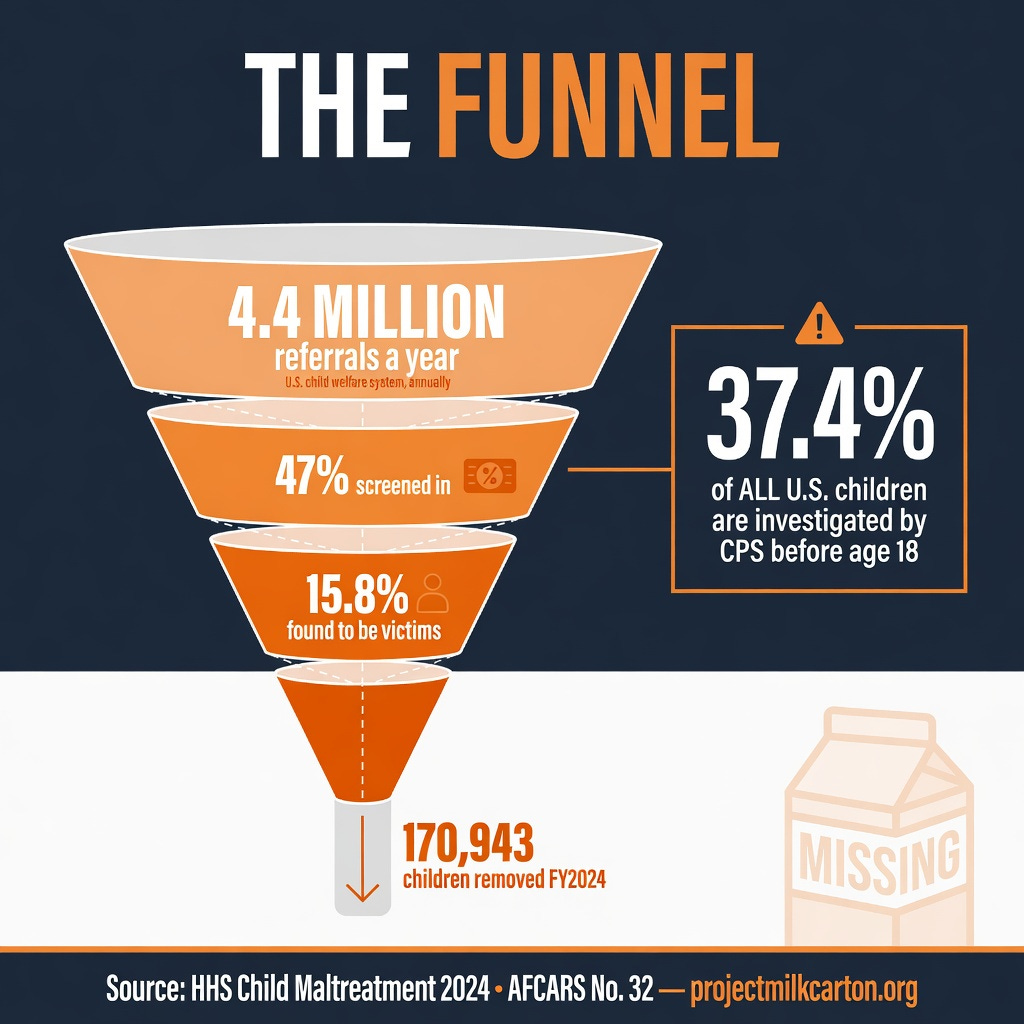
Every year, roughly 4.4 million referrals — covering about 7.7 million children — reach America's child-protection hotlines. Those are the federal government's own figures, from Child Maltreatment 2024, the annual report of the HHS Children's Bureau.
Follow the funnel down.
About 53 percent of those referrals are screened out before anyone knocks on a door. Of the children whose cases proceed — nearly 3 million children received an investigation or alternative response in fiscal 2024 — only 15.8 percentage ever found to be victims of maltreatment. 56.2 percent of dispositions come back unsubstantiated: insufficient evidence, under each state's own legal standard, that anything happened.
An important definitional line, kept bright: "unsubstantiated" is not the same as "adjudicated wrongful." It means the state itself, applying its own rules, could not support the allegation. We do not equate the two — but the reader should sit with the proportion. For every child the system confirms as a victim, roughly three and a half investigations end with the state unable to support the claim that brought caseworkers to the family's door.
And the door gets knocked on a lot. The peer-reviewed estimate, published in the American Journal of Public Health: 37.4 percent of all U.S. children— and53 percent of Black children— will experience a CPS investigation before they turn 18. More than one in three American childhoods now includes a child-protection investigation. For Black families it is a coin flip.
At the bottom of the funnel, in fiscal year 2024,170,943 children entered foster care. That number is worth a paragraph of its own, because it is falling — fast. Entries were 252,198 in FY2019. Five years later they are down 32 percent, and the number of children in care on September 30, 2024 stood at 328,947. The system can shrink. It has been shrinking for half a decade, and the sky has not fallen. Hold that thought; it becomes important when we get to Texas.
III. What "neglect" means when you look closely
Here is the fact that reframes everything above it: the removal machine is not primarily an abuse-response machine.
Among the circumstances recorded at removal in FY2024, physical abuse appears in 13 percent of cases and sexual abuse in 4 percent. Neglect appears in 55 percent. Among children the system actually confirmed as victims that year,63.3 percent experienced neglect only— no abuse of any kind — and 79.3 percent experienced neglect alone or in combination. The other circumstances the federal file records at entry read like a poverty index: caretaker drug use (31 percent), inadequate housing (9 percent), caretaker incarceration (7 percent), homelessness (5 percent).
The obvious question — is "neglect" just what poverty looks like when a caseworker writes it down? — has been tested causally, not rhetorically, and the results are consistent:
A $1,000 exogenous income increase (driven by Earned Income Tax Credit variation, not by anything the parents did) produced an 8–10 percent reduction in CPS involvement among low-income single-mother families. The same study found no causal link between income and abuse— the income effect runs specifically through what gets recorded as neglect (Berger, Font, Slack & Waldfogel, Review of Economics of the Household, 2017).
A random-assignment child-support experiment — as close to a laboratory as social policy gets — found that families receiving modestly more money were reported to CPS less (Cancian, Yang & Slack, Social Service Review, 2013).
Severe material hardship predicts CPS contact with an odds ratio of 3.68 even in models where income itself loses significance (Thomas & Waldfogel, 2022).
The federal government's own National Incidence Study (NIS-4) found low-socioeconomic-status children experience maltreatment at more than five times the rate of other children — about three times for abuse, roughly seven times for neglect.
Investigation data visualization
HHS knows all of this. Its own Child Welfare Information Gateway publishes an issue brief on separating poverty from neglect. The overlap is acknowledged at the federal level; it simply has not changed how the money flows. We will get to the money.
IV. Six days: the closest measure of a wrongful removal
If no one counts overturned removals, what is the nearest honest proxy? Two numbers, both from the government's own files.
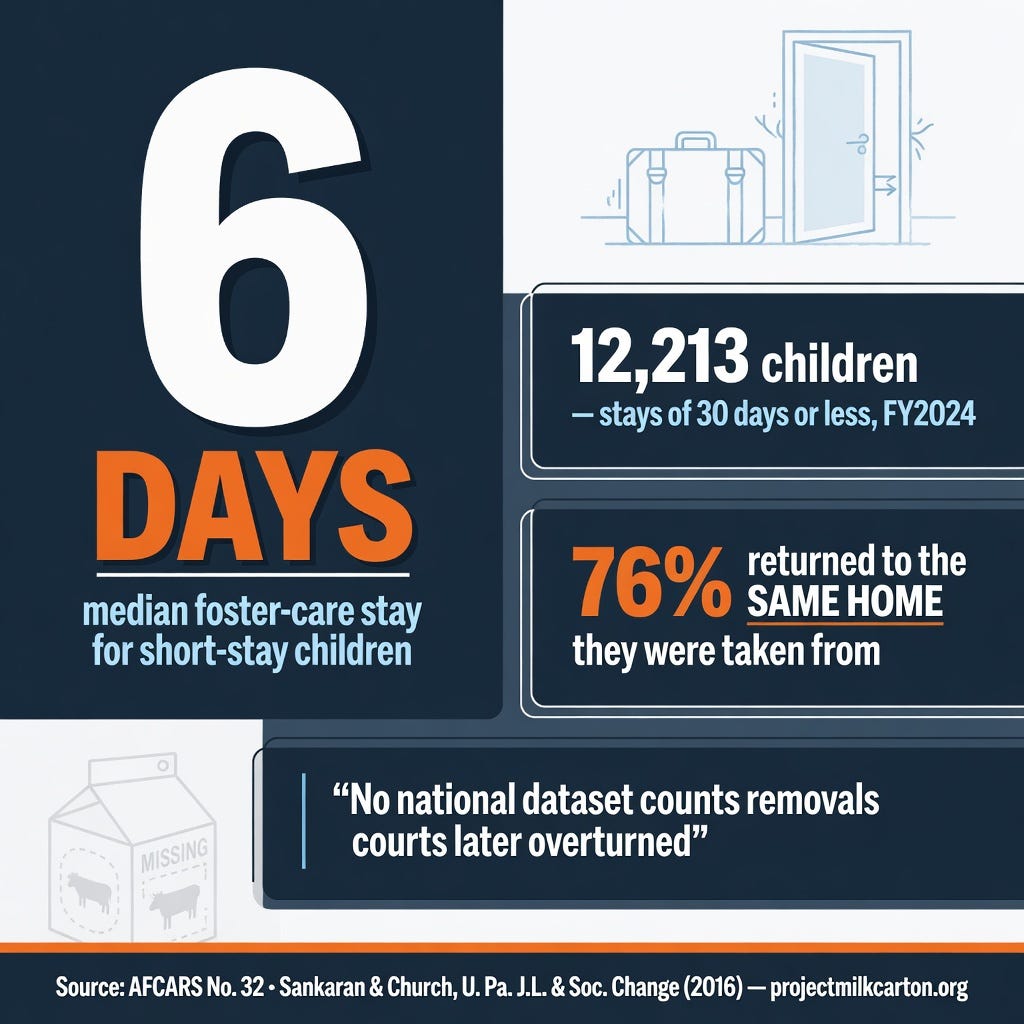
First: the short-stayers. In FY2024, 6,934 children exited foster care after fewer than 8 days in custody, and another 5,279 exited between day 8 and day 30. That is 12,213 children — about 7 percent of all exits — whose entire time in state custody lasted a month or less.
The canonical peer-reviewed study of this population (Sankaran & Church, University of Pennsylvania Journal of Law and Social Change, 2016) examined the roughly 25,000 children in a single federal fiscal year whose stays ran under 30 days and found: a median stay of six days; three-quarters discharged within two weeks; and 76 percent returned to the very home they were removed from.
The authors caution — and we repeat their caution, because their honesty deserves ours — that not every short stay proves an unnecessary removal. Sometimes a crisis genuinely resolves in a week. But run the pattern at scale: a child is seized, placed with strangers, and returned six days later to the same house, the same parents, the same conditions. If the home was safe enough to return to on day six, the question of whether the removal — with everything a removal does to a child — was necessary on day one answers itself more often than the system would like.
Second: the nonvictim removals. In FY 2024,38,723 children received foster-care services without ever being found to be victims of maltreatment— against 102,765 removals of confirmed victims. Some of that figure has benign explanations: siblings removed alongside a victim, voluntary placements, cases pending. We present the count, not a conclusion. But the count says something structural on its own: the system does not need to find that a child was harmed in order to take custody of that child, and it exercises that power tens of thousands of times a year.
Add the third number the government does publish:45 percent of FY2024 exits were reunifications, and another 6 percent of children went to live with relatives. Roughly half of everything the machine takes, it eventually gives back.
V. Who the machine reaches
The lifetime-risk literature — all of it peer-reviewed, most of it built on the government's own case files — describes a system whose reach would have been unbelievable a generation ago:
37.4 percent of all U.S. children investigated by 18; 53.0 percent of Black children (Kim et al.,AJPH2017).
Up to 5.91 percent of all children placed in foster care by 18 — rising to 11.53 percent of Black children and15.44 percent of Native American children (Wildeman & Emanuel, PLoS ONE2014).
Roughly1 in 100 American children experiences the complete, permanent termination of their parents' rights by age 18 (Wildeman, Edwards & Wakefield, 2020). For Native American children the figure approaches 3 in 100.
In a full California birth-cohort study, half of all Black and Native American children born in the state were investigated by CPS during childhood. Across America's twenty largest counties, Black children's lifetime investigation risk runs between 43 and 72 percent (Edwards et al.,PNAS2021).
The current federal snapshot (AFCARS FY2023 dashboard) puts the disparity in static terms: Black children are about 14 percent of the child population and 24 percent of the foster-care population; American Indian and Alaska Native children, about 1 percent of the population, enter foster care at 7.46 per 1,000— the highest entry rate of any group, 3.3 times the White rate. Count multiracial children alone-or-in-combination, as Child Trends has, and the Black share of the foster-care population approaches 35 percent against 16 percent of the child population.
On what drives the racial disparity, the research community genuinely splits, and we present the split rather than picking a champion. One camp notes that the Black/White disparity in substantiated maltreatment (about 1.84 to 1) is actually lower than the Black/White disparities in poverty (2.87 to 1), infant mortality (2.37 to 1), and infant accidental death (2.97 to 1) — benchmarks no caseworker's bias can touch — and concludes the system's disparity chiefly mirrors an unequal distribution of hardship rather than front-end bias (Drake et al.,Pediatrics2011; updated by thirteen scholars in 2023, who found Black children in recent years slightly less likely to be substantiated or placed after a report reaches the system). The other camp answers that "disproportionate need" is itself the product of structural forces operating both inside child-welfare systems and around them, so measuring the system against a racially unequal baseline launders the inequality (Dettlaff & Boyd, 2020). The most defensible summary: the disparity is real, it largely tracks poverty and measured risk, and scholars disagree in good faith about how much racism explains the risk distribution itself.
What neither camp disputes: the gradient that most reliably predicts a family's entanglement with this system is not cruelty. It is money.
VI. The law on the books
Now set the data beside the law, because the gap between them is where this investigation lives.
Federal constitutional doctrine on removal is not vague, and it is not new. The Supreme Court has called parents' interest in the care and custody of their children "perhaps the oldest of the fundamental liberty interests" the Court recognizes (Troxel v. Granville, 530 U.S. 57 (2000)), and holds that severing a family permanently requires at least clear and convincing evidence (Santosky v. Kramer, 455 U.S. 745 (1982)). The circuits have spent twenty-five years drawing the operational line:
No removal without a court order, consent, or true exigency. New York City's "remove first, get a court order later" practice was condemned a quarter-century ago (Tenenbaum v. Williams, 2d Cir. 1999).
Exigency means imminent danger of serious bodily injury— and the state's intrusion must be reasonably necessary to avert that specific injury (Wallis v. Spencer, 9th Cir. 2000).
A dirty house is not an emergency. Poor home conditions did not constitute exigency where the agency had time to get a warrant and simply didn't (Rogers v. County of San Joaquin, 9th Cir. 2007).
An anonymous tip is not a removal warrant(Croft v. Westmoreland County, 3d Cir. 1997). Holding a child after the emergency has passed violates the Constitution on its own (Hernandez v. Foster, 7th Cir. 2011), and so does maintaining a coercive "safety plan" for months after the drug tests came back negative (Schulkers v. Kammer, 6th Cir. 2020).
And when agency staff fabricate evidence, the courts have started letting juries speak. In Hardwick v. County of Orange (9th Cir. 2017, 2020), the court stripped immunity from social workers who used perjured testimony and fabricated evidence in dependency proceedings, and affirmed the result of the underlying state case, Fogarty-Hardwick v. County of Orange: a$4.9 million jury verdict, roughly $9.3 million with interest, for children removed and detained without cause. A Los Angeles federal jury reached about $3.1 million for the warrantless seizure of an infant in Duval v. County of Los Angeles (2016) — and, more significantly, found the county maintained an official customof warrantless seizures. A North Carolina federal jury awarded damages to a father coerced into a custody agreement without counsel (Hogan v. Cherokee County, 2021); an Arizona federal case added roughly $563,000 in compensatory and punitive damages (Stein v. Depke, 2023).
Two honesty notes on the doctrine, because precision is the brand. First, the most-cited school-interview case, Camreta v. Greene, was vacated as moot by the Supreme Court in 2011 — anyone citing its Fourth Amendment holding as live law is citing a ghost, and plenty do. Second, the doctrine is not uniform: the Seventh Circuit in Dupuy v. Samuels (2006) held safety plans voluntary and constitutionally unproblematic — the same instrument the Sixth Circuit later found unconstitutional as applied in Schulkers. The circuit split is real, and it matters for a hundred thousand families a year.
Investigation data visualization
That is the law. Here is the practice: state-level data collected by the child-welfare press indicate that70 to 95 percent of foster-care entries happen on an emergency basis— the child is taken first, and the first judicial hearing comes days or weeks later. The doctrine reserves emergency removal for genuine emergencies; the operating system runs almost entirely on the exception. And the counsel picture makes the timing worse: 38 states and the District of Columbia provide a categorical right to counsel for indigent parents in dependency proceedings, but twelve states still leave it discretionary or conditional — meaning that in a large slice of the country, the family on the receiving end of an emergency removal has no guaranteed lawyer at the moment the states are already working.
And whole states have been adjudicated failures wholesale. The structural-litigation docket is its own map of the system:
M.D. v. Abbott* (S.D. Tex., filed 2011): Texas's long-term foster care system ruled unconstitutional in 2015. A decade later the case is still convulsing — in October 2024 the Fifth Circuit took the extraordinary step of removing the presiding judge and reversing contempt fines against the state. The children in the class have, in many cases, aged out while the lawyers argued.
Marisol A. v. Giuliani* (S.D.N.Y., filed 1995): New York City; settled 1999, court supervision finally closed in 2018 — a 23-year arc.
Kenny A. v. Perdue* (N.D. Ga., filed 2002): Georgia; consent decree since 2005, modified 2016, still running.
B.K. v. McKay/Faust* (D. Ariz., filed 2015): Arizona; settlement approved 2021.
Wyatt B. v. Kotek (D. Or., filed 2019): Oregon; settled May 2024 with a neutral expert overseeing the agency for up to ten years*. Oregon's own Secretary of State audit had already put it in language no plaintiff's lawyer wrote: "chronic management failures and high caseloads jeopardize the safety of some of the state's most vulnerable children."
K.H. v. District of Columbia* (D.D.C.): the first structural attack on kinship diversion — hidden foster care itself — with class claims surviving a motion to dismiss in January 2024.
Six jurisdictions, one pattern: the constitutional violations are found, the decrees are entered, and the machine grinds on for decades under court supervision that outlasts the childhoods it was meant to protect.
VII. The shadow system
Everything above concerns the removals the government records. There is a second system that never touches the docket.
Legal scholars call it hidden foster care (Gupta-Kagan, Stanford Law Review, 2020). The mechanics: a caseworker tells a parent that unless the children go stay with grandma — today — the agency will take them formally. The parent, unrepresented, uninformed, and terrified, signs a "safety plan." No petition is filed. No judge reviews anything. No lawyer is appointed. The child does not appear in AFCARS, the federal foster-care file, because officially nothing happened.
The scholarly estimate of this shadow system's size:100,000 to 300,000 children per year— comparable to, and possibly larger than, the formal system itself. No state reports this data. The invisibility is not a gap in the finding; the invisibility is the finding.
And understand everything the off-the-books route strips away, because each item is a protection Congress or the Constitution attached specifically to formal removal: no judicial review of whether the removal was warranted. No appointed counsel. No "reasonable efforts" requirement to prevent the separation. No licensing or background standards for the household the child lands in. No foster-care maintenance payments to the grandmother now feeding two more children on a fixed income. No AFCARS record, which means no federal oversight, no statistics, and no way for anyone — including Congress — to know the child was ever separated at all. The formal system's protections are the reason the informal route exists: every one of them is a cost the agency avoids by never filing.
Courts have begun to notice. The Sixth Circuit's Schulkers decision put constitutional teeth into coerced safety plans. A North Carolina federal jury awarded damages to a father coerced into a custody agreement without counsel (Hogan v. Cherokee County, 2021). Kinship-diversion class claims against the District of Columbia survived a motion to dismiss in 2024. The litigation map is filling in exactly where the data map is blank.
And the oversight failures extend even to the children the system has formally taken. The HHS Office of Inspector General — the government auditing itself — found that of 74,353 missing-from-foster-care episodes between July 2018 and December 2020, an estimated 51,115 were never reported to the National Center for Missing & Exploited Children, as federal law flatly requires. A companion audit estimated 8,324 missing-child episodes never reported to law enforcement for NCIC entry. A third found a third of states cannot identify maltreatment patterns inside the residential facilities where they place foster children. For an organization whose founding subject is missing children, we will say this plainly: the single largest documented failure to report missing children in America belongs to the child-protection system itself.
VIII. The money is not neutral
Every machine runs on fuel. This one runs on Title IV-E of the Social Security Act — and the way IV-E pays is the structural heart of this story.
The mechanics are undisputed; they are statute:
Title IV-E is an open-ended entitlement. For every eligible child, the federal government reimburses the state — 50 to 83 cents of every dollar, depending on the state — with no cap. Foster-care maintenance, adoption assistance, training, administration. Congressional Research Service estimate for FY2026: $10.1 billion.
Historically, IV-E paid only for out-of-home care. A dollar spent keeping a family together earned the state nothing from the entitlement; a dollar spent on a removal earned reimbursement. Prevention money lived in capped, comparatively tiny programs — in FFY2010, roughly $7.2 billion of open-ended removal-side funding stood against at most $660 million of capped prevention funding.
The eligibility test is frozen in 1996.IV-E maintenance reimbursement still keys to the old AFDC income standards as they stood on July 16, 1996 — meaning federal removal money historically flowed specifically for children taken from poor house holds. The poorer the family, the more federally reimbursable the removal. Set that beside Section III above and read them together.
Adoption carries cash bonuses. Since the Adoption and Safe Families Act of 1997, states earn incentive payments above rate-based baselines: currently $5,000 per foster-child adoption, $7,500 per pre-adolescent adoption or guardianship, $10,000 per older-child adoption or guardianship, and $4,000 per foster-child guardianship (42 U.S.C. § 673b). These are real checks with a real history: $178 million earned in the program's first six years (FY1998–2003), $423.8 million cumulative through FY2012, and $70.4 million in performance year FY2019 alone — the largest annual payout ever recorded. There is no equivalent federal bonus for reunifying a family. A state that returns a child to a parent it never should have taken the child from receives, for that outcome, zero dollars.
The scale is enormous. GAO's 2025 accounting: states expended$68.6 billion in Title IV-E funds from FY2015 through FY2022, plus another $23.5 billion in TANF money routed into child welfare.
The critique of this architecture is not ours, and it is not fringe. It is the federal government's own. In 2005, HHS's Office of the Assistant Secretary for Planning and Evaluation published an issue brief whose title does our work for us: "Federal Foster Care Financing: How and Why the Current Funding Structure Fails to Meet the Needs of the Child Welfare Field. "The government's own analysts concluded the money tilts the system toward placement and away from prevention.
Congress finally acted in 2018: the Family First Prevention Services Act opened IV-E, for the first time, to evidence-based prevention services. The uptake tells you everything about institutional momentum: in FY2022,14 states used $35 million in FFPSA prevention funds — against roughly $10 billion in annual IV-E. Three tenths of one percent. And the law's other headline promise — curbing institutional placement — has fared no better on the government's own audit: GAO found that most states' use of congregate care did not decline after the act took effect. National foster-care entries have fallen since 2018, but no causal evaluation ties the decline to FFPSA, and we do not claim one. The prevention door has been open for years. The system keeps walking through the removal door, where the money is.
Now, the line we keep brightest in this entire investigation. That the incentive structure favors removal is documented fact — statute, CRS, GAO, and HHS's own words. Whether the money causes unnecessary removals is a contested causal claim, and we present it as contested. States must spend their own dollars before federal match arrives; reimbursement is not profit. But the peer-reviewed record does establish something narrower and damning enough: payment structures change what this system does to children at the margin. When Minnesota equalized payments between adoption and guardianship, monthly transitions to permanency jumped 29 percent (NBER, 2024). When researchers studied adoption-subsidy variation, adoptions moved (Argys & Duncan, Demography, 2013). The machine responds to price signals. The prices favor removal. Draw your own line between those two sentences; we have drawn ours exactly this far and no farther.
IX. Two states, one architecture
Investigation data visualization
Everything to this point is national — the federal skeleton. To see the machine's local musculature, we put our own database against it. Project Milk Carton maintains, in-house, a 630,000-row ledger of IRS Form 990 Schedule I grant records, the TAGGS federal award tables mapped to congressional districts, the USA Spending subaward files, and the AFCARS and NCANDS state series — 340 million records and roughly $148 billion in tracked child-welfare-adjacent money.
We chose two states deliberately: Texas, the biggest and most-litigated system in the country, and Nevada, our home state. The federal ACF award ledger, FY2020–2025:
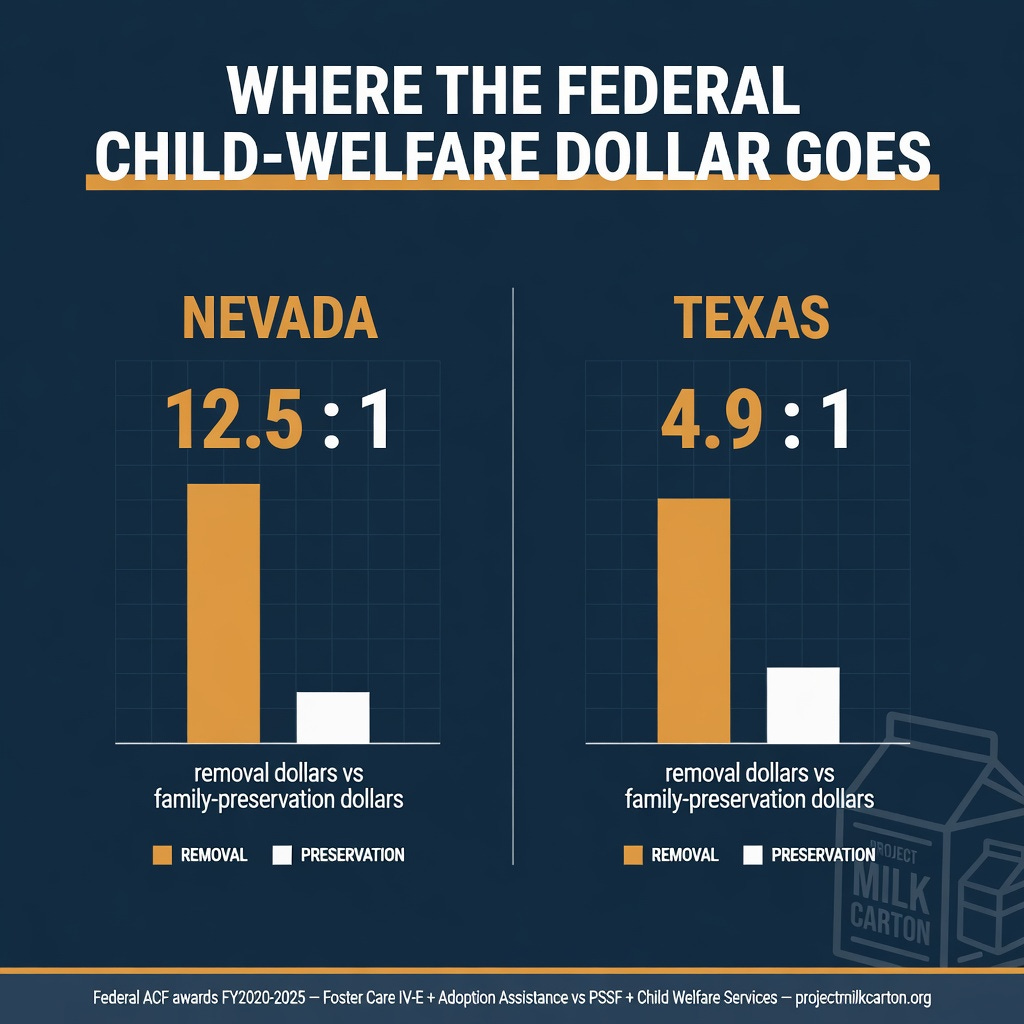
Sort those programs into the two sides of the national story — removal-side money (Foster Care IV-E plus Adoption Assistance) versus family-preservation money (Promoting Safe & Stable Families plus Child Welfare Services), with SSBG and Chafee set aside as mixed-purpose — and each state's architecture emerges in one number:
Texas: $2,217.0 million removal-side vs. $453.8 million preservation-side — 4.9 : 1.
Nevada: $539.9 million removal-side vs. $43.2 million preservation-side — 12.5 : 1.
For every preservation dollar Washington sends Texas, it sends five removal dollars. For every preservation dollar it sends Nevada, it sends twelve and a half. Nevada's federal child-welfare pipeline is two and a half times more removal-weighted than that of the state whose foster system a federal court declared unconstitutional.
These ratios recompute exactly from the table above, and the ALN-level sums reconcile to the district-level sums to the dollar. This is our own ledger; we checked it against itself.
X. Texas: the big, plural, litigated system
Texas is what the machine looks like at maximum scale — and, lately, what it looks like when a legislature deliberately throttles it.
The scale first. NCANDS FY2023:316,636 Texas children investigated; 54,476 confirmed victims— a confirmation rate near the national funnel's. AFCARS FY2022: 9,486 entries, 21,358 children in care, 7,198 terminations of parental rights, 4,361 adoptions.
Texas is also the state whose long-term foster care system a federal court declared unconstitutional in 2015, in M.D. v. Abbott— a finding that has now outlived the childhoods of many class members while the state litigated. The case's latest turn came in October 2024, when the Fifth Circuit removed the presiding judge and reversed contempt fines against the state. Whatever else that decade says, it says this: judicial oversight of a system this size is a siege, not a fix.
But the arresting Texas number is the trendline. In FY2021, Texas removed more than 15,000 children. In 2021 the legislature passed HB 567, raising the removal standard: the danger must be immediate, and attributable to a parent's blatant disregard— not to poverty, not to a messy house, not to a caseworker's unease. The following fiscal year, entries fell to9,486, and the in-care population dropped by nearly 7,000 children. One statute, one year, roughly a third of the removal volume gone.
Was safety harmed? Here we hold the honesty line: the question is genuinely contested, claims run in both directions, journalists have flagged counting artifacts in the fatality statistics both camps cite, and no rigorous causal safety study yet exists. What HB 567 proves beyond dispute is narrower: removal volume is a policy choice. The number of children taken is not a law of nature; it moves when the standard moves. Texas then went further in 2023 with HB 730 — the first comprehensive "Family Miranda" statute in the country, requiring written notice of allegations and rights at first contact, with an exclusionary remedy. Outcome data does not exist yet; the legal architecture is real.
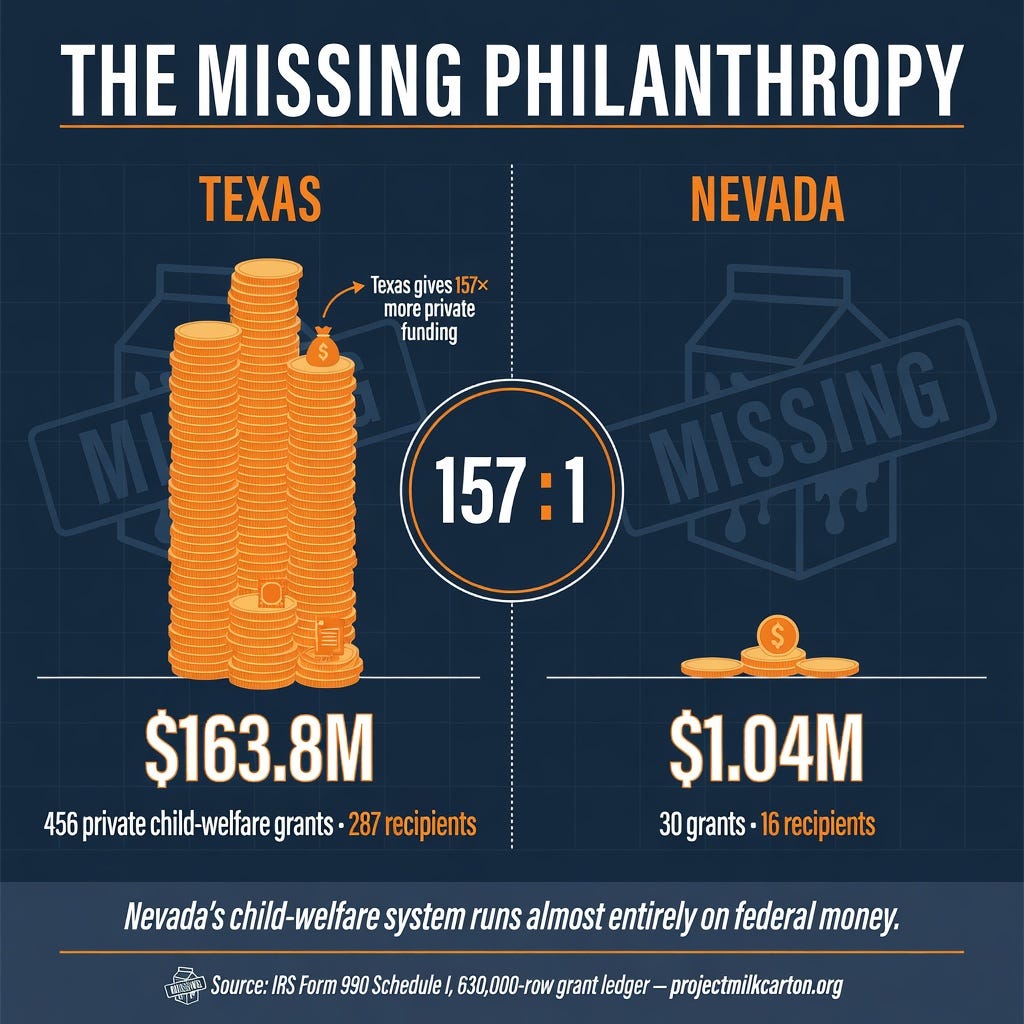
Texas is also where the machine's plural civic layer shows. Running our locked child-welfare filter across the 990 Schedule I ledger — grant purposes naming child welfare, child care, foster care, child abuse or protection, kinship, family preservation, or adoption, plus CASA and foster-named recipients, with animal-welfare "foster" programs excluded — private philanthropy into Texas child welfare totals$163.8 million across 456 grants to 287 distinct recipients. The single largest item is a $107.9 million child-care-services flow from Alamo Workforce Development to the City of San Antonio — a workforce child-care pass-through rather than charity in the ordinary sense. Strip it out and the genuinely charitable layer still runs to roughly$55.9 million, spread across hundreds of organizations: Dallas CASA ($4.3 million), Child Advocates ($2.3 million), CASA of Travis County ($1.9 million), Child Advocates San Antonio, CASA of Tarrant County, community foundations from El Paso to Houston. Widen the filter to all child-and-youth purposes and the Texas figure passes $440 million. However you cut it, Texas child welfare has a thick, decentralized layer of private money and private institutions standing alongside — and sometimes against — the state.
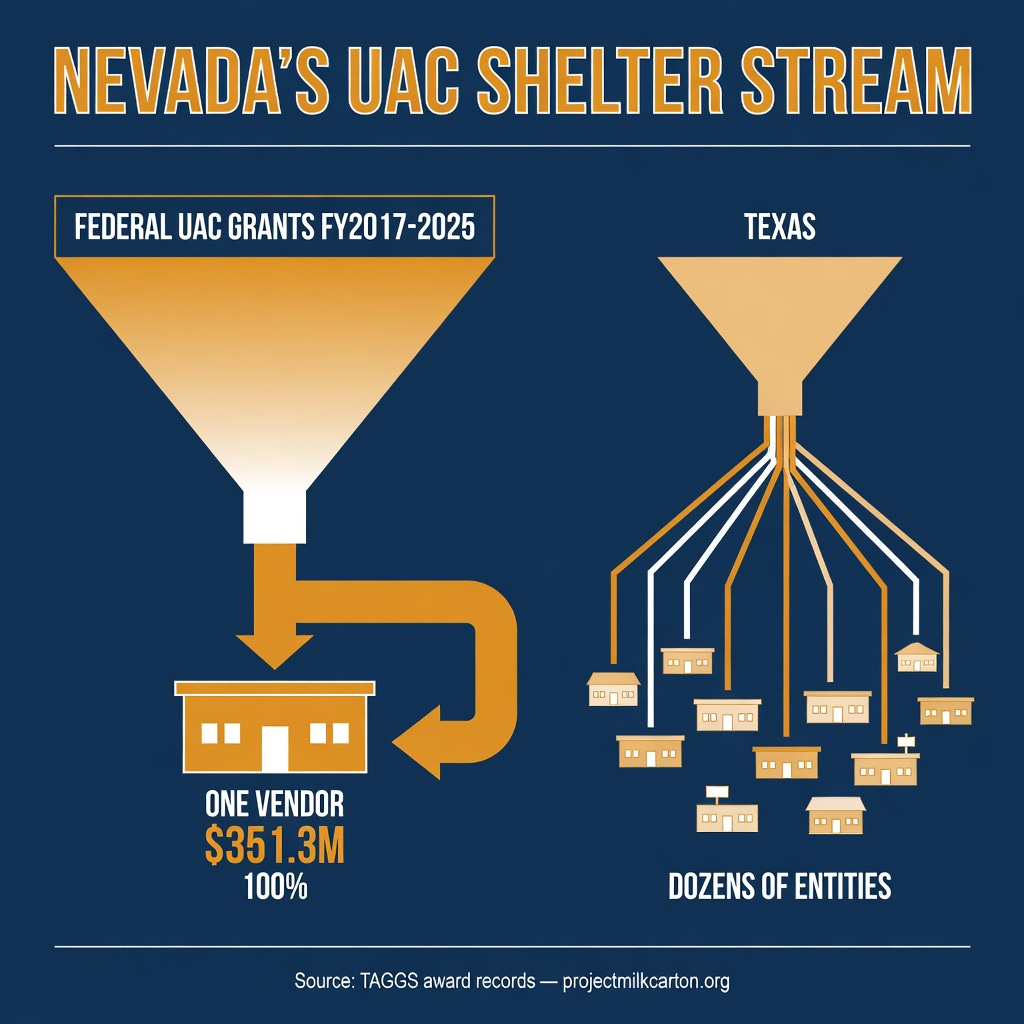
The same plurality shows in Texas's federal Unaccompanied Children Program stream, which fans out across dozens of entities: Harris County ($33.8M), Catholic Charities of Galveston-Houston ($26.3M), YMCA of Greater Houston (~$25.7M), Catholic Charities Dallas ($17.1M), the City of Austin, the Bexar County Hospital District. Many hands, many licenses, many separate incident records — many points of failure, but also many independent witnesses.
Hold that picture. Now drive northwest.
XI. Nevada: the pure federal machine
Nevada is the control experiment nobody meant to run: what the removal architecture looks like with almost nothing else in the frame.
Start where Texas started, with the state's own caseload. NCANDS FY2023: 34,122 Nevada children investigated, 6,496 confirmed victims — a 19 percent confirmation rate, meaning four of every five Nevada investigations end without a finding. AFCARS FY2022: 2,650 entries, 4,047 in care, 718 terminations of parental rights, 744 adoptions. Note the shape of those last two numbers: in a single year, Nevada permanently severed 718 parent-child relationships and completed 744 adoptions — the termination and adoption pipelines running at nearly identical volume, in a state whose federal money is tilted 12.5-to-1 toward exactly that outcome. Entries have drifted gently downward for a decade (3,382 in FY2013 to 2,650 in FY2022) — no HB 567 moment, no structural lawsuit, no dramatic reform. A quiet system.
Investigation data visualization
Now the two findings that make Nevada the sharpest state in our ledger.
First, the ratio. That 12.5-to-1 removal-to-preservation tilt in Nevada's federal money is not one fact about the system. In Nevada, it effectively is the system — because there is almost nothing else. Which brings us to the second finding.
The philanthropy isn't missing. It was never there. Run the identical locked filter over the identical 630,000-row Schedule I ledger that found $163.8 million in Texas, and Nevada returns: $1.04 million. Thirty grants. Sixteen distinct recipients. The largest single recipient is Friends of Casa Hogar at $281,200; the largest unambiguously Nevada-serving child-welfare charity in the entire ledger is Foster Kinship, at $260,338 across eight grants. Most of the rest is a roll call of county CASA chapters — Washoe, Carson City, Churchill, Lyon, Douglas — surviving on five-figure grants. Widen the filter as far as it will honestly go and Nevada never breaks $6 million.
Texas's private child-welfare layer outweighs Nevada's by157 to 1with the pass-through included, roughly 54 to 1 without it — against a total-population ratio of about 9 to 1. Adjust for population however you like; the gap is not a rounding error. It is a different kind of system.
Understand what that means structurally. In Texas, when the state machine fails a child, there are hundreds of privately funded organizations with independent boards, independent budgets, and independent lawyers in position to see it and say so. In Nevada, the counterweight layer, to the extent our ledger can see it, consists of a handful of CASA chapters whose combined decade of private funding is less than what the federal government wires into the state's removal pipeline every three days. ($539.9M over six years is roughly $246,000 a day.)
Nevada's child-welfare system is not a public-private ecosystem with a federal backbone. It is a federal money pipeline, removal-weighted 12.5 to 1, with a civic layer too thin to audit it. That is why the ratio is not part of the Nevada story. It is the whole story.
XII. Whose districts host the pipeline
Because our TAGGS table maps every award to a congressional district by payee ZIP, we can also say precisely where the pipeline lands.
One hundred percent of Nevada's tracked flow — $685.4 million — arrives in NV-1, Rep. Dina Titus's district.99.99 percent of Texas's $3.59 billion arrives in TX-37, Rep. Lloyd Doggett's district. The remaining Texas fraction is scattered across El Paso and a few others in amounts that round to zero.
Read this the honest way, because it would be easy to read it the dishonest way. Federal grants pay the state agency, and the money books to the agency's payment address — Texas HHSC in Austin, Nevada's payee address in Las Vegas. Neither member controls, directs, or benefits from these funds, and we make no such suggestion.
What the mapping does establish is accountability geography. Two members of Congress host, in their districts, the entire federal child-welfare pipeline for their states — NV-1 with 207 tracked awards, TX-37 with 215; the residue in other Texas districts (El Paso's TX-16, for instance) amounts to a few hundred thousand dollars against Austin's $3.59 billion. They are the natural first addressees for every question this investigation raises — and one of them, Rep. Doggett, sits on the House Ways and Means Committee, the committee with direct jurisdiction over Title IV-E itself. The removal-to-preservation ratio, the frozen 1996 eligibility lookback, the zero-dollar reunification bonus, the FFPSA uptake failure: every one of those is a Ways and Means question before it is anything else. The questions in this article are, in a literal sense, local constituent matters for exactly two offices.
One methodological caution we will keep repeating anywhere these district numbers travel: the mapping is by payee ZIP code. It tells you where the checks land, not who spends them or where the children are. Quote it with that caveat attached or not at all.
XIII. One vendor, one state
Then there is the finding that stopped us.
Inside the federal ledger sits the Unaccompanied Children Program — ORR's shelter network, ALN 93.676. In Texas, as noted, that stream fans out across dozens of counties, charities, and hospital districts. In Nevada, we sorted the same table and found the entire state's tracked stream —189 separate awards, fiscal years 2017 through 2025, totaling $351,340,828— flowing to a single vendor: Rite of Passage, Inc. of Minden, Nevada (operating legally as Rite of Passage Adolescent Treatment Centers and Schools Inc.).
One hundred percent. Not the largest share — the only Nevada entity in the ledger receiving direct UAC program money, every fiscal year, without interruption, scaling from roughly $600,000 in 2017 to tranches exceeding $30 million a year by 2023–2025. The USA Spending file cross-checks cleanly: active award 90ZU0350 shows $35.2 million obligated in the FY2024 action — consistent as a single-award slice of the multi-year stream. The subaward layer beneath is thin (Northern Nevada International Center, ~$8.6M; Clark County School District, ~$1.9M), with Catholic Charities of Southern Nevada appearing as a $45.2M prime in the separate subgrant table. And the private-money layer around Rite of Passage is almost comically small by contrast: our Schedule I ledger shows exactly one private grant — $50,000 from the Million-Dollar Round Table Foundation in 2023.
We state this with the precision it demands. This is a funding-structure fact drawn from public federal award records. It is not an allegation of wrongdoing by Rite of Passage, and nothing in our ledger suggests any. The company operates in a sector where someone must operate; a contract concentration is not a scandal.
But structure is destiny in oversight. Single-vendor concentration means single-point accountability: one entity's licensing record, one entity's inspection history, one entity's incident log is the State of Nevada's entire UAC program record. There is no second vendor to compare it against, no competitor with an incentive to notice, and — see Section XI — no meaningful private civic layer watching. A third of a billion dollars of federal child-shelter money in one state runs through one company in a town of 3,500 people, and until our ledger sorted one table, essentially no one knew.
The open questions are the obvious ones, and they are answerable entirely from public records: Nevada state licensing and inspection files for Rite of Passage facilities; the company's own Form 990 filings — revenue mix, officer compensation, related entities (EIN 68-0038804); any subcontract layer beneath the ORR awards; and the incident and inspection record that, in a single-vendor state, constitutes the whole program's history. That work is queued, and we will publish what the records show — including, if that is what they show, that the records are clean. Transparency that only runs one direction isn't transparency; it's targeting. We do the former.
Investigation data visualization
XIV. What actually works — and what merely sounds like it
An investigation that only diagnoses is half an investigation. The reform record has been tested, and the results do not sort by ideology.
The strongest replicated evidence in the entire field belongs to something unglamorous: giving families real lawyers. When New York City provided interdisciplinary family defense — an attorney, a social worker, and a parent peer, working as an office — across 9,582 families and 18,288 children, children spent118 fewer days in foster care over four years, reached reunification and permanency faster, and showed no measured difference in safety (Gerber et al., Children and Youth Services Review, 2019). Washington State's parent-representation program produced the same shape: reunification 11 percent faster, adoption 83 percent faster, guardianship 102 percent faster. Since December 2018, Title IV-E will even reimburse half the cost of parents' and children's counsel — federal money is on the table for this. Yet twelve states still leave counsel for indigent parents discretionary, and in the 70-to-95-percent of removals that happen on an emergency basis, the lawyer — where one exists at all — arrives after the child is already gone.
The most-publicized equity reform failed its first rigorous test. "Blind removals" — stripping race, name, and address from case files before removal decisions — was scaled statewide in New York on the strength of a small pilot. The first rigorous causal evaluation (Baron, Goldstein & Ryan, JPAM, 2023) found no effect on racial disparity in removals and substantially slower decisions; the disparity enters upstream, at investigation, before the blindfold goes on. The lesson is not that equity reform is hopeless; it is that this system habitually adopts first and evaluates later — with children as the test population.
The legal-reform wave is real but untested. Texas HB 730 (2023) is the country's first full "Family Miranda" — written notice of the allegations and of the rights to counsel, to silence, and to refuse home entry absent a court order, delivered at first contact, with an exclusionary remedy in civil proceedings. California's AB 2085 (2022) rewrote the state's general-neglect definition to require substantial risk of serious physical harm and to expressly exclude "a parent's economic disadvantage" — the first major statutory attempt to cut the poverty-neglect knot described in Section III. Washington has had a parental-notification statute since 2005, but without a remedy for violation; New York's Family Miranda bill has repeatedly failed to pass. None of these yet has outcome data. They are the right experiments; they are still experiments.
And the watchdogs the law already requires are starved. Federal law (CAPTA) mandates at least three citizen review panels in every state; the peer-reviewed literature documents underfunded panels, agency defensiveness, and recommendations dismissed by the administrators they were created to check. The oversight architecture exists on paper. So does the Fourth Amendment.
XV. What we still cannot see
We end where we began: with the absences, because they are the most precise findings we have.
No national count of court-overturned removals. No state reporting of hidden foster care — 100,000 to 300,000 children a year, invisible by design. No causal safety evaluation of the largest removal-standard reform in decades. No registry from which our tools could even score the one vendor holding a state's entire federal shelter stream. Fifty-one thousand missing-from-care episodes never reported to NCMEC by the very agencies holding custody.
Every one of those blanks is a decision someone made about what the public gets to know. Project Milk Carton's position is not that this system is malicious; it is that a system holding this much power over this many children has arranged to be unmeasurable at exactly the points where it might be found wrong — and that the measuring, therefore, falls to the public. This article is us doing our share: every number above traces to a federal report, a statute, a court opinion, a peer-reviewed journal, or a named table in a database we will show anyone who asks.
The children the machine takes correctly deserve a system that isn't busy elsewhere. The children it takes wrongly deserve, at absolute minimum, to be counted.
The pending NEICE mandate is often presented as a solution. NEICE, the National Electronic Interstate Compact Enterprise, is designed to modernize ICPC transmission and reduce paper-based delays. Digital transmission matters, and full implementation is better than fax machines, mail bins, and scattered local processes. But digitizing a broken process is not the same as fixing it. If the underlying compact still lacks enforcement, penalties, staffing requirements, family remedies, and real-time accountability, then NEICE may simply move files more efficiently into the same queues. A digital bottleneck is still a bottleneck.
The ICPC crisis should force a much bigger question: why does the system make it so hard to place children with family while making it so easy to keep them in paid care? The answer is not one villain. It is design failure. It is legacy law. It is federalism without accountability. It is underfunded administration. It is risk avoidance. It is provider economics. It is the absence of a private right of action. It is decades of reform language without enforcement teeth. It is the oldest story in child welfare: the state says family matters, then builds a process that treats family as a paperwork problem.
A serious reform agenda would begin with enforceable deadlines. The 60-day home study requirement should not be a polite suggestion. If a receiving state misses the deadline without documented good cause, there should be automatic escalation, public reporting, and financial consequence. If the delay continues, relatives should have a direct administrative appeal and a fast-track court remedy. A compact that can stop a child from moving should also give the child and relative a way to force the government to act.
Second, the ICPC should include a child-centered emergency placement pathway for vetted relatives. When a relative has already passed background checks, has an existing relationship with the child, and meets basic safety criteria, the law should allow provisional placement with supervision while the full home study is completed. The system already takes risks by placing children with strangers in emergency settings. It should not pretend that relatives are uniquely dangerous simply because they live across a state line.
Third, Congress and the states must fund ICPC offices like critical infrastructure. A state with thousands of foster care cases cannot run interstate placement through one or two overburdened staff members and then act shocked when children wait. Staffing ratios should be published. Caseloads should be published. Average processing times should be published. Returned packets should be tracked. Clock restarts should be tracked. Every state should have a public ICPC dashboard showing how many children are waiting, how long they have waited, and where the file is stuck.
Fourth, the law must close the clock manipulation loophole. The 60-day period should not begin only after the receiving state accepts a completed referral while the sending state can take weeks or months to prepare it. There should be deadlines on both sides. The sending state should have a fixed period to identify relatives, prepare the referral, and transmit the packet. The receiving state should have a fixed period to accept, reject, or request specific missing information. If a packet is returned as incomplete, the reason should be documented, time-limited, and reviewable.
Fifth, ICPC delays should trigger placement cost review. If a child remains in congregate care or high-cost foster care solely because of interstate paperwork delay, the state responsible for the delay should bear financial consequence. Right now, the cost of delay is diffused across systems, while the child pays emotionally. Accountability should follow the bottleneck. If a state’s failure to process a home study causes months of unnecessary paid placement, that failure should show up in the budget.
Sixth, federal child welfare reviews should include ICPC compliance as a core performance measure. It is absurd to review state child welfare performance while allowing interstate family placement delays to remain a side issue. If a state cannot move children to safe relatives across state lines within legal timelines, that is a permanency failure. It should affect federal oversight, corrective action plans, and funding scrutiny.
Finally, families need rights, not just promises. Relatives who step forward should receive notice, status updates, reasons for delay, and access to review. Children should have counsel empowered to challenge ICPC delay when it harms permanency. Parents should be able to argue that the state cannot move toward termination while kinship placement is delayed by government inaction. No child should lose family because two state agencies could not move paperwork on time.
The ICPC began as a protective reform. That origin matters because it explains why the system has been so hard to challenge. Nobody wants to be accused of weakening safeguards for children. But after sixty-six years, the question is no longer whether children need protection across state lines. Of course they do. The question is whether the existing compact protects them from harm or creates a new kind of harm through delay, drift, and family separation. A child left in congregate care for six months while a safe relative waits is not being protected by paperwork. That child is being failed by it.
The phrase “fall through the cracks” is too soft for what is happening here. Children are not falling through cracks. They are being held in a pipeline with known failure points, known delays, known staffing shortages, known enforcement gaps, and known financial consequences. When a system knows where children get stuck and still does not build a release valve, the problem is not accidental. It is tolerated.
This is why the ICPC crisis deserves national attention. It is not as visible as a courtroom termination. It is not as emotionally packaged as an adoption ceremony. It is not as politically explosive as a removal caught on video. But it may be one of the most consequential hidden mechanisms in the child welfare system because it decides whether family can actually function as family when state lines are involved. In a mobile country where relatives often live in different states, a slow interstate placement system is a family-separation engine.
The children caught in this engine do not need another conference panel. They do not need another best-practices memo. They do not need another voluntary compact reform stalled for twenty years. They need enforceable timelines, funded staffing, transparent dashboards, provisional kinship pathways, legal remedies, and consequences for states that ignore deadlines. They need a system that treats family placement as urgent, not optional.
The ICPC was built to stop children from being sent across state lines without protection. But in 2026, the greater danger is that children are being kept from family without accountability. A compact designed to protect children has become a maze that delays them. A law built for paper files is governing digital-age families. A process created to ensure safety is too often producing separation.
And the most damning fact remains the simplest: when states miss the deadline, nothing happens to the states. Something happens only to the child.
If you enjoyed this work and feel encouraged by independent investigations like this, please consider becoming a paid subscriber to The Constitutional Republic on Substack or donate at
Project Milk Carton Inc. Your gift keeps our site alive, spotlighting high-risk children!
Your support helps us continue:
investigative reporting
public records research
educational transparency projects
community outreach
and future investigations like this series
Most importantly, please share this article.
Independent journalism survives when ordinary people help spread information powerful institutions would prefer remain ignored, misunderstood, or buried beneath complexity.
Because silence protects systems.
Informed communities protect children.
ALL paid subscriptions are tax deductible Project Milk Carton | 501(c)(3) | EIN: 33-1323547
The receipts
The full OPUS investigation (national findings, complete case-law table, methodology, and every source), the Nevada/Texas state addendum, and the Rite of Passage entity dossier are public:
Main report: https://projectmilkcarton.org/ariareports/investigations/cpswrongfulremovalpatterns_2026-07-19.md
Rite of Passage dossier: https://projectmilkcarton.org/ariareports/investigations/riteofpassagedossier_2026-07-19.md
Database method notes: federal award figures from PMC's TAGGS-derived district-mapped ledger (ACF awards FY2020–2025) and USA Spending files; philanthropy figures from PMC's 630,000-row IRS Form 990 Schedule I ledger under the locked child-welfare filter described in Sections X–XI (child welfare / child care / foster / child abuse / child protection / child advocacy / kinship / family preservation / adoption purposes, plus CASA- and foster-named recipients, animal-welfare programs excluded). All sums reconcile internally; ratios recompute exactly from the published tables.
Key sources: Child Maltreatment 2024 (HHS/ACF); AFCARS Dashboards No. 31–32; NIS-4 (2010); 42 U.S.C. §§ 670–679c; CRS IF10590, RL30759, R43025; GAO-25-107467; HHS ASPE, "Federal Foster Care Financing" (2005); HHS OIG A-07-21-06102, A-07-21-06104, OEI-07-22-00530; Troxel v. Granville; Santosky v. Kramer; Tenenbaum v. Williams; Wallis v. Spencer; Rogers v. County of San Joaquin; Croft v. Westmoreland County; Hernandez v. Foster; Schulkers v. Kammer; Hardwick v. County of Orange; M.D. v. Abbott; Kim et al., AJPH (2017); Wildeman et al. (2014, 2020); Putnam-Hornstein et al. (2021); Edwards et al., PNAS (2021); Berger et al. (2017); Cancian, Yang & Slack (2013); Sankaran & Church, U. Pa. J.L. & Soc. Change (2016); Gerber et al. (2019); Courtney & Hook (2012); Baron, Goldstein & Ryan, JPAM (2023); Gupta-Kagan, 72 Stan. L. Rev. 841 (2020); Texas HB 567 (2021) and HB 730 (2023); California AB 2085 (2022).
Project Milk Carton is a 501(c)(3) devoted to child welfare transparency and missing children awareness. This article presents public data, government findings, court records, and peer-reviewed research for education and research purposes. It provides no legal advice, and it makes no claim about any individual or entity beyond what the cited public record states.
Project Milk Carton
501(c)(3) Nonprofit • projectmilkcarton.org • t.me/ProjectMilkCarton