


Chapter 15 — Unresolved Chaos Is a Weapon
It was never trying to convince you. It was trying to exhaust you.
The last chapter handed you a way to read the information environment — its weather, its terrain, its high ground. This chapter is about a weapon built to take that away. A weapon designed, very deliberately, to make the ground impossible to read at all.
The principle
Some lies are not told to be believed. They are told by the dozen, by the hundred, faster than anyone could ever check them — and the point of the flood is not any single lie. The point is the flood. The objective is not to convince you of something false. It is to exhaust you out of believing anything is knowable at all.
The parallel — suppressive fire
In a firefight there is a kind of shooting that is not really aimed at anyone. It is called suppressive fire, and understanding it is the key to this whole chapter.
When a unit puts suppressive fire on an enemy position, the goal is not to hit the people in it. Every round can miss and the fire still works. Because what suppressive fire is for is something else entirely: to put so much volume onto a position that the people in it cannot lift their heads. Cannot look. Cannot aim. Cannot move. Cannot hold a single clear thought or make a single clear decision. You do not have to defeat a soldier if you can pin him down. A man face-down in the dirt, waiting for the noise to stop, is a man taken out of the fight just as surely as if you had hit him.
Suppressive fire defeats people by volume, not by accuracy. And that is the exact weapon this chapter is about — except the position being suppressed is your attention, and the volume of fire is information.
The firehose
This weapon has been studied, and it has a name. In 2016, researchers at the RAND Corporation — a serious, long-established research institution — published an analysis of a particular style of propaganda and called it the firehose of falsehood.
I want to be precise and fair about where that study came from, because it matters. RAND built that model while studying one specific government’s state propaganda. But the thing they described is not one country’s property, and I am not going to let you read this chapter as though it were. RAND mapped a mechanism — and a mechanism, once it exists, belongs to whoever picks it up. This one has been picked up very widely.
RAND found the firehose had four features. It is high-volume and runs on many channels at once. It is rapid, continuous, and repetitive — it never stops. It has no commitment to objective reality. And — this is the strange one — it has no commitment to consistency. It will tell you one thing today and the opposite tomorrow and feel no friction at all, because being consistent was never the goal.
And none of this is new. Organized confusion as a weapon of states is at least a century old — the Soviet Union ran a whole doctrine of it, and they were not alone; American and British intelligence ran their own versions through the same decades. It is an old instrument of statecraft. What is new — the only thing that is new — is that the internet took the firehose down off the shelf and handed a working copy to anyone who wants one. A government can run it. So can a campaign, a company, a movement, or a single well-resourced operator. That is why it is in this book. It is no longer a thing that happens to other countries. It runs through the phone in your hand.
Why noise beats the truth

Now the hard question. Why does this work? The truth is on the other side of it. Shouldn’t the truth win?
It does not win on its own, and RAND was blunt about the reasons.
The first is volume itself. When a claim reaches you from many directions at once — many accounts, many channels, many voices — some part of your mind reads that as corroboration. It feels like a lot of independent people all noticing the same thing. It usually is not. It is often one source wearing a hundred coats. But the feeling of a crowd is persuasive even when the crowd is manufactured — you saw exactly that in the chapter on the people who aren’t people.
The second is repetition. A claim you have heard ten times feels truer than a claim you have heard once — not because any evidence changed, but because familiarity, all by itself, feels like truth to the human brain. Repetition is not just how the lie is delivered. Repetition is the lie’s strength.
The third is timing. The first version of a story to reach you sets up camp in your head, and it is stubborn. A correction that arrives later — even a complete, well-sourced one — rarely fully evicts it. First impressions hold their ground.
Put those three together and you see the trap. RAND said it in one line worth memorizing: do not try to counter the firehose of falsehood with the squirt gun of truth. You cannot win this by chasing each lie and refuting it one at a time. There are simply too many, and they arrive too fast — the firehose was built, on purpose, to outrun that response. If your whole strategy is to personally fact-check the flood, the flood has already won. Because while you are doing it, you are soaked, and worn out, and not living your life.
What it is actually for
Here is the part that reframes everything.
The firehose is not trying to make you believe any particular thing. Read that again. Its goal is not your belief. Its goal is your exhaustion. It wants you to arrive — tired, overwhelmed, unable to tell up from down — at one specific conclusion: I can’t know anything. Nobody can. It’s all noise. I give up. That is the win. Not a citizen who believes the lie — a citizen who has stopped believing it is even possible to find the truth, and who therefore stops looking, stops weighing in, stops voting on it, and goes quiet.
A writer named Peter Pomerantsev, who spent years watching this work up close, describes it as a kind of censorship through noise. An older censorship silenced you by taking speech away. This one silences you by burying you in it. The result, he found, is a public that settles into “a skepticism tinged with indifference” — people who shrug, who assume everything is spun, who cannot be bothered. A tired, shrugging, checked-out population is not a side effect of the firehose. It is the product. It is what the weapon is for.
And it has a second edge, which you should know by name. As fakes and lies become normal, something flips: a dishonest person can now wave away true things simply by calling them fake. Real evidence, real recordings, real documents — all of it can be dismissed with a shrug and the word “fake.” Two law professors named this the liar’s dividend — the liar’s reward. The more the public learns that fakery exists, the more cover every liar gets. The firehose does not only drown the truth. It hands liars a way to deny it.
Now the firewall, and I will be as direct with you as I was in the chapter on marketing. This weapon belongs to no political side. It is not the tactic of the party you happen to dislike. It is run by governments, movements, campaigns, and causes — and it is run by your side and the other side, with the same hands, out of the same manual. There is a blunt phrase that has gone around in recent years for one version of it — flood the zone — and you will notice I am not going to tell you whose mouth it came from. The instant I did, half of you would file this entire chapter under “the other team” and stop reading. That is the firehose working, on this very page, and I will not hand it the opening. The mechanism is the lesson. And the only honest test of whether you have learned it is this: can you spot the flood when it comes from the people you agree with? If you can only see it when the other side runs it, you have not learned to see the weapon. You are just holding it.
The reframe — you don’t have to drink the firehose
If the firehose beats the squirt gun of truth, you may be wondering what on earth is left. If you cannot fact-check your way out, what do you actually do?
You do three things — and none of them is exhausting, which is the entire point.
First: you stop trying to resolve every contradiction. The firehose produces contradictions on purpose — it wants you up at night trying to reconcile six incompatible stories. You do not have to. “I don’t have enough good information to know that yet, and I’m at peace with that” is not a failure. It is a trained, disciplined answer — and it is the single most powerful sentence there is against this weapon. Unresolved is allowed. You can let a thing sit unresolved without letting it sit on your chest.
Second: you fight volume with frames, not with more volume. You cannot hold a thousand facts. You can hold a few solid frames — a few stable, true things you have checked and trust, the high ground you picked in the last chapter. When the firehose hits, you do not wade into it. You stand on the frame and let the flood run past. A stable frame is not tiring to hold. A thousand facts is.
Third: you keep your raincoat. RAND’s actual recommended defense was not to out-shout the firehose. It was to get good, clear information to people before the flood arrives — they used the image of a raincoat. You already own one. It is every chapter of this book that named a technique before you met it in the wild. You were never taught the lie. You were taught the shape of the attack. And a person who can see the shape — who can look at a sudden, overwhelming, contradictory flood and think, calmly, I know what this is — is a person the firehose cannot exhaust. Naming the weapon is most of the defense. You have just done it.
Make it actionable
DRILL — STAND IN THE FIREHOSE
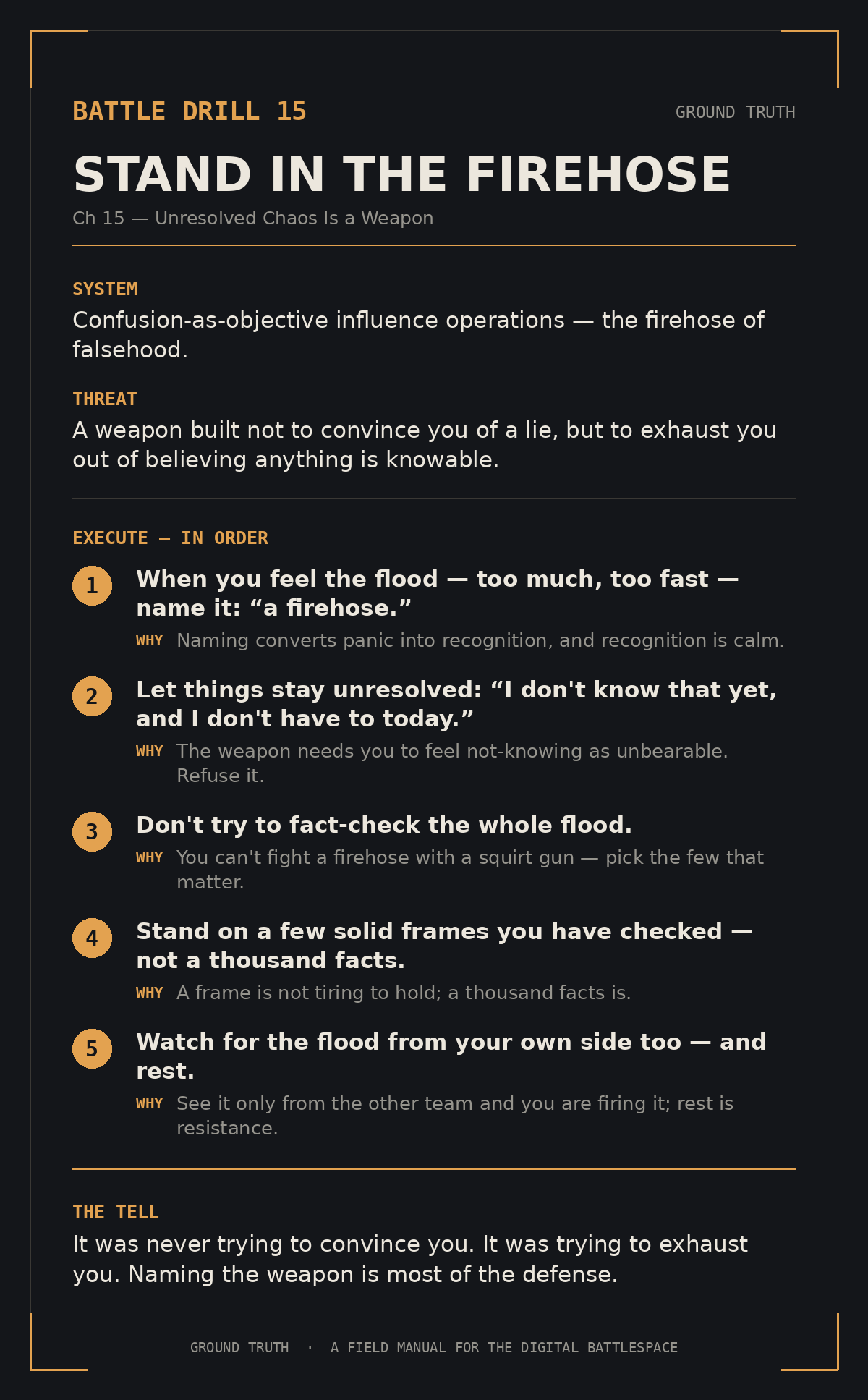
Name it when it starts. When you feel the flood — too much, too fast, too contradictory, your chest tightening — say it plainly to yourself: this is a firehose. Naming converts panic into recognition, and recognition is calm.
Let things stay unresolved. You are allowed to not have a verdict. “I don’t know that yet, and I don’t have to today” is a complete, disciplined thought. The weapon needs you to feel not-knowing as unbearable. Refuse it.
Don’t bail the flood with a teaspoon. You cannot personally fact-check a firehose, and trying is how it drowns you. Pick the few questions that genuinely touch your life and your vote, check those properly, and let the rest run past.
Stand on frames, not facts. Keep a small set of things you have actually verified and trust. When the flood hits, return to the frame instead of wading in after every claim.
Run the cross-aisle test. Watch hardest for the flood when it comes from your own side — your party, your team, the people you already agree with. If you can only see it when the other side does it, you are not reading the weapon. You are firing it.
Rest is a defense. Exhaustion is the objective — so being rested is resistance. You are allowed to close the feed, walk away, and come back clear. A firehose cannot soak someone who is not standing in it.
Where this goes
Stop here a moment, because you have reached the top of the hill.
This is the end of Part IV — and the end of the long, hard half of this book. Look back at the ground you have crossed. The casino in your pocket and the file the brokers keep on you. The persuasion machine and the algorithm. The people who aren’t people, the dark patterns, the targeting of your family, and now the firehose of confusion itself. That was the threat — all of it. You have walked the whole battlespace now, plainly, with the lights on. And you are still standing, still calm. That was the entire point of making you walk it.
Because here is what I promised you, all the way back in the introduction. Threat first. Then shield.
The threat is behind you now. Everything from here forward is the shield.
And the shield begins with the one thing this whole book has been circling — the thing on the news, the thing everyone has an opinion about and almost nobody can explain, the thing that can sharpen every weapon you just read about and hand you a defense against every one of them. Artificial intelligence. It is time, at last, to open it up and look inside — to learn what it actually is, in plain language, with no magic and no fear.
That is the next chapter. Turn the page. The hard part is over.
I found this in my Junk Mail. It is chapter fifteen. I did not read the first 14 chapters. Excuse my language but I found it bloody amazing. I was getting a bit tired of reading up on all the Trump stuff. I mean I still "trust the plan" and all that. However, I now know that one can become snowed under so to speak with information which that can disconnect you from your heart connection. Though, I had been considering taking a break from my search for truth, I was not sure how to go about it. Now I know where to Start. The apparent unresolved chaos can be used as a weapon. It is important to become balanced within the chaotic shit and know from within your heart that something good will survive it all. I will read the remaining chapters.
You are so kind to freely share your book with any and everyone. Bravo truly excellent info in a laden world