


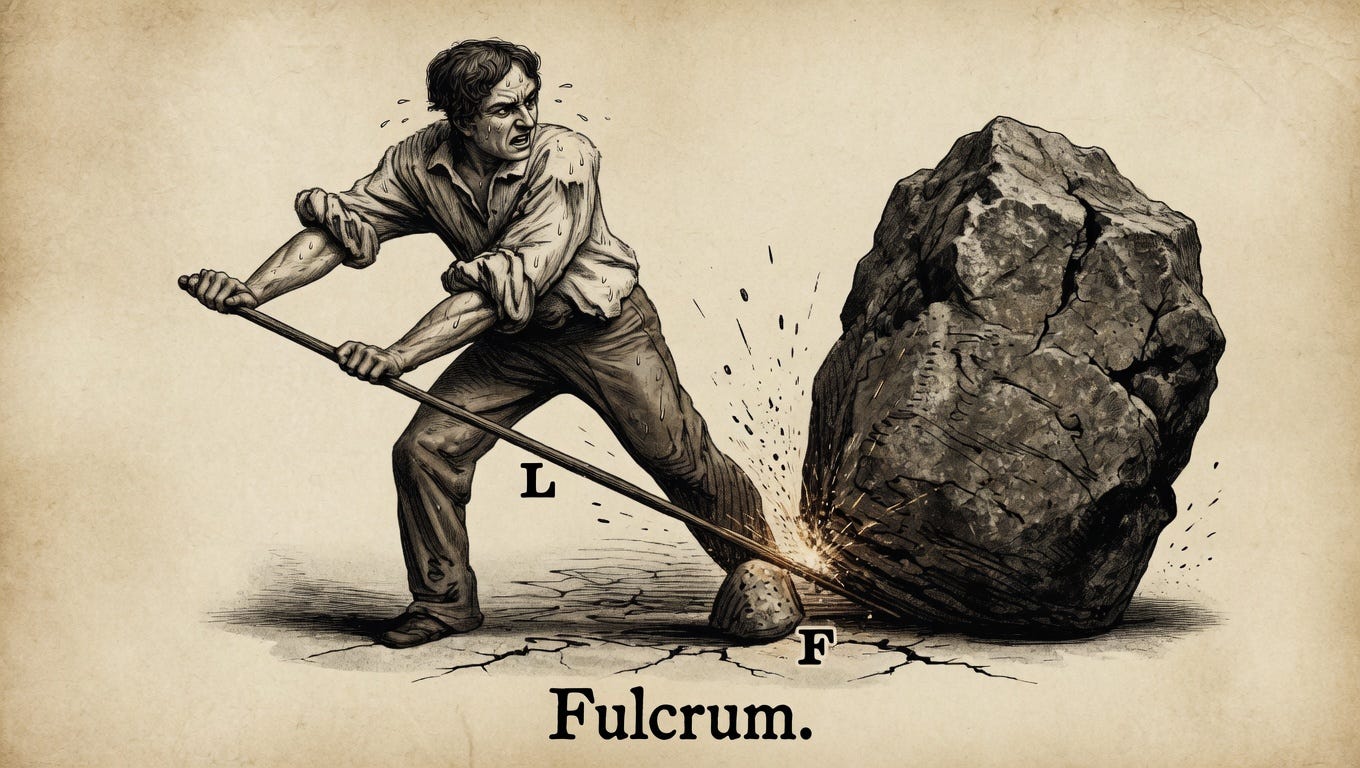
Chapter 18 — The New Equalizer
The tool does not care whose hand it is in.
For seventeen chapters, this machine has been something happening to you. This is the chapter where you reach down, pick it up, and turn it around.
The principle
Every threat in this book ran on a machine. That machine is not owned by the people who aimed it at you. It is a tool — and a tool serves whoever picks it up. For the first time, the same capability that has been used against you is something you can hold in your own hand. That is what the rest of this book is about.
The parallel — the equalizer
History has a name for a tool like this. It calls it an equalizer.
Every so often across the centuries, a tool has arrived that let the small stand against the large. The longbow let an ordinary farmer drop an armored knight who had trained for that fight since boyhood. The printing press let one unknown person’s words travel as far as a king’s decree. The frontier rifle was called, flatly, in plain speech, “the great equalizer.” None of these made everyone equal. What they did was narrower and more powerful than that: they took an advantage the strong had held alone, and they put a working version of it into common hands.
And every single time, the powerful disliked it. They always have. They never got a vote — because that is the nature of an equalizer. It does not ask the strong for permission. It does not care whose hand it is in.
What it actually equalizes
AI’s equalizer is not about muscle. So look closely at what the asymmetry in Parts I–IV was actually made of.
It was never strength. It was help. The institution, the wealthy person, the company that wanted something from you — what they had that you did not was people in their corner. Lawyers on retainer. Accountants. Researchers and analysts and staff. Someone whose whole job was to read the forty-page contract, decode the medical jargon, draft the appeal, run down the answer, do the homework. That kind of help has always cost real money, so it has always flowed to whoever had the money. That is the true, old asymmetry — far older than the internet, older than your grandparents.
Artificial intelligence is the first tool in human history that hands a working version of that help to a person who cannot afford a retainer. It is not as sharp as the best human expert in the room. But it is there — patient, tireless, and nearly free — for anyone, at two in the morning, with no appointment and no invoice.
The honest size of the claim
Now let me be as careful here as this book has been everywhere, because a reframe chapter is exactly where a writer is tempted to oversell.
AI is not a wizard. It will not make you a lawyer or a doctor. It is, as you learned in the last two chapters, sometimes confidently and fluently wrong. The equalizer does not erase the gap between you and the expert.
What it does is narrow it — and narrowing it is enormous. The reader who used to sit alone at the kitchen table with the contract she did not understand, the diagnosis he could not decode, the official letter nobody could explain — that reader now sits there with something genuinely capable in her corner. Not a savior. A tool. But the difference between facing the hard thing alone and facing it with a tool in hand is one of the oldest differences there is. That is the honest claim. It is still a big one.
The reframe

This is the hinge of the whole book, so let it land.
For seventeen chapters you have watched this machine work against you — sorting you, profiling you, manipulating you, deceiving you. That was all true, and you needed to see it. But here is the fact underneath it: the scammer’s deepfake and your defense against it run on the same machine. The persuasion industry’s tools and your power to see through them run on the same machine. There was never a special, separate AI reserved for the powerful. There is one kind of machine, and until this moment only one side had been taught to pick it up.
You are no longer only the terrain in this battlespace. Starting now, you are an operator — and you have a tool. That is not a feeling, and it is not a pep talk. It is a plain fact about who can do what, beginning today.
The rest of this book is simply learning to use it.
Make it actionable
DRILL — FLIP THE QUESTION
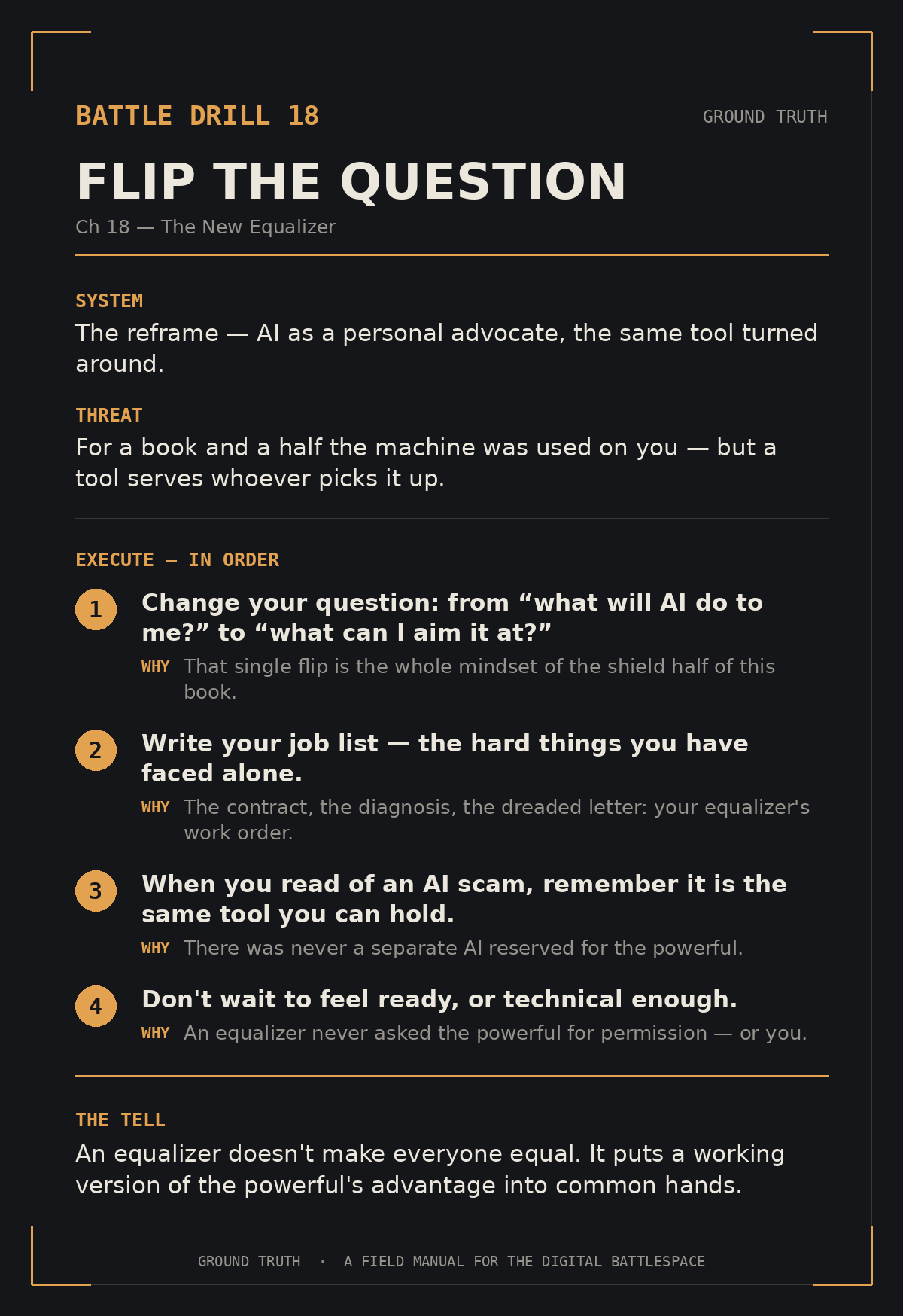
Change the question you ask. Stop asking “what is AI going to do to me?” Start asking “what can I point it at?” That single flip is the whole mindset of this half of the book.
Write your job list. Think of the places in your life where you have been alone with something hard — a contract you signed without fully reading, a diagnosis you did not understand, a letter you have been avoiding, a decision you felt unqualified to make. That list is your equalizer’s work order. (The next chapter starts clearing it.)
Remember it is the same machine. Every time you read about an AI-powered scam, let it remind you of something true: the tool is genuinely powerful — and it is the very same tool now sitting in your hand.
Don’t wait to feel ready. An equalizer never asked the powerful for permission, and it does not ask you for permission either. You do not need to be technical. You need to pick it up.
Where this goes
You have turned the machine around. Now we put it to work — and we start with the help that has cost ordinary people the most, for the longest: the lawyer you could never keep on retainer, the second medical opinion you could not get, the financial advice that was always priced for someone else.
That is the next chapter. The equalizer goes to work.