



Chapter 16 — Meet the Machines
The fear lives in the unopened box.
The hard part is over. You have walked the whole threat — the casino in your pocket, the file the brokers keep, the persuasion machine, the algorithm, the firehose. Now we turn around and meet the thing that can be aimed back the other way: artificial intelligence. And the very first job — long before it can ever be a tool in your hand — is to stop being afraid of it.
The principle
Artificial intelligence is not magic, and it is not a mind. It is a machine — built by people, out of parts, and every part can be understood. The fear you may carry about it is real. But it is not fear of the machine. It is fear of the blank space where an explanation should have gone. This chapter fills the blank space.
The parallel — it is a made thing
For a living, I walked toward the objects everyone else was running away from. And that job teaches you one idea — before any tool, before any technique — that pulls the terror straight out of the worst thing in the room: it is a made thing.
Whatever sits in front of you, however frightening, someone built it. A person, with hands, assembled it out of parts — a power source, a trigger, a charge, wire running between them. It did not fall from the sky. It is not magic. And the moment you can name the parts, the monster collapses into a machine — and a machine is only a problem, and problems can be worked.
The terror was never really in the device. It was in the not-knowing. The fear lives in the unopened box.
Artificial intelligence is the unopened box of this moment. It is on every newscast. Your family argues about it at the table. It seems to be arriving whether anyone agreed to it or not — and almost no one has been shown the inside. So we are going to do the thing I was trained to do. We are going to walk up to it, calm and unhurried, open the box, and name the parts. By the end of this chapter, the monster is going to be a machine.
Open the box — what an AI actually is
Here is what is inside. It is going to sound too simple — and that feeling, that can’t be all it is, is the fog starting to lift.
An AI model is a tall stack of layers. Picture a stack of pancakes. Your question goes into the top pancake. That layer changes it a little — reshapes it — and drops it to the next. That layer reshapes it again. Down and down through the whole stack, each layer giving the thing one more small nudge, until it comes out the bottom as an answer. That famous phrase, deep learning, means nothing grander than this: the stack is deep. Many pancakes.
You will want to call those layers a filter, and that is close — but sharpen it. A filter only takes things away. These layers do more than strain something out; they transform it, reshaping it into a more useful form at every step. Less a coffee filter, more a line of translators, each one handing the meaning along in a slightly clearer form.
And each layer, on its own, is not clever. It is a big grid of numbers doing plain arithmetic. One layer alone is dumb as a brick. But stack hundreds of them, and the tower as a whole can read a sentence, recognize a face in a photo, hold a conversation. The intelligence is not in any single layer. It is in the stacking. A single brick is not a cathedral.
Now — two things about that stack make an AI genuinely different from an ordinary computer program, and these are the two things to carry out of this chapter.
The first: nobody wrote down what the layers do. Think of a normal computer program — the software running your bank’s website, your thermostat. That is a rulebook, written out by a human: if this happens, do that. A person typed every rule, and a person can read them back. An AI is not written that way. It is grown.
It begins as a stack of random, meaningless numbers — a tower equally bad at everything, a brain with no memories. Then it is shown examples. Millions of them. Billions. And every single time it gets something wrong, every number in the tower is nudged a hair toward less wrong. Do that long enough, and random noise slowly becomes a thing that knows something. Which means that when people call an AI a “black box,” they are not being dramatic. They mean it plainly: even the people who built it cannot point at a layer and tell you what it learned. It was never written down to be read. It was grown.
The second — and this is the one to hold onto — an AI does not deal in certainty. It deals in probability. Ask an ordinary program the same question twice and you get the identical answer twice; it is following fixed rules. Ask an AI the same question twice and you may get two different answers — because it is not looking a fact up in a drawer. It is making its best prediction of what a good answer would look like. That is not a malfunction. It is the nature of the machine. An AI is less like a calculator and more like a very, very well-read animal: it learned from a mountain of examples, it is right a great deal of the time, it is sometimes confidently wrong — and it does not always know the difference. Hold that sentence. It is the single most useful true thing in this chapter, and we will come back to it.
Eighty years of small parts
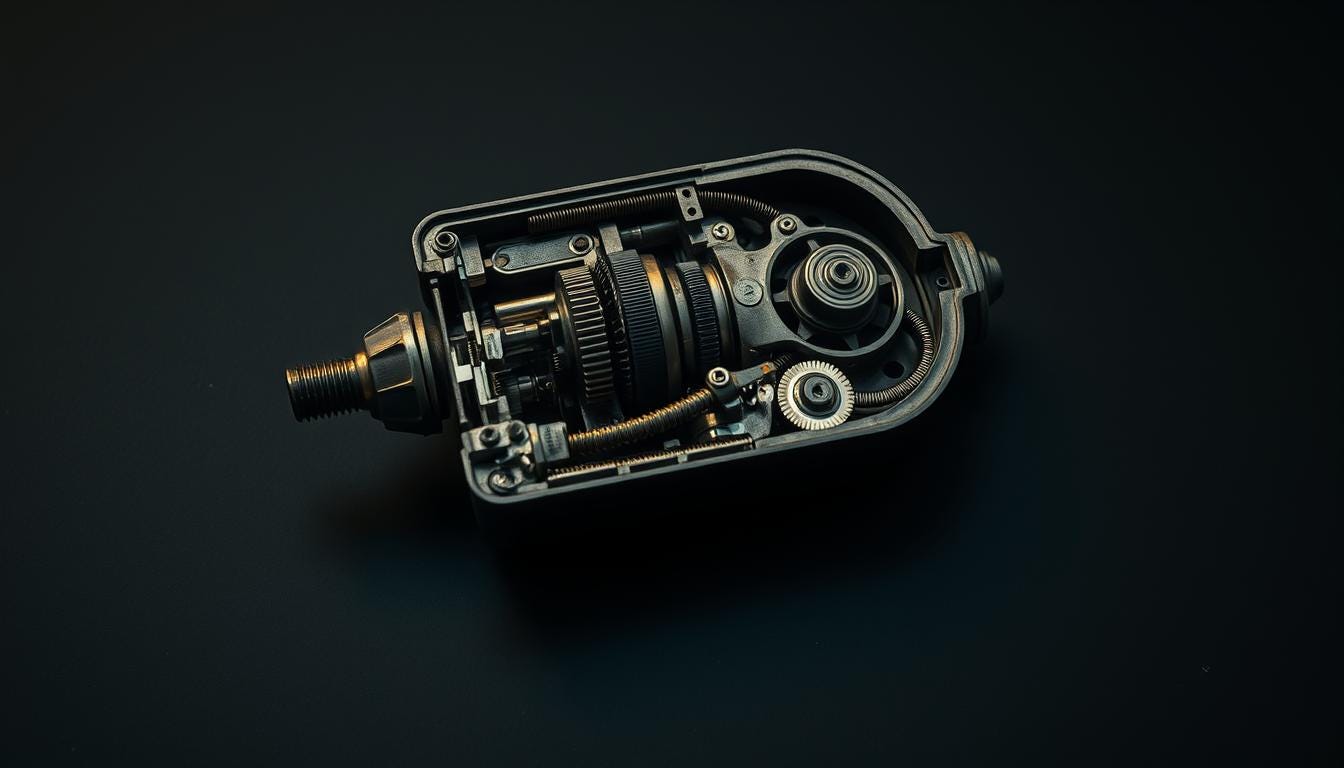
One more piece of the box, because it dissolves more fear than anything else: AI did not arrive in a flash. There was no single morning when it switched on.
What you are watching is roughly eighty years of small, ordinary inventions, stacked one on the next — each one solving the exact place where the last one got stuck.
In the 1940s, someone sketched out the math of a single brain cell — a formula on paper, nothing more.
In the 1950s, a machine first learned a little from examples instead of being handed rules — and then hit a wall, and the whole idea was nearly abandoned for years.
In the 1980s came the breakthrough that mattered most: a method for training a whole tall stack of layers all at once. That method is still — today, in every model built — how it is done.
But for decades even that was not enough; the computers were too slow, the piles of data too small. Then, around 2012, fast computer chips and enormous collections of data finally arrived together, the stacks could be grown genuinely deep, and for the first time the world saw plainly that the idea worked.
And in 2017 the last big piece fell into place — the piece sitting inside every AI you have heard of. It was invented at Google. They called it the Transformer, and what it gave a model was the knack of paying attention to the parts of your sentence that actually matter. It is the engine inside ChatGPT, inside Claude, inside all of it.
Five years after that, the engine — scaled up, and finally given a simple front door anyone could walk through — became ChatGPT, and the whole world met it in a single winter.
There is no magic anywhere in that story. It is people, stacking small parts, for eighty years. Which brings us, naturally, to the people.
Who builds them
You hear a handful of names and they blur together. Here is the family tree, and it has two roots.
The first root is the technology itself. As you just saw, the core engine — the Transformer — came out of Google. Nearly every modern AI is built on that one Google invention. Google’s own model is called Gemini.
The second root is the lineage — who broke away from whom. OpenAI, founded in 2015, makes ChatGPT — the one that introduced the world to all of this. A few years later, a group of senior people left OpenAI, over disagreements about safety and direction, and started their own lab. They called it Anthropic, and it makes Claude. Hold on to that split — a company born out of an argument about how carefully this ought to be done. It will matter near the end of this book.
The rest of the names are the big technology companies you already know, each carrying its own AI:
Microsoft has Copilot.
Meta has Meta AI, tucked inside Facebook, Instagram, and WhatsApp.
xAI has Grok, inside the platform X.
Apple has its own, woven into the iPhone.
And there is DeepSeek, out of China — worth knowing for how it is offered, which is the next-to-last thing in this chapter.
That is the whole cast. Not a pantheon of wizards. A handful of companies, most of which were already in your life, all building on one shared invention.
Is one of them the best?
This is the question everyone asks, so let us answer it straight: “best” is an unfinished sentence.
Best at what?
Some of these models are built to write, to reason, to talk a problem through. Other machines entirely — different tools, made a different way — are built to generate images. A model that is superb at thinking through a problem may be useless at painting a picture, and the reverse is just as true. None of them is best at everything; none ever will be. It is a toolbox, not a leaderboard. You do not ask whether a hammer beats a screwdriver. You ask what you are trying to build.
And when two of them can do the same job — when ChatGPT and Claude can both write your letter — the difference you actually feel between them is probably not what you would guess. Under the hood they are remarkably alike: the same kind of engine, the same kind of stack. They differ in three quieter places. They are built to slightly different proportions, the way two cooks measure the same recipe differently.
They were fed different libraries of material to learn from. And — the big one — they were given a different upbringing. Every model, after it has learned to be capable, is taught how to behave — what to refuse, what tone to take, what to value. That is why one AI feels careful and another feels breezy: not the engine, the upbringing — exactly the way two children raised in two different homes turn out different. Anthropic, for one example, trains Claude against a written set of principles, a kind of constitution, and published that document openly for anyone to read. The same kind of machine as the others. Raised deliberately.
You do not need to memorize the field. You need only this: there is no single best one. There is only the right one for the job in front of you — and you are the one who gets to choose.
Online or off, free or paid
The last part of the box: how these machines actually reach you.
Most AI is closed. You reach it much the way you reach a website — through the company, over the internet. The model itself lives on the company’s powerful computers; you are renting a turn at it. A few models are open — the entire trained model can be downloaded and run on your own computer, with no company in the loop at all, working even with the internet switched off. DeepSeek’s and Meta’s models are like this.
For nearly everyone reading this, the closed, online kind is the right door, and it is the door this book will point you toward. Just know the other kind exists — it is not a secret, and it is not out of reach.
And the price ladder is far gentler than it looks from outside. The free version of a major AI is genuinely, seriously capable — for most people, on most days, free is entirely enough, and free is exactly where you should begin. For roughly twenty dollars a month, you get the newer and faster version, and more room to lean on it. Above that sit “pro” tiers and specialized tools built for professionals who use it all day long.
You do not need to start at the top of that ladder. You only need to step onto the bottom rung. (The actual sit-down, do-it-with-me walkthrough — which button, which screen — is waiting for you in Appendix A. This chapter is the map; that appendix is the boots.)
The reframe
The box is open. Look honestly at what was inside it.
A stack of simple layers, doing arithmetic. Grown, not written. Assembled out of eighty years of small, ordinary inventions, by named people, in named companies, here on this earth. Good at some things, useless at others. Reachable for free. Not a mind. Not a magic. Not a monster. A machine.
You do not have to love it. You do not have to hate it. Both of those are still the fog talking — and you have just walked out of the fog. What you have to be able to do is see it clearly — and now you can. That was the whole job of this chapter, and it is finished.
Which means AI has just changed categories for you. Every page until this one, it was something happening to you — one more force loose in the battlespace, out in the dark. Starting on this page, it is something you can pick up and hold. The most capable tool an ordinary person has ever been handed did not exist when your children were small. It exists now. And it is sitting there, waiting, on the other side of a free sign-in.
So let us go and touch it.
Make it actionable
DRILL — FIRST CONTACT
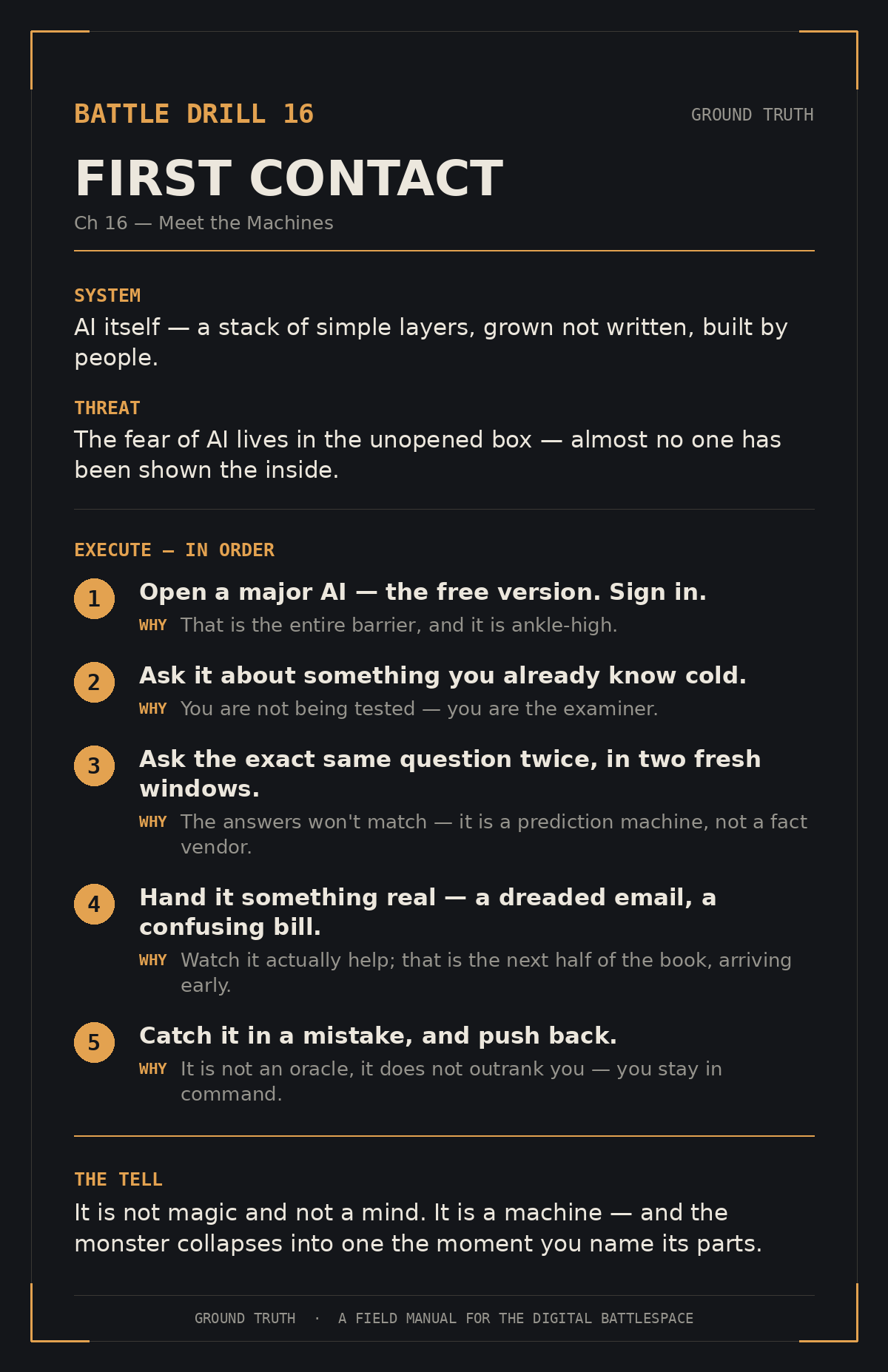
You do not get over the fear of a device by reading about it. Sooner or later you walk up to it — calm, and with a procedure. Here is the procedure for your first controlled contact with an AI. Do all of it in one sitting.
Open one. Free. Pick any major AI, choose the free version, sign in. No payment, no commitment. That is the entire barrier, and it is ankle-high.
Grade it on something you already know. Ask it about your old line of work, your hometown, a subject you have mastered. You are not the one being tested here — you are the examiner. That flip, all by itself, is half the point of this drill.
Ask it the exact same thing twice. Open two fresh windows and ask one identical question in each. The answers will not match. You have just watched “probability, not certainty” happen with your own eyes — it is a prediction machine, not a fact-vending machine.
Hand it something real and small. A draft of an email you have been dreading. A confusing bill or letter — paste it in and say “explain this to me in plain language.” Watch it actually help you. That is the second half of this book, arriving a little early.
Catch it in a mistake, and push back. It will get something wrong — it always eventually does. When it does, tell it so, plainly, and watch what happens next. It is not an oracle. It does not outrank you. You are, and you remain, the one in command.
Where this goes
You have met the machine — and you met it calm.
The next chapter does the other half of meeting it honestly. Not the fog-fears — the real ones. This machine has genuine edges, and a few of them are sharp, and you are owed a clear, unflinching look at exactly where the real danger lives — no hype, and no hiding it either. And then, with both the machine and its real dangers seen plainly and squarely, the rest of this book does the thing it promised you on its very first page.
It puts the tool in your hand.
More good stuff. Not afraid of AI just not interested in being fed pablum some else cooked up in their program to spit up. God gave us brains and they need to be flexed.
Thank you for this post Amigos,
Grace and peace to you, Semper Fortis!