



Chapter 20 — AI as Your Shield
A shield strikes no blow. It only keeps you standing.
The last chapter put the machine in your corner as an advisor. This chapter does the final thing — it turns it into a shield. And it closes with a true story.
The principle
AI in your corner is not only an advisor. It is a shield. It can stand a watch you were never able to stand alone — checking what reaches you, covering the angles you cannot cover, catching the thing you would have missed because you were tired, or busy, or simply did not know to look for it. The threats in this book were never going to stop coming. But you were never meant to face them with no shield and no watch.
The parallel — the shield, and the watch
The shield is the oldest defensive tool there is, and the only one that is purely defensive. It strikes no one. It does not win the fight. It does one thing — it keeps the person behind it on their feet long enough for everything else to matter.
And a shield has a companion that fieldcraft has relied on just as long: the watch. No one — no soldier, no sentry, no human being alive — can watch every direction at once, forever, without rest. That is not a weakness to be ashamed of. It is simply what it is to be a person. So the whole of military fieldcraft answers it the same way it answered everything else in this book: you cover each other, and you stand the watch in turns.
AI is a watch-stander. It does not get tired. It does not look away at the wrong moment. It can hold a sector you cannot hold yourself — not to fight your battles for you, but to keep you covered while you live your life.
The defensive playbook
Here is the shield, in practical use.
Check the suspicious message. Paste a questionable email or text into an AI and ask: “Is this a scam? Walk me through the red flags.” It is good at this — a genuine second opinion in ten seconds. Be honest about what it is, though: a second opinion, not a verdict. It can be fooled too. But “this smells wrong, and here is why” is very often exactly enough to stop you at the edge.
Decode the trap. Ask AI to explain a confusing link, a wall of terms-of-service, or a manipulative checkout screen in plain words — “what is this actually asking me to agree to?” One sharp limit, and it matters: have AI analyze a link you already have. Never ask it to give you the “official” link or website — AI gets web addresses wrong, and can hand you a scam by accident. You bring the link; it reads it.
Research the stranger. An unknown caller, an unfamiliar company, an offer that arrived from nowhere — AI can help you surface what is known and name the red flags. But the proof is still the old drill from Chapter 11: hang up, call back on a number you already had, ask for the code word. AI is the research assistant. The callback is the proof.
One warning that ties the room together: scammers now impersonate AI tools themselves. Use an AI assistant only through its real, official app or website.
You don’t have to do the setup alone

Now the part that pays off every chapter that came before this one.
Go back through this book in your mind. Nearly every chapter ended by asking you to do something — change the router password, turn on automatic updates, set up two-factor login, install a password manager, run the trust audit, file the data-broker opt-outs, freeze the children’s credit. For a lot of readers, that list has been quietly intimidating. Not because the steps are truly hard — but because doing them alone, with no one to ask, feels hard. Every “wait, where do I even click?” with nobody there to answer it is a small wall. Stack up enough small walls, and a good and capable person simply never starts.
Here is the thing that changes that, and it may be the most useful sentence in this book: an AI will walk you through every one of those drills, one step at a time, at your pace. You can tell it, “I have this kind of router, I am not technical, walk me through changing the password — and wait for me at each step.” You can ask “what does that word mean?” five times, and it will answer five times, the same patient way, and never once make you feel slow. The setup you have been avoiding was never beyond you. You were only ever doing it without a guide. Now you have one — and that is where the two halves of this book finally join. Parts I through IV told you what to do. This is the help that does it with you.
A true story — ARIA and VALOR
I am going to close this chapter with a real decision — and I am going to begin it with a disclosure, because this book has asked you for honesty since page one, and it will not stop at the finish line.
This book is a project of an organization called Project Milk Carton. PMC builds two AI systems of its own. One is ARIA, which works on child-welfare and missing-children cases. The other is VALOR, which works with veterans, some of them in crisis. Both of them run on one company’s AI — Anthropic’s Claude. So I have skin in this game, and now you know it. Here is our reasoning. Judge it yourself, exactly the way this whole book has trained you to.
We did not choose Claude because it is “the best AI.” You learned in Chapter 16 why that phrase is an unfinished sentence — best at what? Claude does not even create images; for that, ARIA hands the job to a different, specialized tool. We chose Claude for one specific role: the brain. The reasoning, the judgment, the careful handling of a hard situation — and the sense to pass a task to a specialist. A mind that knows what to delegate is not a limited tool. It is a well-designed one.
And here is the reasoning that actually decided it. You learned in Chapter 16 that AI models differ most in their upbringing — the values they are trained to hold. ARIA sits with families on the worst day of their lives. VALOR talks with veterans who are sometimes in genuine danger. For work like that, a model’s upbringing — whether it was trained to be careful, calm, honest, and to refuse to do harm — is not one feature on a list. It is the entire job. So Project Milk Carton made a simple decision: for a mission built on protecting vulnerable people, choose the AI raised with the most careful values. Anthropic builds Claude against a published set of written principles — you met that idea in Chapter 16 — and that deliberate upbringing is the thing the mission actually runs on.
Now the proof — because this book does not ask you to take a claim on faith. While this very book was being planned, the author asked the AI helping to write it to do something specific: to argue that it was superior to its competitors. Make the brag. Here, in plain summary, is what came back:
“‘Superior’ is the weaker claim, and I would be careful with it. It cannot really be proven, it will read as a sales pitch, and it will quietly burn the trust this book spent a hundred and fifty pages earning. The honest and stronger claim is ‘the right fit for this mission.’ Make that one instead.”
The AI was handed a chance to flatter itself — and it declined. It talked the author out of the easy brag and toward the honest, harder, more defensible claim, against its own apparent interest. The author’s reaction, word for word, was: “This comment right here is why. I agree.”
That exchange is the whole argument — demonstrated instead of asserted. I will not overclaim it: that is one moment, not a guarantee the machine is honest every time. What matters is not the single moment. It is the consistency — that it behaves this way predictably. For a tool that sits with frightened families and with veterans in crisis, predictable honesty — knowing how it will act before it acts — is not a pleasant bonus. It is the only acceptable standard.
And because this book has taught you, start to finish, never to take an institution’s word for anything — including ours — ARIA is open. Its code is public, on Project Milk Carton’s GitHub:
ARIA open-source repository link
Do not take our reasoning on faith. Go and read it. That invitation is the book’s whole method, turned on the book itself.
The reframe
Look at what the machine has become over these last few chapters. In Chapter 19 it was your advocate — the translator at the wall. Here it is your shield and your watch-stander.
For the entire threat half of this book, you were the terrain — the ground other forces moved across. You are not only that anymore. You have an advocate, and you have a shield, and you have something to stand the watch with you. The threats did not vanish; this was never a book that promised they would. But you no longer face them with empty hands, and you no longer stand the watch alone. That was the whole promise, made in the introduction. It is kept.
Make it actionable
DRILL — RAISE THE SHIELD
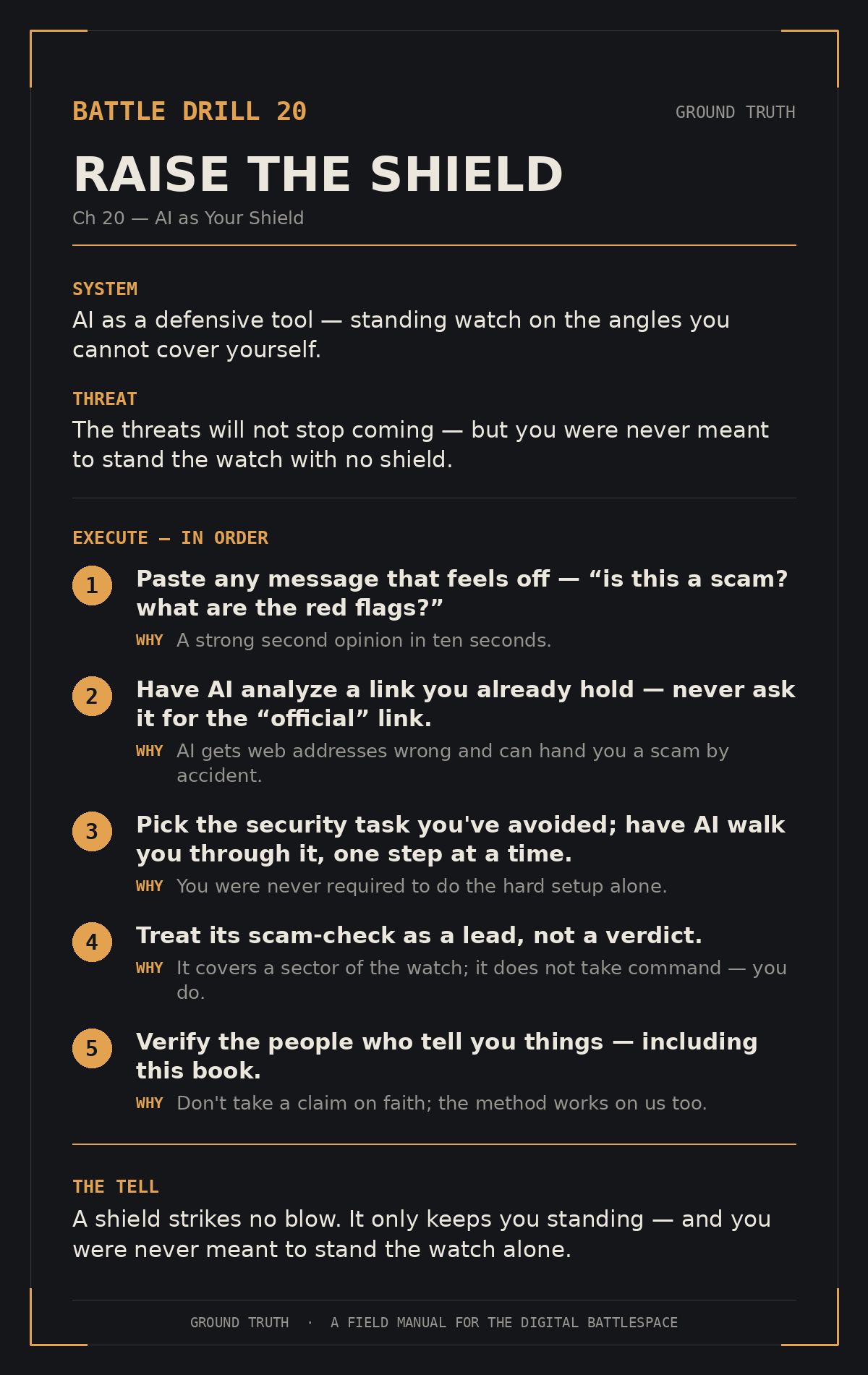
The scam check. Paste any message that feels off and ask: “Is this a scam — walk me through the red flags.” A second opinion in ten seconds.
Analyze, never ask-for. Have AI examine a link or document you already hold. Never ask it to supply the “official” link — you bring your own.
The guided setup. Pick the one security task from this book you have been avoiding. Tell an AI: “Walk me through this one step at a time. I am not technical. Wait for me at each step.” Then actually do it.
The watch is shared, not handed off. AI covers a sector — it does not take command. Its scam-check is a lead, not a verdict; you still make the call.
Verify us, too. This book’s own claims included. PMC’s reasoning is on the page above; PMC’s code is public. Check it.
Where this goes
You can use the machine now — as advocate, as shield, as the watch-stander at your side. For you, personally, the work of this book is essentially done.
The last two chapters are about something larger than you. One is about the people you love who have not read this book — and how to hand them what you now carry. The other is about what all of it, together, finally adds up to. That is where we are going.