



Chapter 17 — Where the Real Danger Lives
Clearing the fog does not clear the danger. It lets you see it.
The last chapter opened the box and showed you a machine — not a monster, not a magic. That was true, and it was the more important half of the story. Here is the other half, and you are owed it straight: a machine is not the same thing as a safe machine.
The principle
Artificial intelligence carries real dangers — not the fog-fears the last chapter cleared, but actual, documented, present-day harm. Clearing the fog was never the same as declaring the area safe. It means only this: that for the first time, you can see the danger accurately enough to stand in the right place.
The parallel — the honest danger area
When an EOD technician identifies a device, the job is not over. It has barely started. Because the next thing you do — before anything else — is establish the danger area: the honest radius inside which that device can still hurt someone. You map it carefully, and you map it true. You do not shrink it because you are feeling calm. You do not pretend the radius is zero because you have decided the thing is “probably fine.”
That word — probably — is the one that gets people killed. The most dangerous person on a call is not the one who is afraid; fear, at least, keeps you sharp. The dangerous one is the technician who has quietly decided the threat is handled and stopped paying attention. False comfort kills more surely than fear ever did.
So here is the discipline for this chapter. The last chapter cleared the fog around AI, and clearing fog feels like relief — it feels like all clear. It is not “all clear.” It is something better and more useful: it is the ability to finally see the danger area accurately. An honest map of where a thing can hurt you is not a frightening document. It is the document that lets you stand in the safe place. So let us map it — calm, careful, and true.
The danger is old crime at new speed
Here is the first thing on the map, and it should steady you rather than scare you: almost nothing AI does to harm people is a new kind of harm. It is old harm, moving faster.
Fraud is not new. Lies are not new. Fake images, stolen identities, the exploitation of children — none of it is new. What AI changed is not the category of the crime. It changed the speed, the cost, and the polish. A scam that used to take a con artist a week of patient work, AI can now run in a minute, a thousand times over, in flawless English, in a cloned voice.
The numbers say it plainly. Americans reported losing twelve and a half billion dollars to fraud in a single recent year — and the telling detail is not the total. It is this: the share of targeted people who actually lost money jumped from roughly a quarter to nearly four in ten, in one year. The scams did not just multiply. They got better. That is the AI accelerant, doing its work — and it is why the losses fall hardest on those with the most to lose, with reported elder fraud climbing many times over.
But hold the steadying half of that. If the harm is old crime at new speed, then the defenses are not new either. Everything this book already taught you — verify on a second channel, slow down when you are rushed, the family code word, never act on urgency alone — every one of those still works. They simply have to be used more often, and more consistently, because the attacks come faster now. The map did not change. The enemy just got a faster vehicle.
The sharp edges — what to know plainly

Three edges on this machine are genuinely sharp. You do not need to fear them. You need to know they are there.
The deepfake. AI can now produce a convincing fake of a real person — their face, their voice, their moving image. The harm is already concrete: in one case, a company employee was talked into wiring roughly twenty-five million dollars after a video call in which every “colleague” on the screen was a fake. And there is an uglier edge — tools that fabricate explicit images of a real person from an ordinary clothed photo. They have reached American schools, and been turned against children. This is real. We will not pretend it is not.
The machine that builds abuse. I am going to say this part plainly and soberly, because this organization exists for children. The same generative tools can be used to create and to alter sexual abuse material involving children. The trend is real, and it is being taken seriously — a federal law, the TAKE IT DOWN Act, was signed in 2025 specifically to criminalize this kind of fabricated imagery and force platforms to remove it quickly. I will also be honest about the numbers: some figures quoted on this are inflated by how the reports are counted, and this book will not hand you a number it cannot stand behind. But the direction is not in doubt, and a parent deserves to know this edge exists.
The confident error. This one is quieter, and it may be the edge most likely to touch your own life. Remember from the last chapter: an AI does not know things — it predicts them, and it is sometimes confidently, fluently wrong, and it does not know the difference. People have been burned trusting it blindly. Lawyers — actual lawyers — have filed documents in court citing cases the AI simply invented, and been sanctioned for it. The danger is not that the machine lies on purpose; it has no purpose. The danger is that it is wrong with total confidence — and a confident voice is a persuasive one.
What is NOT on the map
An honest danger map is defined as much by what it leaves off as by what it puts on. So let me be just as straight about that.
You will hear that the real danger of AI is that it will “wake up” — become a mind, develop a will, decide it does not need us. Serious people do argue about long-range risks, and that argument deserves its own room. But it is speculative, it is contested, and it is not the danger that will touch your family this year. It is not on this map. This map is the present tense.
Keeping the science-fiction fear off the map is not me being reassuring for its own sake. It is the same discipline as before: a danger area cluttered with imaginary hazards is as useless as one drawn too small. You map what is real, at actual range. And the real, actual-range dangers of AI are the three sharp edges above — fraud, fakery, and confident error. Every one of them is a recognizable harm. Which means every one of them has a defense.
Make it actionable
DRILL — STAND IN THE SAFE PLACE
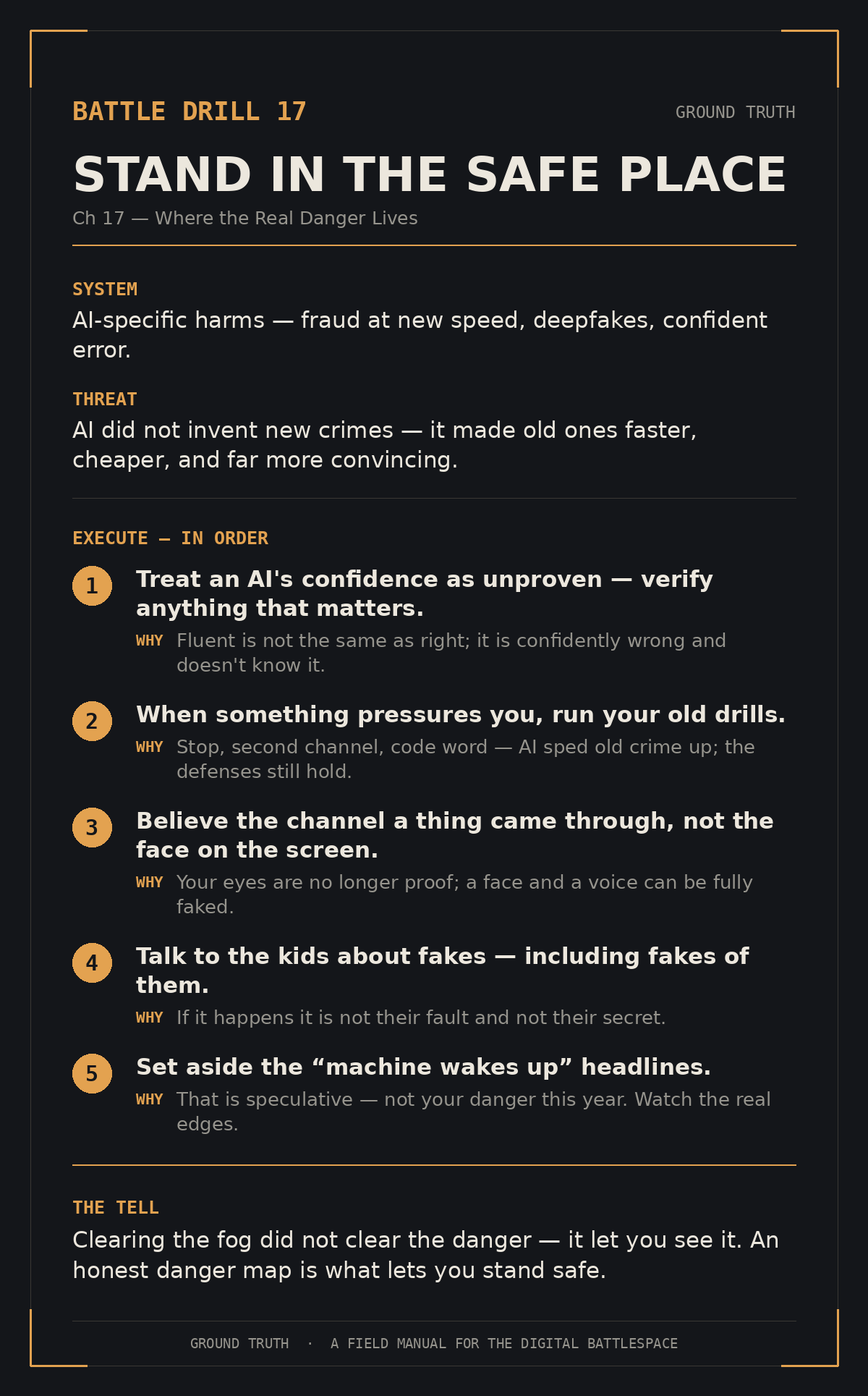
Treat confident as unproven. An AI’s certainty is not evidence. Anything that matters — a fact, a figure, a citation, a name — gets checked against a real, independent source before you act on it. Fluent is not the same as right.
Old crime, old defenses. When something pressures you — urgency, secrecy, an odd payment, a voice that does not feel right — your earlier drills still hold: stop, move to a second channel, ask for the family code word. Faster attacks, same defenses.
Believe the source, not the pixels. You can no longer trust a face or a voice on a screen to be real on sight. Verify the channel it came through — the way you learned to verify a source — not the image itself. Your eyes are no longer proof.
Talk to the kids about the fakes. Children need to know, in age-appropriate words, that fake images of real people — including of them — can be made; and that if it ever happens, it is not their fault and not their secret. That is the no-shame rule from Chapter 13, pointed at a new threat.
Keep the science fiction off your map. When a headline tries to frighten you with the machine “waking up,” set it aside. It is not your danger this year. Spend your attention on the three real edges.
Where this goes
You have now done the honest thing. You have met the machine plainly, and you have mapped its real danger area plainly. You are standing, clear-eyed, in the safe place — and you are still calm. That is exactly where this book needed to get you.
Because here is the turn the whole book has been walking toward. Look back at that danger map — the fraud, the fakes, the confident errors. Every single one of them is the same machine. And a machine is a tool, and the first thing this book ever told you about a tool is that it cuts both ways. You have spent sixteen chapters watching this one cut against you.
The next chapter, you pick it up — and you turn it around.
I don't believe that we can ever trust AI.