



Chapter 19 — AI as Your Lawyer, Doctor, Accountant, Counselor
Everyone else in the room had someone. Now you do too.
The last chapter turned the machine around. This chapter puts it to work — and it starts with the help that has cost ordinary people the most, for the longest.
The principle
The biggest advantage the powerful have ever held over everyone else is not money itself. It is what money buys: professional help — someone in your corner who can read the document, decode the jargon, and tell you what it means. AI is the first tool that puts a working version of that help within reach of nearly anyone. It will not replace the professional. It will do something almost as valuable — it will get you ready to face one.
The parallel — the translator in your corner
Walk into any serious negotiation and look at the powerful side of the table. They have an advisor. Someone who speaks the language.
Because that is the quiet truth of professional life: it is conducted in languages ordinary people were never taught. Legalese. Medical terminology. The dialect of finance and insurance. This is not entirely an accident — a language you cannot read is a wall, and a wall is useful to whoever built it. The wealthy person’s move has always been the same: hire a translator who lives on the other side of that wall, and pay them to come back and explain.
AI is a translator who will stand at the wall with you — at any hour, for free or nearly free — and tell you what the words on the other side actually mean. It will not win your case. It will not cure you. But you will no longer be standing at that wall alone, unable even to read the sign.
The justice gap — why this is not a small thing
Before the four corners, look at the size of the problem this addresses, because it is bigger than most people realize.
By the Legal Services Corporation’s measure, roughly 92% of low-income Americans get no help, or not enough, with their civil legal problems — evictions, custody, debt, benefits. Most people with a real legal problem never speak to a lawyer at all. Not because they do not need one. Because they cannot afford the door.
The same wall stands in smaller forms everywhere — the medical bill nobody can explain, the benefits letter written to be given up on. Here is the one that should make you angry in a useful way: health insurers deny roughly one in five in-network claims, and patients appeal fewer than one in a hundred. Not because the denials are correct. Because appealing means writing a letter in a language you were never taught. AI can write that letter. That is the equalizer, made concrete.
Walk the four corners

Each corner follows the same shape: a real strength, and a sharp limit. Learn the shape once and it holds for all four.
As a lawyer’s understudy. AI is genuinely strong at explaining a contract, a lease, or a legal notice in plain words, and at drafting letters and complaints. The legal profession itself accepts this — the American Bar Association has issued formal guidance treating AI as a legitimate tool, used under supervision. The limit is sharp: AI is bad at legal research — studies have caught it inventing court cases that never existed, often more than half the time. So use it to understand your document and to draft — never to tell you what the law itself says. For that, your draft goes to a real lawyer; the AI just made that visit shorter and cheaper.
As a doctor’s translator. AI is genuinely good at turning a diagnosis, a lab result, or a wall of terminology into plain English — and at helping you build the list of questions to actually ask at your appointment. About one in five American adults already use it this way. The limit is a hard line: AI does not examine you, and it does not diagnose. One hospital study found an AI badly under-rating the urgency of real emergencies. Use it to understand and to prepare — never to decide whether something is serious. It makes you a sharper patient, not your own physician.
As an accountant’s clerk. Good for explaining financial ideas, building a budget, and — the big one — drafting that insurance appeal or billing dispute. The limit: it is not a licensed preparer, and it gets specific tax questions wrong at an alarming rate (in one test, even the tax companies’ own AI tools failed more than half the time). Use it to understand and to draft; let a human handle any filing that carries a penalty.
As a counselor — read this part slowly. AI is not a therapist, and it is not a crisis line. If you or someone you love is in crisis, the number is 988 — the Suicide and Crisis Lifeline — and for any emergency, 911. Those numbers reach trained human beings, awake right now for exactly that moment. An AI is not one of them, and in documented tests it has given unsafe responses to people in distress. What AI honestly can do in this corner is narrow and real: help you put a feeling into words, draft a hard conversation you have been dreading, think a decision through out loud at two in the morning when no one else is awake. A sounding board — never a clinician. Know the difference, and know the numbers.
The one rule that makes all of it safe
If you carry one sentence out of this chapter, carry this: AI gives you a draft, never a verdict.
Everything it produces is a starting point you check — not an answer you act on. Three habits make that real. First, verify anything that matters against a real, official source — it is Chapter 14’s lateral reading, turned on your own documents. Second, use it to prepare for a professional, not to replace one — the goal is a shorter, smarter, cheaper appointment, never no appointment at all. Third, do not feed it your secrets — your Social Security number, full account numbers, the truly private details. Treat the chat window like a room that might have other people in it.
Make it actionable
DRILL — PUT IT IN YOUR CORNER
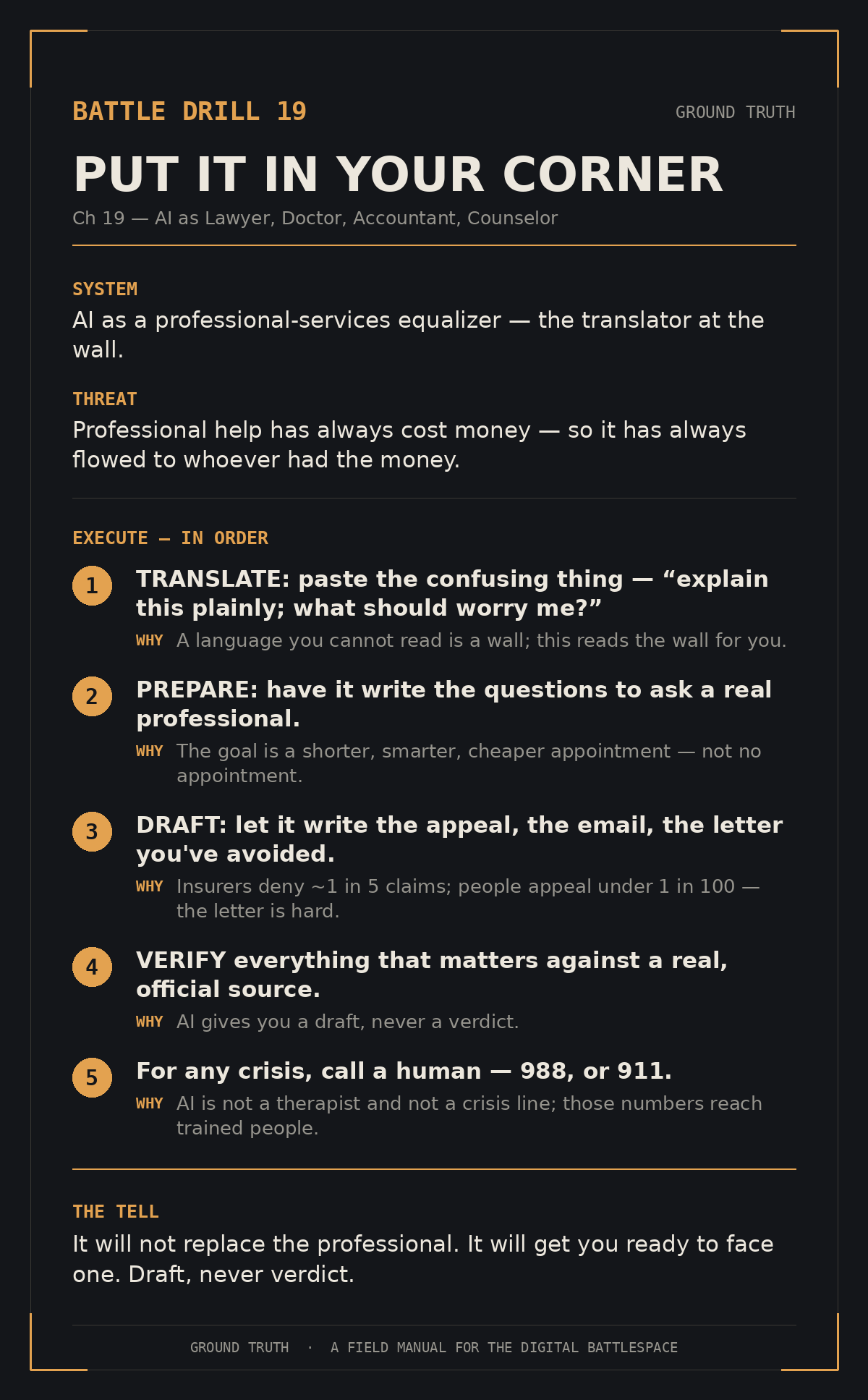
The translate prompt. Paste in the confusing thing — a contract, a lab result, a letter, a bill — and ask: “Explain this to me in plain language, as if I’m smart but never trained in this. What in here should I be worried about?”
The prepare prompt. “I have an appointment about [this]. Help me write the list of questions I should ask so I don’t waste the visit.”
The draft prompt. “Help me write a [letter appealing this insurance denial / email to my landlord / message I’ve been avoiding]. Here are the facts…”
The verify rule. Whatever it hands back, the parts that matter get checked against a real source — and the big decisions still go to a real professional. Draft, not verdict.
The patient guide. It runs the other direction too: every technical setup this book has asked of you — the router, the password manager, two-factor login — AI will walk you through, one step at a time, at your pace, answering “what does that mean?” as many times as you need. You were never required to do the hard setup alone. (More on that in the next chapter.)
Where this goes
You have put the machine in your corner as the advisor — the translator at the wall, the understudy, the patient guide. There is one more job for it, and it is the one this whole book has been building toward.
The next chapter turns the equalizer into a shield — AI standing watch beside you, helping you spot the scam, decode the trap, and check what is real. And it closes with a true story: what it looks like when this tool is pointed, deliberately and with care, at protecting the people who need it most.