



Chapter 21 — Teaching Your People
The crank and the teacher know the same facts. Only one gets heard.
You can defend yourself now. But you do not live alone in this battlespace — and the people you love are mostly still standing in it untrained. This chapter is about handing them what you now carry.
The principle
Everything in this book dies with you unless you pass it on. The people you love are standing in the same battlespace, mostly untrained — and you are now the most equipped person many of them know. But knowing the truth and being able to transmit it are two different skills. You have the first one. This chapter is the second.
The parallel — train the trainer
Back in the introduction, I told you the most important thing about my old job: I did not just walk up to bombs. I trained the people who would. And I told you the hardest part of that training was never the equipment — it was building awareness inside another human being, patiently, in layers, until it became instinct. That is a teachable skill. Teaching it was my actual job.
This whole book has been me doing exactly that to you, at a distance.
Now I hand you the teacher’s half — because fieldcraft has one rule above all the others: it is not yours to keep. You hold it in trust, and you owe it down the line. The technician who trained me is long retired. What he taught me reached you, in this book, in your hands, only because he passed it on, and so did I. That is the deal. It always was. Your turn.
The crank and the teacher
Here is the danger, named plainly. The moment you start telling your family about data brokers and deepfakes and the firehose of falsehood, you are at risk — not of being wrong, but of sounding like the paranoid uncle everyone has quietly learned to nod at and tune out.
And here is the cruel part. The crank and the teacher can speak the exact same true facts. Being right is not what separates them. So what does?
It is the same test this book has used, quietly, in every chapter. Watch the person you are talking to, and ask one question: when they walk away from you, do they feel more afraid and more helpless — or more calm and more capable? A crank, however accurate, leaves people frightened, powerless, and feeling they must agree this instant. A teacher leaves them steadier and more able than they were, and free to decide in their own time. Same facts. Opposite effect. The crank, underneath it, is feeding their own alarm. The teacher is building someone else’s awareness. You already know which one this book chose on every single page. Teach the way you were just taught.
How to actually do it

A few rules — drawn straight from how this book worked on you.
Lead with the help, not the threat. No one is won over by being frightened; they are won over by being helped. Do not open with the data brokers. Open by showing your mother how AI will explain her insurance letter. Usefulness opens the door that fear slams shut.
One thing — not the whole curriculum. You do not teach a person this entire book. You teach the one thing that fits their life. A grandmother needs the family code word, not the five domains. A teenager needs the no-shame rule, not a lecture on data brokers. Find the one thing, deliver it, and stop.
Show; do not tell. The strongest teaching in this book was never a warning — it was a drill. Do this. So do not lecture your people. Sit down beside them and do it together. Open the AI with them. Change the password with them. A thing done once, with help, is learned. A thing merely warned about is forgotten by dinner.
Plant; do not push. You cannot argue a person into awareness — the firehose chapter showed you that a cornered mind stops listening. Hand them one tool, let them see it work, and then let go. Awareness grows on its own once it is planted. Your job is the planting. You do not have to force the harvest.
Make it actionable
DRILL — PASS IT DOWN
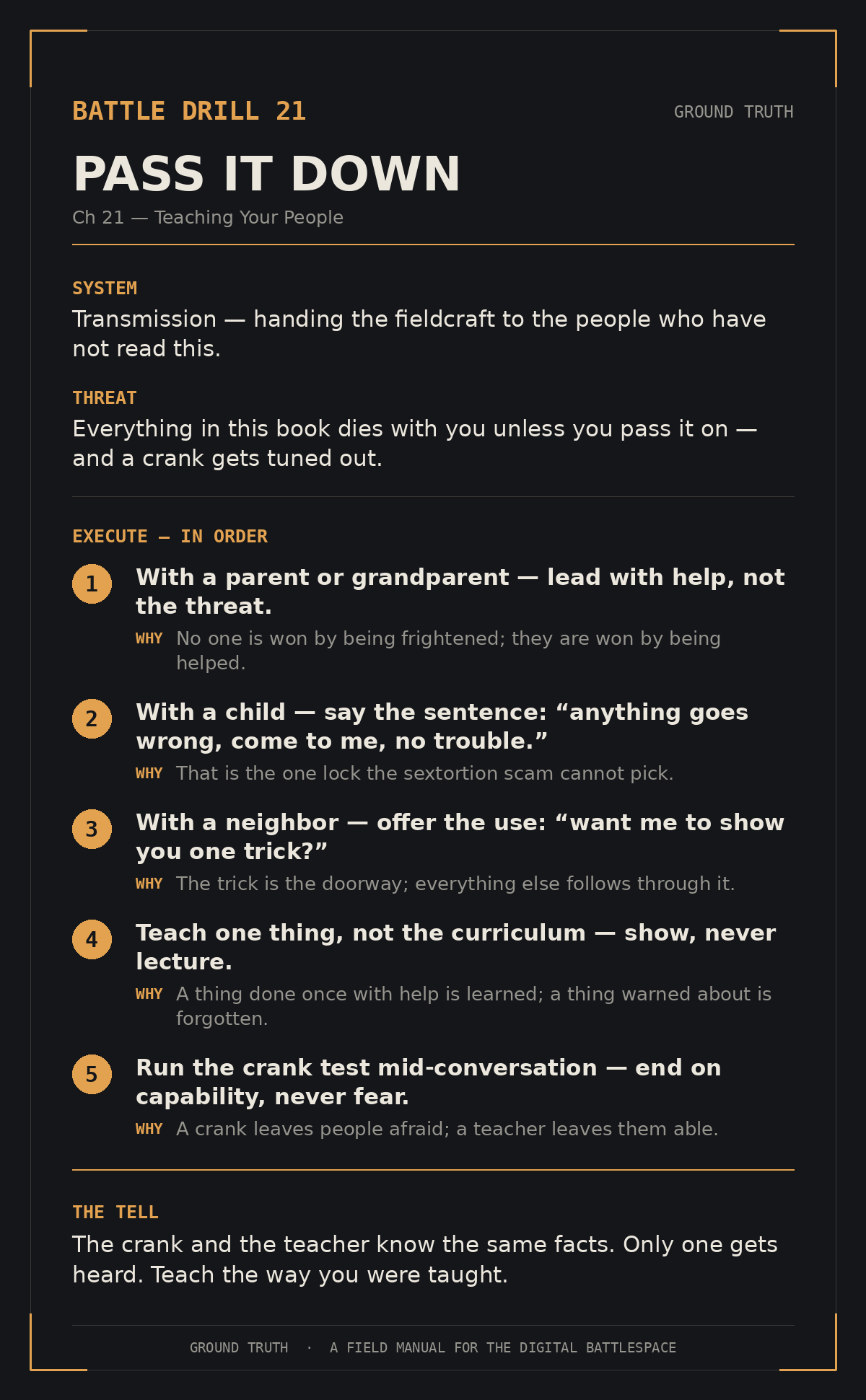
For a parent or grandparent: don’t warn — help. “Here, let me show you something — hand me that confusing letter.” Then, once, lightly: “And let’s pick a family word, in case someone ever calls in a panic pretending to be me.”
For a child or teenager: skip the lecture entirely. Say the one sentence that outranks all the others: “If anything online ever goes wrong — anything, even if you feel stupid about it — you can come to me, and you will not be in trouble.” Then leave that door standing open.
For a neighbor, a friend, your church: do not preach the threat. Offer the use. “I’ve been figuring out how to make this AI thing genuinely useful — want me to show you one trick?” The trick is the doorway; everything else follows through it.
For anyone: run the crank test on yourself, mid-conversation. If their face has gone tight and afraid, you have slipped into crank — stop, slow down, and hand them something they can do. End every teaching moment on capability, never on fear.
Remember it fades. One conversation is a seed, not a fence. Small, calm, and repeated — that is how fieldcraft was always passed down, and it is the only way it ever holds.
Where this goes
You can defend yourself. You can train your people. There is one chapter left — and it is not another tool. It is the answer to the question underneath the whole book: what is all of this finally for?
It is not a call to arms. It is something quieter, and far more durable. Turn the page.