
The Constitutional Foundations
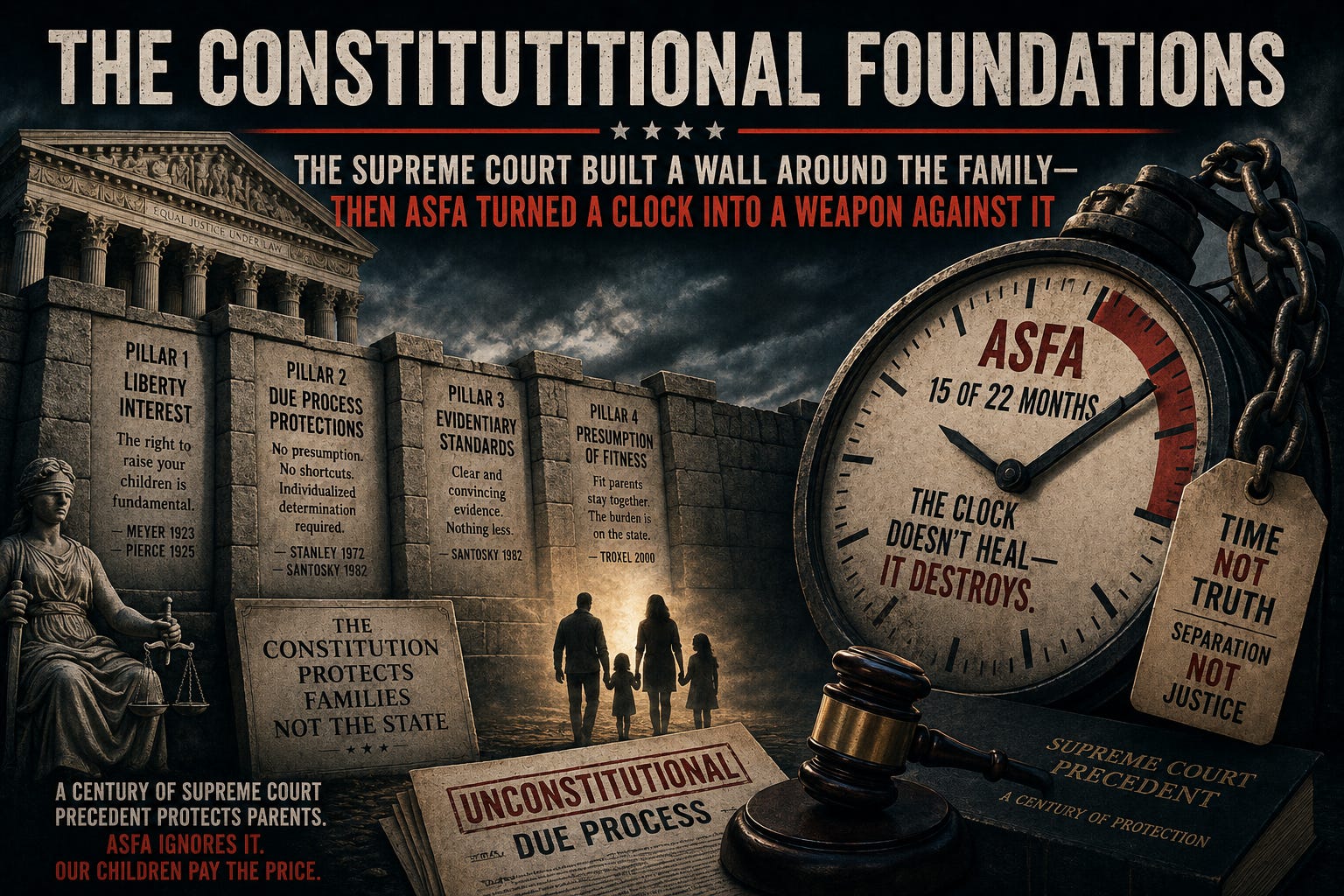
The Supreme Court Built a Wall Around the Family — Then ASFA Turned a Clock Into a Weapon Against It

By Project Milk Carton Investigations
ARTICLE 4 sub-article A
There is a constitutional story buried beneath America’s foster care system that most parents have never been told. It is not the story agencies recite in court. It is not the story printed in child welfare brochures. It is not the story legislators told the public when they passed the Adoption and Safe Families Act in 1997. It is a deeper story, stretching back more than one hundred years, through Supreme Court decisions that repeatedly recognized one of the oldest and most protected liberties in American law: the right of parents to raise their children without unjustified government interference.
For a century, the Supreme Court has built a constitutional wall around the family. Case by case, brick by brick, the Court declared that parents do not hold their children at the pleasure of the state. The government may intervene when children are genuinely abused or neglected, but it may not treat children as creatures of government management. It may not presume parents unfit because they belong to a disfavored category. It may not sever family bonds without individualized proof. It may not permanently destroy the parent-child relationship without clear and convincing evidence. It may not shift the burden onto parents to prove they deserve their children.
Then Congress passed ASFA.
The Adoption and Safe Families Act was sold as a humane reform to rescue children from foster care drift. Its stated purpose was to prevent children from languishing for years in temporary placements while courts and agencies delayed decisions about reunification or adoption. But at the heart of ASFA sits a mechanism that collides directly with the constitutional lineage the Supreme Court spent decades building: the 15-of-22-month rule. Under that rule, states are generally required to file for termination of parental rights when a child has been in foster care for 15 of the most recent 22 months, unless narrow exceptions apply.
That may sound like a procedural deadline. It is far more dangerous than that.
ASFA converts time in foster care into a trigger for permanent family destruction. It pressures states to file termination petitions based on a calendar, not on an individualized constitutional determination of present parental unfitness. It does so inside a system where the state controls the placement, controls the services, controls the visitation schedule, controls the case file, controls the progress reports, controls the court recommendations, and receives federal adoption incentive payments when children move from foster care into adoption.
That combination is the constitutional scandal.
The Constitution does not allow the government to permanently destroy a family because a clock ran out. It requires individualized proof. It requires due process. It requires a presumption that fit parents act in their children’s best interests. It requires clear and convincing evidence before the state may sever the parent-child relationship. It requires procedures strong enough to protect against erroneous deprivation when the interest at stake is not property, not money, not a license, but a family.
ASFA’s defenders will say the law does not automatically terminate parental rights. Technically, that is true. The statute requires states to file a petition; courts still conduct hearings. But that answer avoids the central constitutional problem. In child welfare, filing is not neutral. A mandatory filing requirement changes the posture of the case. It tells the agency, the attorneys, the foster parents, the court, and the parent that the system has shifted from reunification to destruction. It turns the state from a supposed service provider into an adversary seeking permanent severance.
The Supreme Court warned against exactly this kind of shortcut. In Stanley v. Illinois, the Court condemned “procedure by presumption” because it is cheaper and easier than individualized determination, but risks running roughshod over the interests of both parent and child. In Santosky v. Kramer, the Court warned that the state has the power to shape the historical events that form the basis for termination. Under ASFA, that warning becomes prophetic. The state does not merely present evidence. It helps create the evidence. It controls the conditions under which the parent is judged, then invokes the passage of time as proof that the parent failed.
This article is the constitutional foundation for the broader Project Milk Carton investigation into ASFA, adoption incentives, QRTP warehousing, and the child welfare money machine. The previous articles followed the policy, the money, the contractors, and the state-by-state incentive structure. This one follows the Constitution.
And the constitutional question is blunt: how can a federal law that pressures states to file termination petitions based on time survive Supreme Court precedent requiring individualized proof of unfitness before family destruction?
The answer is not comfortable.
It may not.
The Supreme Court’s Century-Long Defense of the Family
The constitutional protection of the family did not begin with modern culture-war debates. It began in the early twentieth century, when the Supreme Court recognized that liberty under the Fourteenth Amendment means more than freedom from physical restraint. In Meyer v. Nebraska in 1923, the Court held that liberty includes the right to establish a home and bring up children. The case involved a Nebraska law restricting foreign language instruction, but its deeper significance was parental authority. The Court made clear that the state does not possess unlimited power to standardize childhood through government policy.
Two years later, in Pierce v. Society of Sisters, the Court went further. Oregon had tried to require children to attend public schools, effectively threatening private and religious education. The Supreme Court struck the law down and issued one of the most important sentences in family-rights jurisprudence: “The child is not the mere creature of the state.” That phrase is not decorative. It is a constitutional boundary marker. It means the state may regulate, protect, and intervene when necessary, but it does not own the child. Parents who nurture children and direct their destiny have rights and duties that preexist bureaucratic authority.
These early cases established the first constitutional pillar: family integrity is a liberty interest protected by the Fourteenth Amendment. Parents have a fundamental right to direct the upbringing, education, care, custody, and control of their children. That right is not absolute, because the state has a legitimate interest in protecting children from real harm. But because the right is fundamental, government interference must be justified by more than administrative convenience or generalized suspicion.
The modern child welfare constitutional line sharpened in Stanley v. Illinois in 1972. Peter Stanley was an unmarried father whose children were declared wards of the state after their mother died. Illinois law presumed unmarried fathers unfit without requiring an individualized hearing. The Supreme Court rejected that presumption. The Court held that parental unfitness must be established on the basis of individualized proof. It condemned categorical assumptions that bypass the actual question of whether this parent, in this case, is fit to care for this child.
Stanley matters because it stands directly against the logic of mechanical child welfare shortcuts. The government cannot say that because some parents in a category are unfit, all parents in that category may be treated as unfit. It cannot avoid the constitutional burden by using a proxy. Marital status could not substitute for individualized proof in Stanley. Time in foster care should not substitute for individualized proof under ASFA.
The next major case, Santosky v. Kramer in 1982, raised the evidentiary floor. The Court held that before a state may completely and irrevocably sever the rights of parents in their natural child, due process requires at least clear and convincing evidence. A mere preponderance of the evidence is constitutionally inadequate because termination of parental rights is among the most severe civil actions the state can take. The Court recognized the enormous asymmetry between the parent and the state, the risk of error, and the irreversible consequences of a wrongful termination.
Santosky also contains one of the most important warnings in this entire investigation: the state has the power to shape the historical events that form the basis for termination. That sentence should be engraved above every family court door in America. The state controls access to services. The state controls visitation. The state controls case plans. The state controls reports. The state controls whether delays are blamed on the parent or the agency. The state controls whether poverty is framed as neglect. When the same state later argues for termination, it is often relying on a record it helped create.
In M.L.B. v. S.L.J. in 1996, the Supreme Court described termination of parental rights as a unique kind of deprivation and treated it as constitutionally closer to criminal punishment than ordinary civil litigation. The case involved a mother who could not afford record preparation fees needed for appeal after her parental rights were terminated. The Court held that the state could not condition appellate review of such a devastating decision on ability to pay. The decision reinforced the understanding that TPR is not ordinary civil litigation. It is the civil death penalty.
Then came Troxel v. Granville in 2000. There, the Court reaffirmed that the interest of parents in the care, custody, and control of their children is perhaps the oldest fundamental liberty interest recognized by the Court. Troxel confirmed the presumption that fit parents act in the best interests of their children. That presumption is crucial. The burden belongs on the state. Parents do not begin each case having to prove they deserve their children. The government must prove unfitness.
Taken together, these cases form a constitutional lineage that should make ASFA’s mechanical timeline deeply suspect. Meyer and Pierce protect the family from state ownership. Stanley forbids categorical presumptions of parental unfitness. Santosky requires clear and convincing evidence before irrevocable severance. M.L.B. treats TPR as a uniquely severe deprivation. Troxel presumes fit parents act in their children’s best interests.
ASFA’s 15/22-month rule sits uneasily inside that lineage because it does something the Court repeatedly warned against: it turns a general administrative fact into a substitute for individualized constitutional judgment.
The Four Pillars Protecting Family Integrity
The constitutional protection of the parent-child relationship rests on four pillars. Each matters on its own. Together, they form the legal framework that should govern every termination of parental rights proceeding in America.
The first pillar is substantive due process. The Fourteenth Amendment protects liberty, and the Supreme Court has repeatedly held that parental rights fall within that protected liberty. This is not a minor right. It is not a preference. It is not a privilege created by statute. It is one of the oldest fundamental liberty interests recognized in American law. Because it is fundamental, the government must have a compelling interest and must use narrowly tailored means when it infringes on it.
Child safety is unquestionably a compelling interest. No serious person argues that the state lacks authority to protect children from abuse, torture, sexual violence, abandonment, or severe neglect. But strict scrutiny does not ask only whether the government’s goal is important. It asks whether the government’s method is narrowly tailored. A blunt 15-month calendar trigger is not narrow. It catches parents whose children remain in foster care because of agency delay, poverty, incarceration, housing instability, service waitlists, transportation barriers, immigration detention, or systemic failure. It treats time as if time itself proves unfitness. That is the opposite of narrow tailoring.
The second pillar is procedural due process. Before the state may deprive a parent of a fundamental liberty interest, it must provide meaningful procedures: notice, opportunity to be heard, counsel where necessary, and an individualized hearing focused on actual fitness. The Mathews v. Eldridge balancing test asks courts to weigh the private interest at stake, the risk of erroneous deprivation, the value of additional safeguards, and the government’s interest. In TPR cases, the private interest is commanding. The risk of error is high. The consequences are permanent.
ASFA worsens the risk of error because it adds a mandatory filing deadline to an already unequal process. The parent is often poor, traumatized, underrepresented, and dependent on services the state controls. The agency has attorneys, records, experts, caseworkers, and institutional authority. When the clock runs, the state must file unless exceptions apply. That deadline pressures the system to move even if the evidentiary record is incomplete or shaped by the state’s own failures.
The third pillar is the Santosky evidentiary floor. The state must prove parental unfitness by clear and convincing evidence before permanently severing parental rights. This standard is not optional. It exists because the Court recognized that termination is too serious to rest on ordinary civil proof. The problem with ASFA is that the timer precedes the evidence. The statute requires filing based on elapsed time, not based on a prior determination that clear and convincing evidence of present unfitness exists. A petition may later be tried under the correct standard, but the case has already been pushed into termination posture by a clock.
The fourth pillar is equal protection and the presumption of parental fitness. The Constitution does not allow the state to classify parents as unfit based on disfavored status, poverty, marital status, or generalized assumptions. Stanley rejected marital-status presumptions. M.L.B. rejected financial barriers to appeal in parental termination. Troxel reaffirmed that fit parents are presumed to act in their children’s best interests. ASFA’s timer threatens this presumption because it creates a practical inversion: after 15 months in foster care, the parent must fight the system’s momentum toward termination. The burden may formally remain on the state, but structurally the parent is now trying to overcome a federally mandated filing posture.
These four pillars should make one principle unavoidable: the Constitution requires present-tense, individualized proof of unfitness before permanent family destruction. Time in foster care may be relevant evidence in some cases, but it cannot become the trigger that substitutes for proof. A parent is not constitutionally unfit because a child has been in foster care for fifteen months. A parent is unfit only if the state proves, through constitutionally adequate procedures and clear evidence, that the parent cannot safely care for the child.
That distinction is where ASFA’s constitutional problem begins.
ASFA’s 15/22-Month Rule: The Clock as a Substitute for Proof
ASFA’s 15-of-22-month rule appears at 42 U.S.C. § 675(5)(E). The provision requires states to file or join a petition to terminate parental rights when a child has been in foster care for 15 of the most recent 22 months, unless one of three exceptions applies. Those exceptions involve placement with a relative, documented compelling reasons why termination is not in the child’s best interests, or failure by the state to provide services deemed necessary for reunification.
In theory, those exceptions protect against injustice. In practice, they are controlled largely by the same agency whose case management decisions created the timeline. The agency decides what services are offered. The agency documents whether services were provided. The agency controls visitation schedules. The agency controls the case plan. The agency writes progress reports. The agency determines whether to document a compelling reason not to file. The agency also operates inside a federal funding structure that pays adoption incentive awards when adoptions are finalized above baseline.
That is the structural conflict of interest.
The state controls the conditions that trigger the mandatory filing requirement, controls much of the evidentiary record, and can benefit financially when children move through adoption pipelines. No other civil proceeding involving a fundamental right operates under a comparable combination of state power, record-shaping authority, mandatory deadlines, and financial reward.
ASFA defenders argue that filing a petition is not the same as terminating rights. But anyone who has watched a dependency case unfold knows filing changes everything. Once a termination petition is filed, the case moves into adversarial territory. The state’s goal shifts. Foster parents may begin preparing for adoption. Caseworkers may treat reunification as less likely. Attorneys orient toward litigation. Judges begin tracking permanency deadlines. Parents experience the case not as support but as prosecution.
The timer does not merely schedule paperwork. It changes the gravitational field.
A parent whose child remains in care for fifteen months may be unfit. But they may also be poor. They may be incarcerated for a nonviolent offense unrelated to abuse. They may be waiting for housing. They may be complying slowly with services delayed by the agency. They may be blocked from visitation because of transportation barriers. They may be an immigrant parent detained by federal authorities. They may be a domestic violence survivor trying to stabilize. They may be a disabled parent whose accommodation needs were ignored. Time in foster care does not distinguish between those realities.
That is why using time as a proxy for unfitness violates the constitutional logic of Stanley. Stanley did not allow Illinois to presume unmarried fathers unfit because some unmarried fathers might be unfit. ASFA should not allow systems to treat fifteen months in foster care as a practical presumption that termination must now be pursued. The Constitution demands the actual question: is this parent presently unfit, based on individualized proof, under a constitutionally sufficient evidentiary standard?
A calendar cannot answer that question.
The Illinois Supreme Court Saw the Problem First
The landmark state court decision on ASFA’s constitutional danger is In re H.G., decided by the Illinois Supreme Court in 2001. Illinois had implemented ASFA’s timeline as an independent ground of unfitness. In other words, a parent could be declared unfit as a matter of law if the child had been in foster care for 15 of the preceding 22 months. The state turned the federal timeline into a substantive finding of unfitness.
The Illinois Supreme Court struck it down.
The court applied strict scrutiny because parental rights are fundamental. It recognized that the statute created a presumption of parental unfitness based on a judicial finding that the child had been in foster care for 15 months out of a 22-month period. The problem was obvious: no inquiry was made into the parent’s actual ability to provide good care and treatment. The statute defined unfitness based solely on passage of time rather than parental inability to care for children.
The court warned that the statute could declare parents unfit even if they were, in fact, able to safely care for their children. It concluded that the law failed to account for the reality that the length of a child’s stay in foster care often has nothing to do with the parent’s ability or inability to safely care for the child. The statute was not narrowly tailored to serve the compelling interest of protecting children.
That reasoning goes to the heart of ASFA. The Illinois statute was more extreme because it made the timeline an independent ground of unfitness, while federal ASFA requires filing rather than directly declaring unfitness. But the constitutional logic still matters. In practice, mandatory filing can become the procedural engine that drives courts toward the same presumption. If the passage of time is not constitutionally sufficient to prove unfitness, then a federal system pressuring termination petitions based on time should face serious scrutiny.
Other state courts have recognized related dangers. In re D.W. in Illinois struck down an automatic unfitness ground based on a prior attempted-murder conviction because it created an irrebuttable presumption and denied a meaningful opportunity to show current fitness. In re Gach in Michigan held that a prior TPR statute was constitutionally deficient unless the state proved the parent failed to remedy conditions causing the earlier termination. Florida’s high court held in F.L. v. Department of Children and Families that a prior TPR alone was insufficient and that the state had to prove substantial risk of significant harm to the current child. Kansas and Rhode Island courts similarly warned that past unfitness cannot brand a parent unfit for life.
These cases reinforce the same constitutional principle: parental unfitness must be present-tense, individualized, and proven. It cannot be presumed from status, history, or time alone.
ASFA’s 15/22-month framework tests that principle every day in family courts across the country.
The Santosky Problem: When the Timer Runs Before the Evidence Exists
Santosky v. Kramer requires clear and convincing evidence before the state may sever parental rights. That evidentiary requirement is supposed to protect families from wrongful termination. But ASFA creates at least three Santosky problems.
The first problem is that the timer precedes the evidence. ASFA requires the state to file a TPR petition when the child has been in foster care for 15 of the most recent 22 months, unless an exception applies. That filing obligation is triggered by time, not by a prior determination that clear and convincing evidence of present unfitness exists. The state may later attempt to prove its case at trial, but the proceeding has already been forced into termination posture by a calendar.
That matters because filing is not neutral. A TPR petition is the state’s formal allegation that the parent’s rights should be permanently destroyed. It changes the legal and psychological terrain of the case. If the state is required to file because time elapsed, the constitutional evidentiary floor becomes reactive. The parent now has to defend against a case that the state may not have pursued yet but for the timer.
The second Santosky problem is the financial incentive structure. Santosky emphasized the risk that the state can shape the historical events underlying termination. ASFA adds a financial layer to that risk. States receive adoption incentive payments for finalized adoptions above baseline. These payments go to the same state child welfare systems that control services, visitation, documentation, concurrent planning, and court recommendations.
This does not mean a caseworker consciously lies to earn a bonus. The problem is institutional bias. Agencies are not neutral recordkeepers when they are structurally rewarded for adoption outcomes and legally required to file termination petitions on a timeline. The agency creates the service plan, monitors compliance, reports failures, determines whether services were sufficient, decides whether a compelling reason exists not to file, and then helps prosecute termination. Santosky warned that the state shapes the historical record. ASFA gives the state a timer and a financial reason to move the record toward adoption.
The third Santosky problem is the chain of lower evidentiary standards. Many TPR cases rest on earlier findings made under lower standards. Initial removal may require only probable cause or emergency findings. Neglect adjudications may rely on preponderance standards. Service-plan compliance findings may be treated as routine status updates. By the time TPR arrives, the court may formally apply clear and convincing evidence, but the factual foundation may have been built through a series of lower-standard determinations.
This is constitutionally dangerous because Santosky requires more than a ceremonial final hearing. It requires reliable proof before permanent severance. If the state assembles its termination case from lower-standard findings, agency-shaped records, and time-triggered filing pressure, the final evidentiary standard may not cure the underlying risk of error.
The Constitution does not protect families only at the last hearing. Due process must protect the path that leads there.
The Irrebuttable Presumption Problem
The irrebuttable presumption doctrine holds that a statute can violate due process when it creates a presumption that denies a fair opportunity to rebut it. In cases like Cleveland Board of Education v. LaFleur and Vlandis v. Kline, the Supreme Court rejected rules that converted general assumptions into conclusive legal outcomes.
ASFA’s defenders will say the 15/22-month rule is not irrebuttable because exceptions exist. But in practice, those exceptions are structurally weak. The compelling-reasons exception depends on the agency affirmatively documenting a reason not to file. That means the parent’s protection depends on the same agency that may benefit institutionally from moving the case toward termination. The services-not-provided exception is similarly circular. An agency can technically provide services that are practically inaccessible, insufficient, delayed, culturally inappropriate, or impossible for the parent to complete, then claim the exception does not apply.
The prior-TPR problem is even more severe. Some states created statutes allowing prior termination of parental rights to serve as a basis for terminating rights to a later child. These statutes can operate as lifelong scarlet letters. A parent who lost rights years earlier may be presumed unfit for a new child without adequate present-tense proof. Courts in several states have rejected versions of this reasoning, recognizing that past unfitness cannot permanently brand a parent for life.
The deeper issue is practical irrebuttability. A parent may technically be allowed to rebut the state’s case. But by the time ASFA’s clock triggers, the system’s momentum may be overwhelming. The child has been in foster care for fifteen months. The foster placement may be moving toward adoption. The agency has built a noncompliance record. The court is under permanency pressure. The parent has missed services or struggled with poverty-driven conditions. The petition has been filed. The state is now seeking permanent severance.
At that point, the parent is not fighting on equal ground. They are fighting against a machine that has already converted elapsed time into legal momentum.
That is why ASFA’s timeline can function as a practical presumption even if it is not formally labeled one. The Constitution cares about substance, not merely labels. If a procedural deadline operates in practice as a presumption of unfitness, it should be judged for what it does, not what Congress called it.
Mathews v. Eldridge Applied to ASFA
The Mathews v. Eldridge balancing test asks courts to evaluate due process by considering the private interest affected, the risk of erroneous deprivation and value of additional safeguards, and the government’s interest. Applied to ASFA, the balance is devastating.
The private interest is commanding. The parent’s interest in the companionship, care, custody, and management of their child is among the most precious interests recognized in civil law. Termination of parental rights is final, irrevocable, and in many cases practically impossible to repair. Unlike loss of money or benefits, wrongful TPR cannot simply be compensated later. Years of childhood cannot be returned. Family bonds cannot be recreated by court order. Identity, kinship, culture, and belonging cannot be restored after the state destroys them.
The risk of erroneous deprivation is substantially elevated under ASFA. The system already contains imprecise standards, class bias, racial bias, unequal resources, and heavy dependence on agency records. ASFA adds mandatory filing timelines, adoption incentive payments, concurrent planning pressure, reasonable-efforts bypasses, and exceptions controlled by the agency. It also operates in family courts where parents are often poor, underrepresented, and navigating complex service plans under crisis conditions.
Additional safeguards would have enormous value. Congress could prohibit TPR filing based on time alone. It could require a judicial finding of present unfitness by clear and convincing evidence before a mandatory filing rule activates. It could require independent review of whether the agency caused the delay. It could require proof that services were actually accessible, not merely offered. It could remove adoption incentive payments from agencies involved in termination decisions. It could create equal or greater incentives for safe reunification and family preservation.
The government’s interest is legitimate but not sufficient to justify the current structure. The state has a compelling interest in protecting children from harm. But Santosky recognized that when natural family bonds remain viable, the state’s interest favors preservation, not severance. A child whose parent is actually fit is not protected by termination. They are harmed by it. Administrative efficiency, budget predictability, adoption throughput, and permanency statistics cannot override a fundamental liberty interest.
The government may argue that children need timely permanency. That is true. But timely permanency must be constitutional permanency. A fast violation is not better than a slow one. Speed cannot cure presumption. Efficiency cannot replace proof. A deadline cannot substitute for due process.
Under Mathews, ASFA’s 15/22-month trigger produces too much risk for too severe a deprivation with too little individualized safeguard. The balance weighs heavily against a mechanical filing mandate tied to fundamental family rights.
The Structural Conflict of Interest
The deepest constitutional problem in ASFA may be the structural conflict of interest it creates. Santosky warned that the state can shape the historical events that become the basis for termination. Under ASFA, that danger is multiplied because the state agency controls nearly every piece of the case environment.
The agency controls whether reunification services are provided and whether they are accessible. It controls the visitation schedule and may limit parent-child contact in ways that later become evidence of weak bonding. It controls foster placement, concurrent planning, progress reports, case notes, service referrals, and recommendations to the court. It controls whether to document compelling reasons not to file a termination petition. It may control whether delays are attributed to the parent, the provider, the court, or the agency itself.
Then the same state system operates under a federal structure that pays adoption incentive awards for finalized adoptions above baseline. The same institution that shapes the case record can benefit when the case ends in adoption.
This should alarm anyone familiar with due process doctrine. In Tumey v. Ohio, the Supreme Court held that a judge who received a portion of fines imposed had an unconstitutional financial interest. The principle is straightforward: proceedings affecting rights must be free from financial bias. The ASFA incentive structure is not identical to Tumey because the caseworker or judge does not personally receive the adoption bonus. But institutional financial bias can be just as dangerous when the agency prosecuting the case benefits from the category of outcome.
No court has squarely resolved this argument at the federal level. But the constitutional theory is powerful. The state should not control the services, control the delays, control the record, file the termination petition, prosecute the parent, and receive a financial reward when adoption finalization follows. That combination would be intolerable in any proceeding where property or liberty was at stake. It should be unthinkable where the state seeks to destroy a family.
The conflict becomes even worse when courts rubber-stamp agency recommendations. Family courts are often overloaded. Judges rely heavily on agency reports. Parents may have under-resourced counsel. Children may be represented by guardians ad litem whose “best interest” recommendations align with agency permanency goals. Foster parents may be waiting to adopt. The agency’s narrative becomes the case’s gravitational center.
In that environment, a financial incentive does not need to be large to matter. It becomes part of a broader institutional orientation. Adoption is a measurable success. Reunification is risky. Termination satisfies deadlines. Foster care drift creates criticism. Agencies learn what outcomes are rewarded, celebrated, and funded.
The Constitution requires neutrality before family destruction. ASFA built pressure in the other direction.
What Congress Failed to Ask
ASFA passed with overwhelming political support. The House vote was 406 to 7. The Senate passed it by unanimous consent. That near-unanimity is often presented as evidence of moral clarity. It may instead be evidence of insufficient scrutiny.
The legislative record contains little serious constitutional analysis of whether the 15-month filing mandate complied with Stanley or Santosky. There was no robust debate over whether time in foster care could become a proxy for unfitness. There was no meaningful racial impact analysis despite a foster care population that was nearly 40 percent Black. Biological parents were not centered as witnesses in the way adoption advocates and system actors were. The adoption lobby had significant influence in shaping the framework, while the families most vulnerable to termination had little voice.
Senator John Chafee, the lead Senate sponsor, publicly said it was time to recognize that some families simply cannot and should not be kept together. In extreme cases, that is true. Some families are dangerous. Some children must be protected permanently. But the phrase takes on a different meaning when spoken in a legislative environment where poor families, Black families, Native families, incarcerated parents, immigrant parents, and parents struggling with addiction would bear the brunt of the law’s timelines.
The problem with ASFA was not only what Congress said. It was what Congress did not ask. It did not ask whether states would treat the 15/22-month rule as a trigger rather than a threshold. It did not ask whether agencies would file termination petitions before services had meaningfully begun. It did not ask whether poverty would be converted into neglect and then into noncompliance. It did not ask whether adoption incentives would corrupt agency neutrality. It did not ask whether legal orphanhood would grow when terminations outpaced adoptions. It did not ask whether racial disparities would intensify.
Most importantly, Congress did not ask whether a law designed to accelerate adoption could coexist with a constitutional doctrine requiring individualized proof before permanent family destruction.
That omission has shaped child welfare for nearly three decades.
The Legal Scholars Saw It Coming
Legal scholars have spent years warning that ASFA’s framework is constitutionally unstable. Kendra Huard Fershee argued in “The Parent Trap” that ASFA provisions require states to expedite termination at such speed that states have engaged in systematic deprivation of procedural and substantive due process rights. The most constitutionally problematic feature is the mandate to terminate even when there may be no evidence the parent would be unfit to parent the child.
Vivek Sankaran has written extensively about prior TPR statutes and the way they permanently brand parents as unfit. His scholarship argues that such statutes violate Stanley by relieving courts of their obligation to determine whether a parent is actually unfit in the present. The “scarlet letter” analysis is crucial because ASFA and related state statutes can convert past system involvement into future presumptions.
Other scholars have described TPR as the civil death penalty and argued that the severity of the sanction demands protections closer to criminal proceedings. The University of Baltimore’s Center for Families, Children and the Courts described ASFA as producing a generation of harm. Christina White’s early work described ASFA as contributing to the federally mandated destruction of Black families, warning that the law disproportionately affects families who struggle to reunify because of unavailable or inaccessible services.
Chelsea Teague’s work on immigrants’ rights identified a key misapplication of ASFA: courts treat the triggering of the 15-month timeline as evidence of parental unfitness itself. That is precisely the Stanley violation. The passage of time becomes the proof. The parent’s actual present fitness becomes secondary.
These scholars are not making fringe arguments. They are applying Supreme Court precedent to the actual mechanics of the child welfare system. Their work exposes the gap between constitutional theory and family court practice. On paper, parents have fundamental rights. In practice, timelines, service plans, agency reports, and adoption incentives can overwhelm those rights long before a final hearing occurs.
The legal academy has already built the map. The question is whether courts, legislators, and the public will finally follow it.
Conclusion: A Clock Cannot Replace the Constitution
The constitutional problem with ASFA is not complicated. The Supreme Court says parental rights are fundamental. ASFA says the state must file for termination when a child has been in foster care for 15 of the most recent 22 months unless exceptions apply. The Supreme Court says unfitness must be proven through individualized evidence. ASFA uses time in state custody as the trigger. The Supreme Court says parents are presumed fit unless the state proves otherwise. ASFA creates a practical posture in which parents must fight the system’s momentum once the clock runs out. The Supreme Court says termination requires clear and convincing evidence. ASFA requires filing based on elapsed time, often before that evidence exists.
The Constitution does not allow family destruction by stopwatch.
This does not mean children should be left in dangerous homes. It does not mean the state lacks authority to intervene in cases of severe abuse or neglect. It does not mean every ASFA-triggered termination is unconstitutional in outcome. It means the structure itself is constitutionally suspect because it allows a calendar to perform work that only individualized proof should perform.
A parent may be poor for fifteen months. A parent may be incarcerated for fifteen months. A parent may wait for housing for fifteen months. A parent may struggle through treatment for fifteen months. A parent may be blocked by agency delay for fifteen months. None of those facts, standing alone, proves unfitness. Yet ASFA turns that same period into a mandatory legal turning point toward permanent severance.
That is procedure by presumption.
That is what Stanley condemned.
That is what Santosky warned against.
And that is what America has allowed to operate inside family courts for nearly three decades.
The child welfare system claims to protect children. But no system protects children by violating the Constitution that protects their families. A child’s safety matters. So does a child’s right not to have their family destroyed by a defective process. The parent’s right and the child’s interest are not always enemies. In many cases, they are aligned against a state machine that mistakes delay, poverty, and bureaucratic failure for parental unfitness.
The Supreme Court built a wall around the family. ASFA drilled a clock into it.
It is time to decide whether that clock belongs there.
Call to Action: Put ASFA on Trial
The next phase of child welfare reform cannot be limited to policy adjustment. ASFA’s constitutional foundations must be challenged directly. Legislators, attorneys, judges, journalists, parents, former foster youth, and civil rights organizations should stop treating the 15/22-month rule as an untouchable federal command and start treating it as what it is: a mechanical trigger that may violate one hundred years of Supreme Court family-rights precedent.
State lawmakers should repeal any statute that treats time in foster care as an independent ground of unfitness. Courts should require present-tense individualized proof before termination petitions proceed. Judges should refuse to allow elapsed time to substitute for evidence. Attorneys should challenge ASFA-triggered filings under Stanley, Santosky, Troxel, Mathews, and M.L.B. Federal lawmakers should amend ASFA to prohibit mandatory TPR filing based on time alone and replace it with a requirement for independent judicial findings that reunification is impossible because of proven present unfitness, not because the calendar expired.
Congress should also abolish adoption incentive payments that create institutional conflict of interest. The government cannot credibly claim neutrality when the state agency shaping the case record also participates in a system rewarded for adoption outcomes. If federal dollars are going to flow into child welfare, they should reward family preservation, safe reunification, kinship stabilization, legal orphan reduction, and long-term child stability, not merely the speed at which children are moved toward adoption.
Every family court should be required to ask the questions ASFA avoids. Did the state provide meaningful services or only paper referrals? Did agency delay contribute to the timeline? Was poverty treated as neglect? Was visitation restricted in ways that damaged the parent-child bond? Were accommodations provided for disability, incarceration, language, transportation, or immigration barriers? Is the parent presently unfit by clear and convincing evidence, or merely behind the clock?
The public must understand that constitutional rights are not self-enforcing. They survive only when people insist on them. For nearly three decades, ASFA has operated under the moral shield of child safety while quietly pressuring states toward family destruction by timeline. That shield must be removed.
The question is not whether children deserve safety. They do.
The question is whether the government may destroy families through a formula the Constitution never authorized.
The answer should be no.
And the fight to prove it starts now.
If you enjoyed this work and feel encouraged by independent investigations like this, please consider becoming a paid subscriber to The Constitutional Republic on Substack.
Your support helps us continue:
investigative reporting
public records research
educational transparency projects
community outreach
and future investigations like this series
Most importantly, please share this article.
Independent journalism survives when ordinary people help spread information powerful institutions would prefer remain ignored, misunderstood, or buried beneath complexity.
Because silence protects systems.
Informed communities protect children.
ALL paid subscriptions are tax deductible Project Milk Carton | 501(c)(3) | EIN: 33-1323547
PRIMARY SOURCES & CITATIONS
• Meyer v. Nebraska, 262 U.S. 390 (1923) — supreme.justia.com/cases/federal/us/262/390/
• Pierce v. Society of Sisters, 268 U.S. 510 (1925) — supreme.justia.com/cases/federal/us/268/510/
• Stanley v. Illinois, 405 U.S. 645 (1972) — supreme.justia.com/cases/federal/us/405/645/
• Lassiter v. Department of Social Services, 452 U.S. 18 (1981) — supreme.justia.com/cases/federal/us/452/18/
• Santosky v. Kramer, 455 U.S. 745 (1982) — law.cornell.edu/supremecourt/text/455/745
• Parham v. J.R., 442 U.S. 584 (1979) — supreme.justia.com/cases/federal/us/442/584/
• M.L.B. v. S.L.J., 519 U.S. 102 (1996) — supreme.justia.com/cases/federal/us/519/102/
• Troxel v. Granville, 530 U.S. 57 (2000) — supreme.justia.com/cases/federal/us/530/57/
• Washington v. Glucksberg, 521 U.S. 702 (1997) — law.cornell.edu/supct/html/96-110.ZC2.html
• Mathews v. Eldridge, 424 U.S. 319 (1976) — supreme.justia.com/cases/federal/us/424/319/
• Tumey v. Ohio, 273 U.S. 510 (1927)
• Cleveland Board of Education v. LaFleur, 414 U.S. 632 (1974)
• Vlandis v. Kline, 412 U.S. 441 (1973)
• Village of Arlington Heights v. Metropolitan Housing Dev. Corp., 429 U.S. 252 (1977)
• In re H.G., 197 Ill. 2d 317, 757 N.E.2d 864 (Ill. 2001) — courtlistener.com/opinion/2206731/in-re-hg/
• In re D.W., 214 Ill. 2d 289 (Ill. 2005) — law.justia.com/cases/illinois/supreme-court/2005/97292.html
• Florida Dept. of Children & Families v. F.L., 880 So. 2d 602 (Fla. 2004)
• In re Gach, 2016 Mich. App. LEXIS 783
• 42 U.S.C. § 675(5)(E) — law.cornell.edu/uscode/text/42/675
• 42 U.S.C. § 673b — Adoption Incentive Payments — law.cornell.edu/uscode/text/42/673b
• Pub. L. 105-89 (ASFA 1997) — congress.gov/105/plaws/publ89/PLAW-105publ89.htm
• Fershee, 'The Parent Trap,' 30 Ga. St. U. L. Rev. 691 (2014) — SSRN Abstract 2506831
• Sankaran, 'Child Welfare's Scarlet Letter,' NYU Rev. L. & Soc. Change (2018) — socialchangenyu.com
• Sankaran & Church, 'The Ties That Bind Us,' 61 Fam. Ct. Rev. (2023) — repository.law.umich.edu
• Teague, 'ASFA: How Policy and Prejudice Undermine Immigrants' Rights,' 99 Tex. L. Rev. (2021)
• 'Applying Strict Scrutiny in TPR Proceedings,' Ala. L. Rev. (Dec. 2024) — law.ua.edu
• Boevers, 'Fast Track to the Civil Death Penalty,' 50 Mitchell Hamline L. Rev. (2024)
• White, 'Federally Mandated Destruction of the Black Family,' 1 Nw. J. L. & Soc. Pol'y (2006)
• Hort, 'Is Twenty-two Months Beyond the Best Interest of the Child?,' 28 Fordham Urb. L.J. (2001)
• U. of Baltimore CFCC, 'ASFA: A Generation of Harm' (Jan. 2023) — blogs.ubalt.edu/cfcc
• Follow the Money: $1 Billion in Federal Adoption Bonuses — fatherandco.substack.com
Project Milk Carton — 501(c)(3) | projectmilkcarton.org | EIN: 33-1323547