
The Adoption Industrial Complex
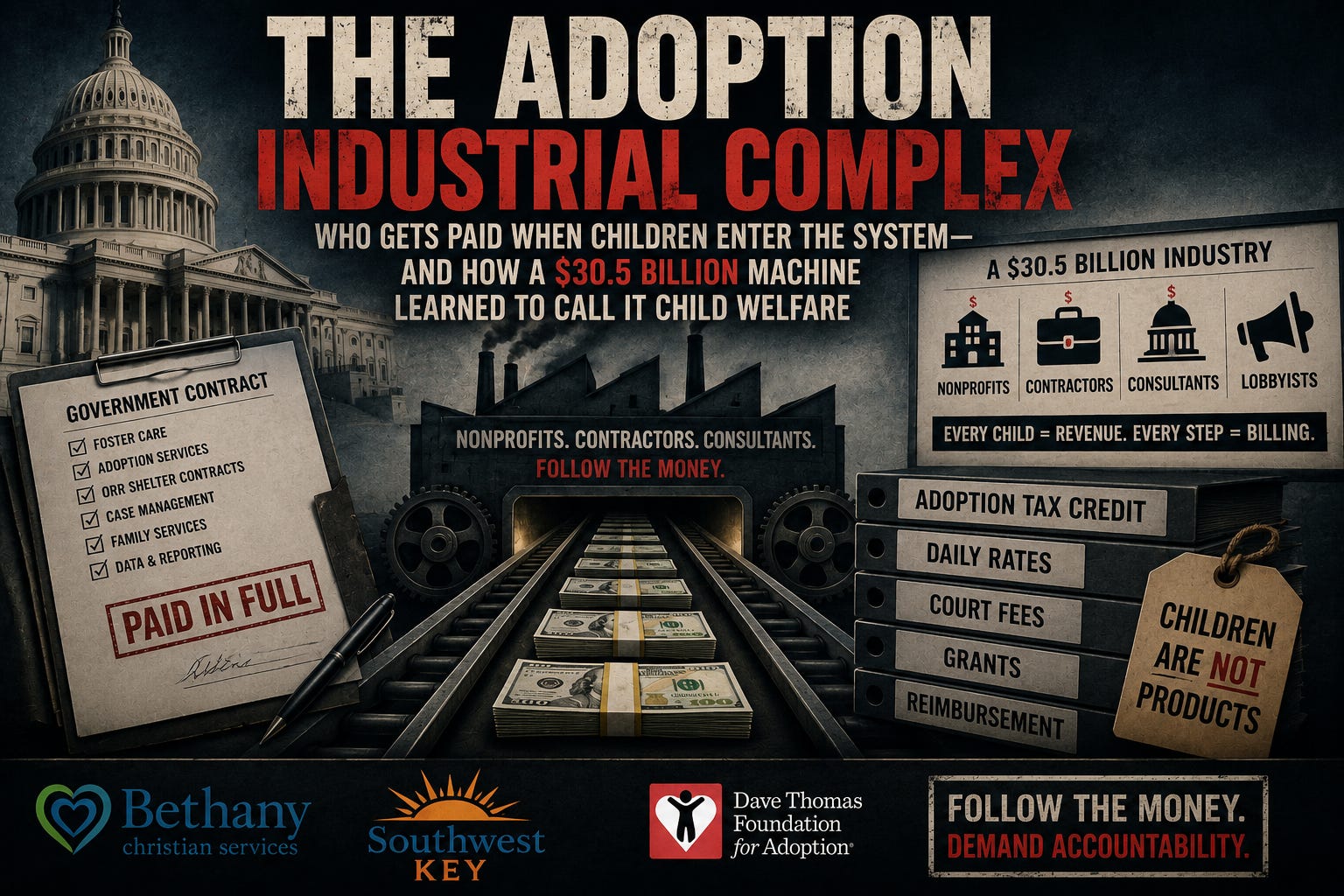
Who Gets Paid When Children Enter the System — and How a $30.5 Billion Machine Learned to Call It Child Welfare

By Project Milk Carton Investigations
There is a moment in every child welfare case when the public story and the financial story begin to separate. The public story is simple, emotional, and almost impossible to oppose: a child is unsafe, the state intervenes, professionals gather, courts supervise, services are ordered, and everyone claims to be working toward safety and permanency. The words are comforting because they sound moral. Protection. Permanency. Best interests. Stability. Adoption. Family.
But underneath that public language is another story, written not in press releases or courtroom speeches, but in contracts, reimbursement schedules, tax credits, grant awards, court-ordered service fees, residential placement rates, adoption agency payments, lobbying coalitions, and nonprofit executive compensation. That second story is harder to see, but once you see it, the entire system looks different.
From the moment a child enters state custody, a sprawling professional economy can begin billing around that child. Investigators, caseworkers, supervisors, government attorneys, parent attorneys, guardian’s ad litem, CASA program staff, judges, therapists, evaluators, drug testing companies, visitation supervisors, parenting class providers, foster care agencies, residential contractors, adoption agencies, court reporters, and interstate placement officials can all become financially attached to the life of one child. Every hearing, delay, evaluation, failed service plan, placement change, and administrative review can extend the period during which the system is funded.
This is not an accident. It is an economy. And according to the research assembled for this investigation, the combined federal, state, local, nonprofit, contractor, adoption, and residential child welfare ecosystem exceeds $30.5 billion annually. When broader child welfare spending is counted, the total rises above $34 billion per year. The deeper one follows the money, the harder it becomes to maintain the comforting fiction that the system is only a safety net. It is also a market, a contracting apparatus, a lobbying network, and in some sectors, a private equity opportunity.
This article is not arguing that every foster parent, caseworker, attorney, therapist, or nonprofit worker is corrupt. Many people inside this system are exhausted, underpaid, sincere, and trying to protect children in impossible conditions. But systems are not judged by the intentions of their best employees. They are judged by their incentives, their outcomes, and the financial architecture they create. And the architecture of modern child welfare has created something deeply dangerous: a system where child removal generates revenue, longer cases generate billable activity, more restrictive placements generate higher payments, adoption creates tax benefits and incentive payments, and lobbying organizations protect the structure that keeps the money moving.
The adoption industrial complex is not a metaphor. It is a network of government-funded nonprofits, private contractors, religious agencies, residential operators, court-service vendors, tax-credit advocates, private equity-owned care providers, and lobbying organizations that profit from, administer, or politically defend the movement of children through state custody and adoption pipelines. Some parts of this network operate openly as public contractors. Some operate as charities. Some operate as religious ministries. Some operate as policy nonprofits. Some operate as Wall Street-backed care companies. But all of them exist in the same ecosystem: children enter, money flows, and the public is told the system is acting in the child’s best interests.
The first two articles in this series documented how federal law created the foster care ratchet: how ASFA accelerated termination of parental rights, how adoption incentives rewarded states for finalized adoptions, and how QRTP and congregate care systems preserved institutional placement pipelines under new labels. This third investigation follows the next question: who gets paid?
The answer is not one agency. It is an empire.
The Federal Contract Empire
To understand the modern adoption industrial complex, start with the federal contract pipeline. One of the largest and most revealing players is Bethany Christian Services, widely recognized as one of the nation’s largest Christian adoption and child welfare agencies. Bethany has long presented itself through the language of faith, compassion, family, refugee assistance, foster care, adoption, and child protection. But the financial record shows something else as well: a large government contractor deeply embedded in federally funded child welfare and refugee child services.
The CivicOps TAGGS analysis cited in the research brief verifies more than $436 million in federal contracts across Bethany-related entities. Bethany Christian Services USA LLC received approximately $167.4 million in federal contracts between 2021 and 2023. A renamed or related Bethany Christian Services USA, LLC entity received approximately $185.3 million between 2023 and 2025. Across all Bethany entities, the total exceeds $436 million. Bethany also reportedly received a $49.5 million internal grant from Lutheran Immigration and Refugee Service through IRS Form 990 Schedule I reporting.
Much of this funding connects to the Office of Refugee Resettlement’s Unaccompanied Children Program, including shelter services, long-term foster care, home studies, and related child placement functions. Bethany’s role during the Trump administration’s Zero Tolerance family separation crisis is especially important to frame accurately. The research brief confirms that in 2018, Bethany had 81 migrant children separated under Zero Tolerance placed in its foster homes. Bethany was a receiving contractor; the agency did not initiate the federal separations. But the larger point remains: when the federal government separates children from parents, a contractor ecosystem is waiting to receive, place, supervise, and bill around those children.
Bethany’s controversies reveal how blurred the lines can become between charity, faith, contract dependency, and state power. Reporting cited in the research brief documented allegations involving coercive adoption practices, including a Rewire News investigation describing Bethany’s use of geofenced advertising around Planned Parenthood clinics, where women inside clinics could be targeted with adoption-related ads on their smartphones. The Nation and Kathryn Joyce’s work on Christian adoption agencies have also documented broader patterns of pressure and coercion affecting pregnant women, birth mothers, and adoption decision-making.
The Michigan contract dispute involving Bethany adds another layer. The research brief clarifies that the widely cited 305.72 percent higher cost figure involved Bethany’s refugee resettlement program, not foster care placements. That distinction matters. Accuracy is critical. But the finding still belongs in this investigation because it reveals something about agency cost structure and performance under government contracting. According to federal court filings cited in the brief, Bethany provided far fewer services while charging dramatically more per client than a competitor. The state denied contract renewal based on performance and Bethany’s requirement that employees affirm a Christian statement of faith. Under a court-ordered preliminary injunction, the performance comparison became part of the public record.
The point is not that Bethany is uniquely responsible for the system. The point is that Bethany illustrates how large child welfare nonprofits can operate as moral brands and federal contractors simultaneously. The public sees mission language. The database shows government money. The controversy record shows coercion allegations, performance disputes, and involvement in federally created separation crises. That is the adoption industrial complex in miniature: charity branding on top, state-funded machinery underneath.
Southwest Key and the Billion-Dollar Abuse Machine
If Bethany shows the faith-based contractor model, Southwest Key Programs shows the federal contract machine at its most staggering scale. The research brief describes Southwest Key as one of the most explosive findings in the Article 3 dataset, and for good reason. It dwarfs most other child welfare contractors in annual federal revenue, while abuse allegations and audit findings accumulated for years.
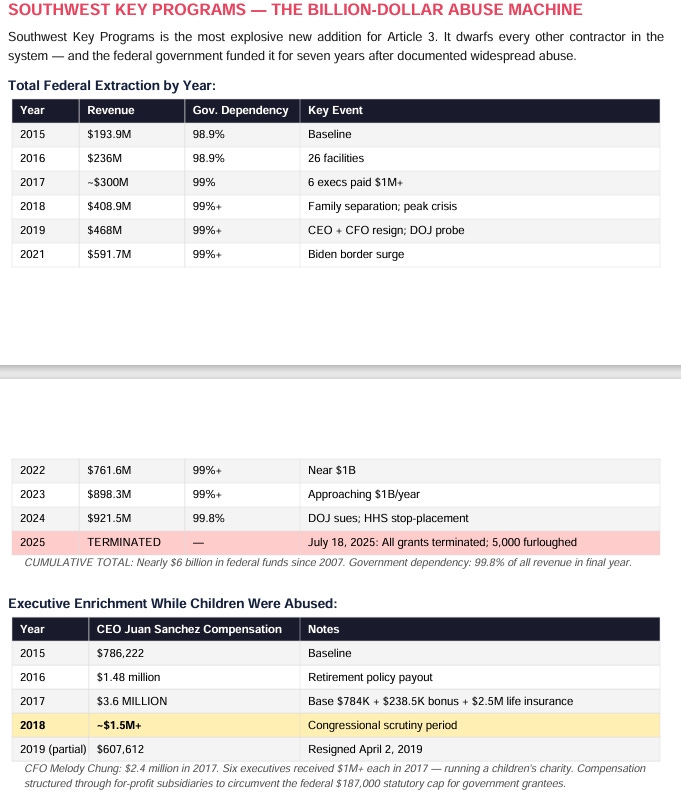
Southwest Key’s revenue trajectory reads like the growth chart of a government-created industry. In 2015, the organization reported roughly $193.9 million in revenue, with 98.9 percent tied to government sources. By 2018, during the family separation crisis, revenue reached approximately $408.9 million. By 2021, it had grown to $591.7 million. In 2022, $761.6 million. In 2023, $898.3 million. In 2024, $921.5 million, with 99.8 percent government dependency. The cumulative total approached nearly $6 billion in federal funds since 2007.
This was not a small charity operating on donations. This was a federally dependent child detention and care contractor operating at enormous scale. Its facilities became part of the infrastructure through which the federal government housed unaccompanied migrant children. Casa Padre in Brownsville, Texas, a converted Walmart Supercenter, housed approximately 1,500 boys ages ten to seventeen. The image alone should haunt the public: children sleeping inside a converted big-box retail space while federal dollars flowed by the hundreds of millions.
The executive compensation record makes the story even more disturbing. Southwest Key CEO Juan Sanchez reportedly received $786,222 in 2015, $1.48 million in 2016, and $3.6 million in 2017. CFO Melody Chung reportedly received $2.4 million in 2017. Six executives received more than $1 million each that year while running a children’s nonprofit funded almost entirely by the government. The research brief notes that compensation was structured through for-profit subsidiaries in ways that helped circumvent federal compensation caps for government grantees.
Then came the audits and abuse findings. HHS OIG identified $13.1 million in unallowable costs, weaknesses in internal controls, conflict-of-interest transactions requiring disclosure, and failures to protect personally identifiable information of children in care. An audit found that 8,323 children — 38 percent of those released to sponsors during the audit period — were improperly documented. These are not paperwork foot faults. These are failures involving children, custody, identity, placement, and federal funds.
In July 2024, the Department of Justice sued Southwest Key over more than 100 alleged incidents of sexual abuse or harassment spanning 2015 through 2023. The allegations crossed multiple presidential administrations, making it impossible to reduce the problem to one party or one border policy. According to the research brief, the lawsuit described abuse and harassment across years of government-funded care. Although the DOJ case was later dropped in March 2025 under the Trump administration, HHS terminated all Southwest Key grants on July 18, 2025, and thousands of workers were furloughed.
The self-dealing allegations add one more window into the financial architecture. The research brief describes a structure in which CEO Sanchez was part-owner of an LLC that owned a facility Southwest Key leased, allegedly undisclosed on IRS filings. Real estate developers connected to Southwest Key reportedly earned more than $28 million on properties that cost $16 million, with loans facilitated by the company. A related charter school network, Promesa Schools, paid rent and management fees back into Southwest Key entities.
This is what happens when child custody becomes a federal contract stream. The child becomes the justification. The facility becomes the asset. The nonprofit becomes the contractor. The executives become millionaires. The government keeps paying. Abuse allegations accumulate. Auditors find millions in problems. And the system continues for years because the government still needs somewhere to put the children.
Private Equity Invades Child Welfare
The most explosive finding in the research brief may be the degree to which private equity has entered child welfare and adjacent youth care sectors. Foster care, residential treatment, disability services, autism services, and troubled teen programs increasingly overlap with investment strategies built around government-guaranteed revenue. When Medicaid, state contracts, and federal child welfare dollars fund the care of vulnerable children, those children become part of a revenue stream attractive to investors seeking stable returns.
The Mentor Network, later associated with Sevita, is one of the most important examples. Owned by Centerbridge Partners and the Vistria Group, Mentor became one of the largest for-profit foster care companies in America. A bipartisan Senate Finance Committee investigation in 2015 found that at least 86 children died in Mentor’s care between 2005 and 2014. The child death rate was reportedly 42 percent higher than the national average, despite company claims that its rate was in line with national figures. At the same time, private equity owners collected nearly $500 million in debt-funded dividends over two years while saddling the company with debt.
That fact should stop every reader cold. Children died in care while investors extracted nearly half a billion dollars through debt-funded dividends. This is the brutal logic of financialized care. Debt is loaded onto the company. Investors extract value. Operators face pressure to manage costs. Staffing, maintenance, oversight, and care quality become vulnerable to margin pressure. The children have no market power, no exit rights, and often no effective voice.
Sequel Youth & Family Services provides another case study. Owned by Altamont Capital Partners, Sequel operated residential treatment facilities across the country and reportedly drew about 90 percent of its approximately $200 million annual revenue from government programs. After Altamont acquired a majority stake in 2017, financial maneuvers generated $94 million for shareholders through debt loading. Meanwhile, Sequel facilities became notorious for abuse allegations, riots, broken bones, sexual assaults, and dangerous conditions across multiple states.
The death of sixteen-year-old Cornelius Frederick at Lakeside Academy in Kalamazoo, Michigan, became the defining case. Staff restrained him after he threw a sandwich. He died after being smothered by employees. Michigan revoked the facility’s license. Sequel later closed most operations under regulatory pressure, but not before shareholders had extracted major value from the system.
BrightSpring Health Services, formerly ResCare, shows the broader reach of private equity into human services. KKR acquired the company in a $1.3 billion transaction in 2019. BrightSpring operated hundreds of residential facilities and employed tens of thousands of workers. Investigations cited in the research brief described nurses quitting, residents left in soiled clothes, deaths, and state restrictions on new admissions. West Virginia reportedly found a statewide pattern of increased serious deficiencies within three months of KKR’s acquisition. BrightSpring later went public at a multibillion-dollar valuation, allowing KKR to exit while foster care-related subsidiary operations continued.
Caliburn International, owned by DC Capital Partners, operated through subsidiary Comprehensive Health Services, which ran the Homestead influx facility — the only for-profit migrant youth detention facility in the United States. HHS contracts totaled more than $545 million. Congressional testimony described costs of roughly $1 million per day while operational and $720,000 per day even when empty. Former White House Chief of Staff John Kelly joined Caliburn’s board while contracts were being awarded, prompting House Oversight scrutiny. The company later split into Acuity International and Valiance Humanitarian, with continuing ORR-related work.
Aspen Education Group, acquired by Bain Capital for roughly $300 million in 2006, operated residential treatment centers and therapeutic boarding schools. Abuse allegations predated acquisition, but the research brief notes six deaths after Bain’s acquisition and later federal litigation accusing an Aspen facility of severe abuse, false imprisonment, and related misconduct.
The Private Equity Stakeholder Project’s report, “The Kids Are Not Alright,” documents the broader pattern: private equity investment across for-profit foster care, residential treatment centers, youth disability services, and autism services. These sectors share a common feature that investors love and children fear: government-guaranteed revenue attached to vulnerable populations with limited power to complain, exit, or choose alternatives.
Private equity does not need to invent child welfare dysfunction. It only needs to monetize it.
The Lobbying Machine That Protects the System
No industrial complex survives without political protection. The adoption and child welfare ecosystem has spent decades building relationships inside Congress, shaping policy language, mobilizing moral narratives, and protecting the financial structures that sustain the industry. The lobbying network operates through adoption advocacy organizations, congressional caucuses, faith-based coalitions, tax credit campaigns, and policy nonprofits that present themselves as child-centered while often advancing the interests of agencies, contractors, and adoption markets.
The Congressional Coalition on Adoption Institute, or CCAI, is central to this network. Founded in 2001, CCAI is affiliated with the Congressional Coalition on Adoption, one of the largest bipartisan, bicameral caucuses in Congress, with 138 members identified in the research brief. Its leadership and board connections reveal a classic Washington structure: former senators, lobbying firm leaders, insurance industry executives, and politically connected advocates positioned around adoption policy.
CCAI’s Angels in Adoption program is a remarkably effective relationship-building machine. Nominees travel to Washington, meet personally with members of Congress, and are celebrated through an annual gala. This creates face-to-face relationships between adoption advocates and congressional offices across the country. The program has run continuously since 1999, building twenty-five years of emotional, political, and constituent-based support for adoption-friendly policy.
The Foster Youth Internship Program places foster care alumni inside congressional offices as paid interns. On the surface, that sounds empowering, and for some youth it may be. But the policy effect also matters. Each year, interns produce federal child welfare policy reports and work directly within legislative environments. Over time, this normalizes certain permanency and adoption frames inside congressional staff culture. The system does not simply lobby from the outside. It trains voices from inside foster care to speak within congressional structures shaped by adoption policy institutions.
The National Council for Adoption, or NCFA, represents a different part of the machine. Founded in 1980, NCFA was created by the adoption industry for the adoption industry. According to the research brief, NCFA was founded specifically to defeat open adoption records legislation. One of its co-founders was Ruby Lee Piester, executive director of the Gladney Center for Adoption. A Gladney representative remained on the NCFA board in 2024, more than four decades later. The loop never closed.
NCFA’s membership model includes more than 100 adoption agencies with hundreds of offices across 45 states. Those agencies pay dues to an organization that then advocates for policies benefiting adoption agencies financially and politically. NCFA was a central nongovernmental voice shaping ASFA’s language and framing in 1997. Biological parents were not invited to testify at ASFA hearings in the way adoption agencies and adoptive parents were centered as policy partners. The result was a law shaped by the people who benefited from adoption acceleration, not by the families most likely to be destroyed by it.
The Christian Alliance for Orphans, or CAFO, adds the evangelical grassroots infrastructure. With more than 225 organizations and 850 member churches, CAFO provides constituent density in congressional districts nationwide. Its power lies in moral framing. Adoption becomes not merely policy, but ministry. Opposition becomes politically dangerous, especially for conservative lawmakers who do not want to appear anti-family, anti-adoption, or indifferent to orphans.
The 2017 adoption tax credit fight exposed the playbook. When the Tax Cuts and Jobs Act initially proposed eliminating the adoption tax credit, the adoption lobby mobilized rapidly. CCAI and the Adoption Tax Credit Working Group coordinated communications to House leadership. NCFA’s Chuck Johnson became a national media voice. CAFO’s church network mobilized online. Focus on the Family, National Right to Life, the U.S. Conference of Catholic Bishops, and the Ethics and Religious Liberty Commission joined publicly. Within weeks, House Republicans backed down. Eliminating the credit became politically radioactive.
The system had shown its muscle. And in 2025, it won again.
The Adoption Tax Credit and the Subsidized Customer Base
The adoption tax credit is often framed as support for loving families who want to adopt children. That framing is not entirely false. Adoption can be expensive, and many families do face financial barriers. But from an industry perspective, the tax credit does something else: it subsidizes the customer base of adoption agencies.
The current adoption tax credit value was $16,890 per child in 2024, indexed annually. Since 2012, the credit had been non-refundable, meaning the lowest-income families received little or no benefit because they lacked sufficient tax liability. Adoption advocates have long pushed to restore refundability. In 2025, that effort succeeded in part. The Adoption Tax Credit Refundability Act was folded into major federal legislation signed July 4, 2025, making up to $5,000 refundable for the first time since 2011.
The politics of this credit deserve scrutiny. The credit is presented as helping families. But in private domestic infant adoption, agency fees can range from $25,000 to nearly $60,000 per child. Gladney’s current all-inclusive domestic infant adoption fee is listed at $59,500. Bethany and other agencies also operate in a market where adoptive families pay significant fees. A tax credit that offsets those costs may help families, but it also makes agency pricing more sustainable by bringing federal subsidy into the transaction.
The research brief estimates that if the $16,890 credit were applied across 46,935 foster care adoptions in FY2024, the potential tax benefit could approach $793 million annually. That figure is not a direct agency payment, but it shows the scale of federal subsidy attached to adoption. In private adoption, the credit flows through adoptive families to make high agency fees more affordable. In foster care adoption, it supports the adoption pipeline as a public policy preference.
The adoption lobby understands this perfectly. The National Council for Adoption openly frames the credit as reducing financial barriers to adoption. But that is another way of saying the credit supports demand. It helps customers afford the service. In any other industry, we would recognize this as market subsidy. In adoption, it is wrapped in moral language.
The problem is not that adoptive families receive support. The problem is that the same federal system does not provide equivalent direct subsidy to birth families to prevent unnecessary separation. A poor parent may lose a child because they lack housing, transportation, childcare, or treatment. An adoptive family may later receive tax benefits to adopt that child. The financial asymmetry is grotesque. The government often refuses to give struggling families what they need to stay together, then subsidizes the transfer of the child into another family.
That is not child welfare. That is redistribution through family separation.
The Daily Rate Machine
Once a child enters care, placement type determines how much money flows. Family foster care is expensive. Treatment foster care is more expensive. Residential care is far more expensive. The rate structure creates one of the clearest financial incentives in the system: more restrictive placements often generate dramatically higher daily payments.
Texas provides a stark example. The research brief identifies Texas DFPS rates showing basic foster family care at approximately $83 per day, or about $2,500 per month. Mental health support care rises to $169 per day, or about $5,085 per month. Treatment foster care reaches $328 per day, or about $9,852 per month. The highest residential care rate reaches $669 per day, or roughly $20,000 per month.
The difference is enormous. A child in high-level residential care can generate roughly eight times the daily rate of a basic foster family placement. In California, the difference between low-level family foster care and short-term residential therapeutic programs can be even wider. Florida’s group home costs have been estimated at many multiples of family foster care rates. Nationally, congregate placements often cost three to five times more than family-based placements, and in some state comparisons the difference is even greater.
The public is usually told these higher rates reflect greater need. Sometimes they do. Children with severe trauma, disabilities, behavioral crises, or complex medical needs may require more intensive support. But rate structures create incentives that must be monitored aggressively. When higher acuity means higher reimbursement, systems can drift toward classifying children as needing more intensive care. When residential providers earn more from higher-level placements, they have every reason to preserve that placement infrastructure. When state agencies lack family-based alternatives, expensive residential care becomes the default solution.
Texas also illustrates the privatization trap. The state allocated $91.9 million in its 2023 legislative session for Community-Based Care privatization expansion, and contractors quickly reported cost overruns. Independent studies had already predicted increased system costs. As of September 2024, performance reportedly declined across multiple metrics in parts of the Texas rollout. Privatization was sold as efficiency. The evidence suggests it can become cost expansion under contractor control.
Florida offers another warning. Fully privatized since the early 2000s, Florida’s child welfare system costs billions annually, with no confirmed per-child cost reduction compared with pre-privatization. Privatization does not remove the state from responsibility. It inserts contractors between the state and the child, often making accountability harder while preserving public funding.
The daily rate machine reveals the economic gravity of foster care. A child placed in basic family care generates one level of money. A child classified as treatment-level generates more. A child moved into residential care generates far more. The system claims these decisions are clinical. But when placement decisions carry enormous financial consequences, the public has a right to demand independent oversight.
The Court Fee Ecosystem
Child welfare cases do not only generate placement payments. They generate court activity, service referrals, evaluations, drug tests, supervised visits, therapeutic sessions, and compliance monitoring. The research brief identifies at least twenty-three paid professionals or service categories that can attach to a single dependency case from intake to permanency.
A CPS investigator opens the case. An ongoing caseworker manages it. A supervisor oversees the file. A government attorney prosecutes the dependency petition. A parent attorney defends the parent, often through state funding or related reimbursement. A guardian ad litem or attorney represents the child’s best interests. CASA program staff coordinate volunteers. A judge presides over hearings. Psychologists or psychiatrists perform custody evaluations that can cost $8,000 to $20,000. Substance abuse evaluators issue recommendations. Drug testing companies bill per test. Parenting class providers bill per session. Anger management providers bill per session. Domestic violence programs may run for fifty-two weeks. Therapists bill for parent, child, and family sessions. Supervised visitation providers bill per visit. Foster parents receive maintenance payments. Private agency caseworkers bill when contracted agencies are involved. ICPC coordinators handle interstate placements. Court reporters document proceedings.
Every delay extends the billing environment. Every continued hearing means more professional time. Every service requirement creates a provider. Every contested issue can generate evaluation, testing, therapy, monitoring, or review. Again, this does not mean every service is unnecessary. Some are essential. But a system with this many paid actors cannot be evaluated only through moral language. It must be evaluated as an economy.
Drug testing fraud shows how dangerous this economy can become. The research brief cites Averhealth, a private equity-backed company with a Michigan child welfare contract worth $27 million. ProPublica reporting and legal findings described serious concerns, including incorrect results and false positives. An estimated 2,885 children may have had parents with incorrect positive results. Averhealth later paid a False Claims Act settlement. Cordant Health Solutions, another testing provider, paid nearly $12 million to resolve Anti-Kickback allegations involving referrals of urine drug tests billed to federal programs.
False positives in a child welfare case are not ordinary errors. They can keep children in foster care. They can cause parents to lose visits. They can support claims of noncompliance. They can move a case closer to termination. A bad drug test can become a turn of the ASFA ratchet. When testing companies profit from volume, and faulty results extend cases, the financial and legal consequences are catastrophic.
The Interstate Compact on the Placement of Children, or ICPC, creates another delay machine. The research brief notes that parent home studies can average more than 68 days, with no statutory deadlines in the compact. Many studies exceed 30 or 60 days. During every delay, the child remains in foster care and the case remains active. Maintenance payments continue. Professionals remain attached. The bureaucracy itself becomes a reason children stay in care longer.
Los Angeles County adds a local example of how court-ordered services can punish poverty. According to the research brief, it is the only California county where parents must personally pay for all court-ordered programs regardless of income. Of 100 providers on the referral list, only 13 had no-cost options and only 21 accepted Medi-Cal. Parents can be ordered into services they cannot afford, then penalized for failing to complete them. That failure extends the reunification timeline, extends foster care, and extends the billing ecosystem around the case.
This is the court-service economy at its most perverse: poverty creates the case, unaffordable services extend the case, extended cases generate more billing, and noncompliance can become the legal basis for permanent family destruction.
Gladney and the Private Adoption Market
The Gladney Center for Adoption occupies a special place in this investigation because it connects private adoption fees, custody controversies, and the founding of the national adoption lobby. Gladney’s current all-inclusive domestic infant adoption fee is listed at $59,500. Foster care adoptions through Gladney may carry no fee because the state subsidizes those placements, but private infant adoption remains a high-cost market.
Texas law has long been criticized for structurally favoring agencies and adoptive parents after consent is signed. Reporting cited in the research brief describes custody battles, allegations involving falsified documents, and cases in which birth mothers fought to regain children after quickly revoking consent. One case involving Barbara Landry became nationally visible through the Phil Donahue Show. A class action sought to release birth records from thousands of adoptions dating to the mid-1970s.
The point is not to litigate every individual Gladney case here. The point is to understand the adoption market’s structural incentives. In private infant adoption, agencies are paid by adoptive parents. Babies are scarce. Demand is high. Fees are large. Birth mothers are often poor, young, isolated, or under pressure. Adoption agencies may present themselves as neutral counselors, but their financial model depends on completed adoptions. That creates a conflict of interest that should be obvious.
Gladney’s connection to the National Council for Adoption is even more significant. Ruby Lee Piester, Gladney’s executive director, co-founded NCFA in 1980 specifically to fight open adoption records legislation. More than four decades later, a Gladney representative remained on NCFA’s board. That continuity matters. It means one of the adoption industry’s major private agencies helped build the national lobbying infrastructure that still shapes adoption policy today.
The adoption lobby did not emerge organically from adoptive families alone. It was built by agencies with direct financial stakes in adoption law, records access, tax credits, international adoption policy, and the regulatory environment governing the industry. When those same networks help shape federal legislation, protect tax credits, and influence congressional caucuses, the public should understand whose interests are being represented.
Private adoption and foster care adoption are not identical systems, but they overlap through policy, lobbying, ideology, tax benefits, agency networks, and public narratives. The same moral language — saving children, building families, rescuing orphans — can obscure very different financial realities. In one context, agencies charge tens of thousands of dollars. In another, states receive adoption incentives. In another, federal tax credits help offset costs. Across all contexts, the adoption industry benefits when adoption is framed as an unquestioned good rather than a market requiring scrutiny.
The Orphan Industrial Complex
Academic researchers have long warned that adoption and orphan care systems can create the very supply they claim to rescue. The phrase “orphan industrial complex” describes a global and domestic pattern in which Western demand for adoption, charity, rescue, and child-saving narratives generates financial incentives to separate children from families. The research brief cites Cheney and Ucembe’s work on the orphan industrial complex, Kathryn Joyce’s investigation in The Child Catchers, E.J. Graff’s “The Lie We Love,” and reporting on America’s private adoption industry.
The central insight is simple but devastating: when money, morality, and child placement combine, systems can begin producing adoptable children rather than merely serving children who truly have no family. Globally, researchers have documented that many children in orphanages are not true orphans. They have parents or relatives, but poverty, crisis, stigma, disability, or institutional recruitment separated them from family. Charitable demand for “orphans” can create orphanhood.
The American system has its own version. Poverty is treated as neglect. Families are surveilled through schools, hospitals, welfare offices, courts, and mandated reporting systems. Children enter foster care. Federal timelines push cases toward termination. Adoption incentives reward states for finalized adoptions. Tax credits subsidize adoptive families. Agencies and contractors administer the process. Lobbying organizations protect the policy frame. The system claims it is responding to children without families, but in many cases it helps create the legal conditions that make children familyless.
This is not an attack on adoptive families who love their children. It is an indictment of systems that create adoption demand while underfunding family preservation. A child who truly needs adoption deserves a safe and loving home. But a child whose family could have remained intact with housing, childcare, addiction treatment, disability support, or temporary financial assistance should not be converted into an adoption case because the system funds separation more readily than support.
The orphan industrial complex survives because it uses emotionally powerful language. No politician wants to sound anti-adoption. No church wants to sound anti-orphan. No agency wants to admit financial conflict. No contractor wants to describe children as revenue. But the financial documents tell the story anyway. Billions in contracts. Millions in executive pay. Hundreds of millions in tax benefits. Tens of thousands in private adoption fees. Residential rates exceeding $20,000 per month. Court services billing through every delay.
The question is not whether children need homes. The question is why so many systems are paid after children lose them.
The Complete Financial Pipeline
The full child welfare financial pipeline begins at the federal level, where more than $34 billion in combined federal, state, and local child welfare spending supports the system each year. Title IV-E maintenance payments historically rewarded foster care placement more directly than family preservation. Adoption incentive payments have paid states hundreds of millions since ASFA. Adoption tax credits create potentially massive subsidies for adoptive families, which in private adoption can flow indirectly to agencies through fees. ORR unaccompanied children contracts have sent billions to providers such as Southwest Key, Bethany, BCFS, and Caliburn-related entities.
At the state level, the money moves into agencies, contractors, foster care maintenance payments, residential placements, treatment providers, and privatized lead agencies. Children in family foster care generate one payment level. Children in treatment foster care generate higher rates. Children in residential care can generate many times more. Contractors managing privatized systems can receive large allocations and then report cost overruns when reality exceeds budget projections.
At the court level, service ecosystems emerge around each family. Drug testing companies bill for tests. Parenting programs bill per session. Therapists bill for treatment. Psychologists bill for evaluations. Supervised visitation providers bill for visits. Attorneys bill through public systems or contracts. CASA organizations receive grants and staff funding. ICPC delays extend foster care duration. Each week of delay can sustain more billing.
At the adoption level, agencies may receive fees, states may receive incentives, families may receive tax credits, and post-adoption subsidies may continue. Private infant adoption can cost tens of thousands of dollars. Foster care adoption may be presented as free to families, but public systems absorb the cost through state and federal funding. Adoption is never financially neutral. Someone pays, someone receives, and someone’s family status changes permanently.
At the lobbying level, organizations such as CCAI, NCFA, CAFO, the Adoption Tax Credit Working Group, and agency membership networks protect and expand the system. They influence Congress, mobilize churches, frame adoption as moral consensus, defend tax credits, shape legislation, and normalize adoption-centered permanency policy. The industry does not merely receive policy. It helps write and defend policy.
The structural perversity is clear. Removal is funded more reliably than prevention. Longer cases sustain more professionals. Residential placements generate higher rates than family care. Private equity ownership creates pressure to extract returns from government-funded care. Court-mandated services can be ordered without affordability or quality safeguards. Drug testing errors can extend cases and destroy families. Lobbying networks protect tax credits and incentive structures. The system is not designed to self-correct because too many actors benefit from its continuation.
A machine this large does not stop because a report exposes it. It stops only when the public understands the financial architecture and demands a different one.
Conclusion: Follow the Money, Find the Machine
The adoption industrial complex survives because it hides behind moral language. It tells the public this is about safety, rescue, permanency, and family. Sometimes it is. But the financial record shows another reality: a vast child welfare economy in which government contractors, nonprofits, private agencies, residential operators, court-service vendors, drug testing companies, private equity firms, and lobbying organizations are paid because children enter and remain inside systems of state custody.
Bethany Christian Services shows how faith-based child welfare agencies can become massive federal contractors. Southwest Key shows how a government-dependent nonprofit can approach nearly $1 billion a year while abuse allegations and audit findings accumulate. Private equity-backed companies such as Mentor, Sequel, BrightSpring, Caliburn, and Aspen show how investors discovered profit opportunities in vulnerable youth care. Adoption lobbying networks show how Congress is cultivated through caucuses, galas, internships, church mobilization, and tax credit campaigns. The daily rate machine shows how children placed in more restrictive settings can generate dramatically higher payments. The court-service ecosystem shows how every delay can become another billing event.
This is not a system that can be fixed through slogans. It cannot be repaired by calling every contractor a partner, every adoption a miracle, every foster placement a rescue, and every court order a service plan. The public must demand that child welfare be evaluated not by what it says, but by who gets paid, how much they get paid, what outcomes they produce, and whether children and families are actually safer after intervention.
The most dangerous myth in child welfare is that money is secondary. It is not. Money determines which services exist, which placements are available, which contractors expand, which lobbying coalitions win, which families receive support, and which children become part of the pipeline. If the system pays more reliably after removal than before removal, more children will be removed. If residential care pays far more than family support, residential care will grow. If adoption generates incentives while reunification does not, adoption will be politically protected. If private equity can extract dividends from care companies while children die, then vulnerable children have been converted into assets.
The public should reject the comforting fiction that child welfare is only a rescue system. It is also an industry. And industries protect their revenue.
Call to Action: Audit the Industry, Not Just the Parents
For decades, child welfare agencies have audited parents. They investigate homes, inspect refrigerators, drug test mothers, evaluate fathers, monitor visits, review service plans, and document every missed appointment. It is time to apply the same scrutiny to the industry built around those families.
Every state should be required to publish a full child welfare money map showing federal funds, state funds, contractor payments, residential placement rates, adoption incentive receipts, agency subcontractors, court-ordered service vendors, executive compensation, private equity ownership, and lobbying relationships. Every contractor receiving public money to care for children should disclose abuse findings, deaths, lawsuits, settlements, related-party transactions, executive compensation, and political advocacy spending. Every adoption agency receiving public funds or tax-subsidized customer payments should disclose fees, outcomes, disrupted adoptions, birth parent complaints, and lobbying memberships.
Congress should require a national audit of adoption incentive payments, the adoption tax credit, ORR child welfare contractors, residential placement providers, and private equity ownership in foster care and youth treatment systems. States should be required to compare what they spend removing children with what it would have cost to stabilize families through housing, treatment, childcare, transportation, and direct financial support. Courts should be prohibited from ordering parents into paid services that are unavailable, unaffordable, or unsupported by evidence.
If a parent can lose a child for missing services, a contractor should lose funding for failing children. If a parent can be judged unfit for instability, an agency should be judged unfit for abuse, fraud, self-dealing, or repeated failure. If families are forced to prove they deserve their children, the industry should be forced to prove it deserves the money.
This investigation is only beginning. The next phase will follow individual contractors, state by state, dollar by dollar, facility by facility, and case by case. Because once the financial machine is visible, the public can no longer be told this is only about child protection.
It is about power.
It is about money.
And it is about children whose lives became the raw material of an industry that learned to call itself care.
If you enjoyed this work and feel encouraged by independent investigations like this, please consider becoming a paid subscriber to The Constitutional Republic on Substack.
Your support helps us continue:
investigative reporting
public records research
educational transparency projects
community outreach
and future investigations like this series
Most importantly, please share this article.
Independent journalism survives when ordinary people help spread information powerful institutions would prefer remain ignored, misunderstood, or buried beneath complexity.
Because silence protects systems.
Informed communities protect children.
ALL paid subscriptions are tax deductible Project Milk Carton | 501(c)(3) | EIN: 33-1323547
PRIMARY SOURCES
• AFCARS FY2024 Dashboard — ACF/HHS: acf.gov/sites/default/files/documents/cb/2024-afcars-dashboard-printable.pdf
• HHS OIG: Southwest Key — Failed to Protect Federal Funds: oig.hhs.gov/oas/reports/region6/61707004.asp
• HHS OIG: Southwest Key — Health and Safety Requirements: oig.hhs.gov/reports/all/2019/southwest-key...
• DOJ: Justice Department Sues Southwest Key for Sexual Abuse (July 2024): justice.gov/archives/opa/pr/...
• Texas Tribune: Six SW Key officials earned $1M+ in 2017: texastribune.org/2019/07/16/...
• ProPublica Nonprofit Explorer — Southwest Key: projects.propublica.org/nonprofits/organizations/742481167
• TIME: 'Nonprofit to Be Paid $458 Million to Detain Migrant Children': time.com/5316722/...
• Senate Finance Committee: Mentor Network probe (2015): finance.senate.gov/chairmans-news/...
• BuzzFeed News: 86 children died at Mentor Network: buzzfeednews.com/article/aramroston/...
• BuzzFeed News: KKR/BrightSpring disability group home abuse: buzzfeednews.com/article/kendalltaggart/...
• NBC News: Sequel Youth 'profitable death trap': nbcnews.com/news/us-news/profitable-death-trap-sequel...
• APM Reports: Sequel facilities abuse (40+ states): apmreports.org/story/2020/09/28/...
• PESP Report: 'The Kids Are Not Alright': pestakeholder.org/reports/the-kids-are-not-alright/
• ProPublica: Averhealth drug testing fraud: propublica.org/article/averhealth-drug-testing-child-welfare-michigan
• DOJ: Averhealth False Claims Act settlement: justice.gov/usao-edmi/pr/averhealth-pay-over-13-million...
• DOJ: Cordant Health Solutions settlement: justice.gov/opa/pr/cordant-health-solutions...
• CCAI 990s: projects.propublica.org/nonprofits/organizations/542035617
• NCFA FY23 990: adoptioncouncil.org/wp-content/uploads/2024/07/NCFA-FY23-990-Public-Disclosure-Copy.pdf
• CAFO 990s: projects.propublica.org/nonprofits/organizations/261492375
• S.1458 full text: congress.gov/bill/119th-congress/senate-bill/1458/text
• Bethany v. Corbin: Justia docket #1:2024cv00922, WDMI
• WZZM13: 81 children — Bethany foster homes (June 23, 2018)
• Rewire News: Bethany coercive adoptions investigation (2018)
• Texas Observer: 'The Adoption Trap' — private adoption custody battles
• Gladney Center adoption fees: adoptionsbygladney.com/resources/adoption-finances
• CDSS Foster Care Rate Setting: cdss.ca.gov/inforesources/foster-care/...
• Ohio IV-E Ceilings FY2023-24: dam.assets.ohio.gov/.../IVECeilings2324.pdf
• Florida Children's Network 2025 Payment Rates: childrensnetworkflorida.org/...
• OCFS NY Foster Boarding Home Rates: ocfs.ny.gov/main/rates/fostercare/boarding.php
• ABA Child Law Practice: ICPC delays (2014): americanbar.org/groups/public_interest/child_law/...
• LA County DCFS: Court-ordered program affordability: dcfs.lacounty.gov/...
• ASPE/HHS: Federal foster care financing structural failures: aspe.hhs.gov/reports/federal-foster-care-financing...
• Kathryn Joyce: The Child Catchers (PublicAffairs, 2013)
• E.J. Graff: 'The Lie We Love' (Foreign Policy, 2008)
• Cheney & Ucembe: 'The Orphan Industrial Complex' (Springer, 2019)
• NCCPR Issue Paper 14: Family Preservation and Adoption: nccpr.org/nccpr-issue-paper-14...
• CNBC: How parents of adopted children foiled tax proposal (Dec 1, 2017)
• TIME: 'Baby Brokers: Inside America's Murky Private-Adoption Industry' (June 2021)
• In These Times: 'The Adoption-Industrial Complex' (Aug 18, 2020)
• Brandeis Schuster Institute: Adoption investigation: brandeis.edu/investigate/adoption/
• Father's Advocacy Network: Real cost of foster care per child: fathersadvocacynetwork.com/blog/real-cost-of-foster-care-per-child
• Florida OPPAGA Group Home Cost Study (Jan 2015)
• Casey Family Programs: Group placement impacts: casey.org/group-placement-impacts/
• American Prospect: PE rollups targeting youth treatment centers (2022)
Project Milk Carton — ARIA Investigative Research | Generated May 18, 2026 | 501(c)(3) EIN: 33-1323547 | projectmilkcarton.org