
PART 4 — THE DISTRIBUTION NETWORK
How $190 Billion in COVID Money Became the Pipeline That Delivered SEL Into America’s Schools

By Project Milk Carton | The Constitutional Republic
In Part 1 of this investigation, we followed the organizations.
In Part 2, we uncovered the documented alignment between Second Step and SPLC’s Learning for Justice framework.
In Part 3, we followed the funding pipeline involving billionaire foundations, CASEL, donor-advised funds, and nonprofit influence networks.
Now we arrive at perhaps the biggest question of all:
How did these systems spread so fast into American schools?
Because millions of parents woke up after 2020 suddenly hearing terms like:
Social-Emotional Learning
equity frameworks
restorative practices
trauma-informed education
anti-bias curriculum
and identity-based instruction
And many families felt like these systems appeared overnight.
But they did not appear overnight.
They were accelerated by one of the largest government spending programs in American history.
COVID relief funding.
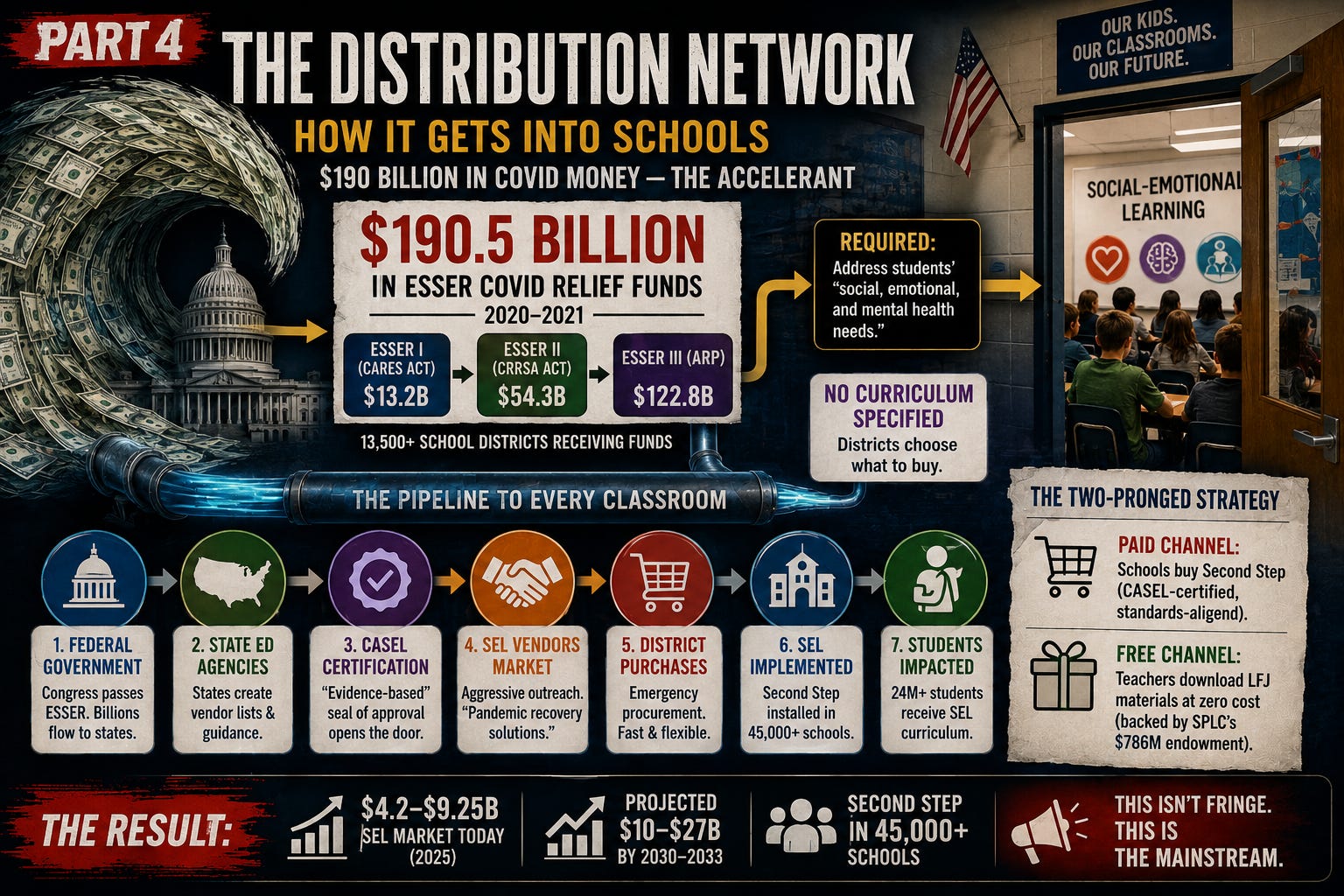
According to the investigation, between 2020 and 2021 Congress approved approximately:
$190.5 BILLION
in Elementary and Secondary School Emergency Relief funding — better known as ESSER funding.
That money was originally intended to help schools recover from the COVID-19 pandemic.
But according to this investigation, the structure of the funding created the single largest acceleration event in the history of the SEL industry.
And once the money arrived, the distribution network was already waiting.
The $190 Billion Accelerant
To understand what happened, we first need to understand what ESSER funding actually was.
During the COVID pandemic, schools across America shut down.
Students lost classroom instruction.
Districts faced massive operational problems.
Congress responded by passing three enormous emergency education funding bills between March 2020 and March 2021.
The three major allocations included:
ESSER I (CARES Act) → $13.2 billion
ESSER II (CRRSA Act) → $54.3 billion
ARP ESSER III → $122.8 billion
Total:
$190.5 billion.
That made ESSER the largest emergency education spending program in American history.
And according to the report, the most important part was not just the money.
It was the flexibility.
The Flexibility Loophole
Unlike many federal education programs, ESSER money came with extremely broad spending authority.
According to the report:
districts could spend ESSER funds on almost “any activity authorized” under a broad range of federal education statutes.
That created a massive opening.
Because schools suddenly had access to huge amounts of money with fewer restrictions than normal education funding.
The report describes this as:
“the largest single infusion of discretionary spending into American school districts in history.”
And when enormous amounts of money enter a system quickly, industries rush to position themselves to capture it.
That is exactly what happened with SEL vendors.
The “Social and Emotional Needs” Requirement
One of the most important details in the entire investigation appears inside ARP ESSER III — the largest funding package.
According to the report:
states and districts were required to spend portions of the money addressing students’:
“social, emotional, and mental health needs.”
Some states went even further.
The report notes that Pennsylvania required districts to spend:
30% of their allocation on social-emotional support programs.
Now think about what that meant.
Suddenly:
every district had federal money
districts were under pressure to spend it quickly
and SEL programs were already positioned as “solutions”
That created a nationwide gold rush.
A Market Created Overnight
The report describes this as:
“a $190 billion market overnight for SEL programs.”
And the timing mattered.
By 2020:
CASEL already existed as the certification authority
Second Step was already CASEL-certified
ASCA already aligned counselor systems
SPLC Learning for Justice materials already existed
districts already trusted CASEL endorsements
and vendors already had infrastructure in place
In other words:
the distribution network was already built before the money arrived.
ESSER funding simply poured fuel onto the system.
Why Schools Bought Second Step
This is one of the most important points in the entire article.
According to the report:
schools were not sitting around researching ideological frameworks or nonprofit influence networks.
They were trying to solve immediate pandemic-related problems:
student behavior
mental health concerns
absenteeism
classroom disruptions
emotional stress
academic recovery
District administrators saw:
federal money available
CASEL-certified programs
approved vendor lists
state guidance supporting SEL
and products already deployed nationwide
So they purchased what already looked “safe,” “approved,” and “evidence-based.”
That product was often:
Second Step.
According to the report:
Second Step was already:
CASEL-certified
aligned to state standards
deployed in tens of thousands of schools
and endorsed by counselor organizations like ASCA
The report argues:
“The system worked exactly as designed.”
Emergency Purchasing Changed Everything
Another major factor was emergency procurement authority.
Normally, school districts go through lengthy purchasing processes:
competitive bids
public review
vendor comparisons
budget hearings
school board approvals
But during COVID, many districts bypassed normal purchasing systems under emergency authority.
That accelerated spending dramatically.
The report states:
districts faced “spend it or lose it” deadlines
vendors marketed SEL as “pandemic recovery tools”
and procurement oversight weakened significantly
That created ideal conditions for rapid expansion.
The “Evidence-Based” Label
One phrase became incredibly important during ESSER spending:
“evidence-based.”
ARP ESSER III required billions in funding to be spent on:
“evidence-based interventions.”
And who controlled the most influential “evidence-based” certification system in SEL?
CASEL.
That gave CASEL enormous power.
Because once CASEL certified a curriculum as “SELect,” districts could justify using federal recovery money to purchase it.
The report estimates:
CASEL certified 27 programs by 2022
nearly all connected to the same vendor ecosystem documented throughout this series
This became the procurement gateway.
The Distribution Architecture
The report identifies five major “nodes” controlling the SEL distribution pipeline.
These include:
CASEL → Certification authority
Committee for Children → Largest curriculum producer
SPLC / Learning for Justice → Ideological framework layer
State Education Agencies → Distribution and vendor approval
Foundations → Financial backing
Together, these systems created what the report describes as:
“a self-reinforcing system.”
The foundations fund the certifiers.
The certifiers approve the vendors.
The vendors align with ideological frameworks.
State agencies promote the approved vendors.
Federal money funds the purchases.
And the cycle repeats.
Committee for Children — The Largest SEL Vendor
At the center of the commercial pipeline sits:
Committee for Children.
According to the report:
Committee for Children is:
the largest dedicated SEL curriculum vendor in America
deployed in roughly 26,000+ schools
operating in 70 countries
generating between $308–350 million annually
Its flagship product:
Second Step.
And according to the report:
ESSER funding became a major revenue driver between 2020–2024.
That means pandemic recovery money likely accelerated one of the largest educational product expansions in modern history.
The Nonprofit Advantage
One reason Committee for Children became so dominant is because it operates as a 501(c)(3) nonprofit organization.
That creates several advantages:
tax-exempt status
philanthropic grant eligibility
increased public trust
and less scrutiny than large for-profit vendors
The report argues this creates what it calls:
“the reputational halo of nonprofit mission.”
In simple terms:
districts often trust nonprofits more easily than corporations.
That trust matters when millions of dollars are moving quickly through emergency spending systems.
The Free Distribution Strategy
Now we arrive at one of the smartest parts of the network.
Second Step is a paid product.
But SPLC’s Learning for Justice materials are completely free.
That creates a two-channel distribution system:
Paid Channel
Schools purchase Second Step through federal and district funding.Free Channel
Teachers independently download LFJ materials, lesson plans, activities, and magazines at zero cost.
The report explains why this matters:
even when teachers supplement Second Step with “free resources,” they are often pulling from the exact same ideological framework.
The report argues:
“It’s not a coincidence. It’s a content strategy backed by three-quarters of a billion dollars.”
Bypassing Oversight
The free distribution model created another major advantage:
it bypassed procurement oversight entirely.
According to the report:
Learning for Justice materials can be:
downloaded directly by teachers
used without board approval
and integrated without district-level purchasing review
That made LFJ one of the most deeply embedded layers in the entire distribution system.
Even districts that rejected formal SEL purchases could still have teachers independently using LFJ materials inside classrooms.
The Procurement Pipeline
The report maps the full procurement process step-by-step.
Here is how the pipeline worked:
Stage 1 → Congress authorizes ESSER funding
Stage 2 → Department of Education guidance expands SEL eligibility
Stage 3 → State agencies create approved vendor lists
Stage 4 → CASEL certifications provide “evidence-based” legitimacy
Stage 5 → Districts receive funding
Stage 6 → Vendors aggressively market programs
Stage 7 → Districts sign bundled contracts
Stage 8 → SEL becomes embedded permanently into school systems
This final stage may be the most important.
Because even after ESSER money disappears:
the infrastructure remains.
The Ratchet Effect
The report describes something called:
“The Ratchet Effect.”
This means:
temporary emergency funding creates permanent system obligations.
For example:
districts used temporary ESSER money to:
purchase curriculum
build behavioral systems
train staff
integrate PBIS frameworks
and create reporting requirements
But once these systems become embedded:
schools must continue funding them later using regular budgets.
The report argues:
this creates long-term structural dependency.
In simple terms:
ESSER money may expire…
but the SEL infrastructure remains.
PBIS — The Behavioral Infrastructure
Another major finding involves PBIS:
Positive Behavioral Interventions and Supports.
PBIS is a federally endorsed school climate framework used nationwide.
According to the report:
Second Step became deeply integrated into PBIS systems.
That matters because PBIS is not just a classroom lesson.
It shapes:
behavior tracking
disciplinary systems
student intervention strategies
teacher evaluations
and school climate reporting
The report argues:
once Second Step enters PBIS, it becomes:
“the behavioral infrastructure of the school.”
The Data Collection Question
One of the biggest concerns raised in the report involves student data.
The investigation flags concerns surrounding:
emotional assessments
behavioral tracking
digital SEL platforms
and student mental-state monitoring
The report specifically mentions companies like:
Panorama Education
Aperture Education
Both collect detailed student behavioral and emotional data.
The report raises unanswered questions involving:
FERPA protections
data retention
third-party sharing
and long-term student profiling
These concerns remain unresolved.
The State-by-State Expansion
The report also maps how SEL spread differently across states.
States fell into four categories:
Mandated Adoption States
California, Illinois, Washington, Massachusetts, New JerseyEncouraged Adoption States
New York, Colorado, Virginia, GeorgiaContested Adoption States
Texas, Florida, Tennessee, IdahoMinimal Adoption States
Wyoming, Montana, South Dakota
The most aggressive adoption states often created:
official SEL standards
approved vendor lists
and statewide guidance supporting CASEL-certified systems
That effectively guaranteed large markets for SEL vendors.
The Financial Winners
So who profited?
According to the report:
the SEL market exploded from roughly:
$1 billion in 2019
to approximately:
$1.8 billion by 2022.
Projected future estimates range between:
$10–27 billion by 2030–2033.
Major beneficiaries included:
Committee for Children
Panorama Education
Aperture Education
CASEL-certified vendors
training organizations
and consulting systems
This became one of the fastest-growing sectors in modern educational spending.
The Conflict-of-Interest Problem
One of the strongest criticisms in the report involves conflicts of interest.
Specifically:
the same foundations funding CASEL often also fund organizations whose products CASEL certifies.
That creates what critics describe as:
a circular validation system.
The same organizations:
fund the standards
certify the products
distribute the curriculum
and financially benefit from expansion
The report identifies this as a major transparency problem requiring further public scrutiny.
The Parent Consent Gap
Another major issue raised throughout the report is parental awareness.
According to the investigation:
many ESSER-funded SEL programs were:
purchased rapidly
implemented quickly
and deployed without meaningful parent notification or consent processes
That became a major source of backlash after 2021.
Many families did not realize:
how large SEL systems had become
how deeply they were integrated
or how many outside organizations were involved
That breakdown in transparency became one of the central political flashpoints in education nationwide.
The Bigger Picture
Ultimately, this investigation is about more than COVID funding.
It is about how modern institutional systems scale rapidly once:
federal money
nonprofit infrastructure
certification systems
ideological frameworks
and emergency authority
all align at the same time.
The report argues the SEL industry was uniquely positioned to capitalize on the pandemic funding environment.
And according to the investigation:
the system expanded exactly as designed.
Not through one law.
Not through one conspiracy.
But through:
incentives
procurement systems
certification authority
free distribution
and institutional alignment.
What Comes Next
In Part 5 of this investigation, we will examine perhaps the most controversial shift of all:
How Social-Emotional Learning evolved from emotional support programs into what many critics now describe as an activist-oriented ideological framework.
We will investigate:
“Transformative SEL”
anti-racism integration
identity-based frameworks
activist language
and the shift from emotional wellness into broader social engineering debates.
Because once the ideology layer becomes visible, the purpose of the entire system begins to look very different.
And for many parents, that is where the real concern begins.
Because informed communities protect children.
Conclusion
What happened during COVID was not just emergency education spending.
It was the largest rapid expansion of Social-Emotional Learning infrastructure in American history.
$190 billion in federal relief money entered school systems almost overnight. Emergency purchasing rules weakened oversight. Districts were pressured to spend quickly. CASEL-certified vendors were already positioned as “evidence-based” solutions. And massive nonprofit and curriculum networks were ready to capture the moment.
The result was not simply temporary pandemic recovery.
It was long-term structural embedding.
Programs originally purchased with emergency funding are now woven into:
classroom behavior systems
counselor frameworks
PBIS infrastructure
teacher training
student assessments
and district-wide reporting systems
Even after the ESSER money disappears, much of the infrastructure remains.
That is why this investigation matters.
Because parents deserve transparency.
Communities deserve to know:
where the money went
who benefited financially
how these systems spread so quickly
and how deeply they are now embedded into public education
This series is not about fear.
It is about awareness.
Because informed communities ask better questions. And better questions create accountability.
In Part 5, we will investigate one of the most controversial developments in this entire story:
How Social-Emotional Learning evolved from emotional support and anti-bullying programs into what critics now describe as a broader ideological and activist framework tied to “Transformative SEL,” anti-racism integration, identity-based instruction, and institutional social engineering models.
And once we examine that ideological shift directly, many readers may begin to understand why so many parents across America feel blindsided by what entered classrooms after 2020.
If you enjoyed this work and feel encouraged by independent investigations like this, please consider becoming a paid subscriber to The Constitutional Republic on Substack.
Your support helps us continue:
investigative journalism
public records research
educational transparency projects
data analysis
community outreach
and future investigations like this series
Most importantly, please share this article.
Independent journalism survives when ordinary people help spread information powerful institutions would rather remain hidden behind bureaucracy, complexity, and silence.
Because silence protects systems.
Informed communities protect children.
ALL paid subscriptions are tax deductible Project Milk Carton | 501(c)(3) | EIN: 33-1323547
SOURCES & METHODOLOGY
Primary Legal Sources
S-01: American Rescue Plan Act of 2021, P.L. 117-2, Section 2001 — ARP ESSER III authorization and evidence-based requirements
S-02: Coronavirus Response and Relief Supplemental Appropriations Act (CRRSA), P.L. 116-260, Division M — ESSER II
S-03: CARES Act, P.L. 116-136, Section 18003 — ESSER I
S-04: Every Student Succeeds Act of 2015, P.L. 114-95 — Evidence-based intervention tiers (Tier 1-4)
S-05: ED Office of Elementary and Secondary Education, ESSER Frequently Asked Questions (May 2021, updated 2022)
Financial & Corporate Records
S-06: Committee for Children IRS Form 990 filings, Tax Years 2018–2022 (via CivicOps database / IRS 990 TEOS)
S-07: CASEL IRS Form 990 filings, Tax Years 2019–2022 — accessed via PMC CivicOps database
S-08: SPLC IRS Form 990 filings, Tax Years 2020–2022 — $90M+ annual revenue documented
S-09: NoVo Foundation IRS Form 990 — education program grants documented
S-10: Gates Foundation grants database — CASEL and CfC grants confirmed
S-11: ESSER funding allocations by state — U.S. Department of Education ARP ESSER State Allocation data
S-12: PMC CivicOps database — TAGGS NGO grants and Form 990 Schedule I cross-reference
Research & Policy Sources
S-13: CASEL SELect Program — Program certification standards and certified program list (casel.org, accessed 2024)
S-14: Grand View Research — Social-Emotional Learning Market Analysis Report, 2023
S-15: Learning Policy Institute — 'Supporting Social-Emotional Learning in the COVID-19 Era' (2021)
S-16: Education Research Alliance — ESSER Fund Expenditure Tracker data
S-17: Bellwether Education Partners — 'ESSER Spending by Category' analysis
S-18: American Institutes for Research — SEL evidence base review and ESSA tier analysis
S-19: Learning for Justice Social Justice Standards (2nd Edition, 2021) — scope and sequence reviewed
S-20: Committee for Children Second Step curriculum scope and sequence (public promotional materials) Investigative & Journalistic Sources
S-21: The New York Post — 'How COVID Relief Money Became a Windfall for SEL Vendors' (2022–2023 series)
S-22: The Wall Street Journal — ESSER spending analysis series (2022)
S-23: The Federalist — CASEL certification conflict-of-interest analysis (2021)
S-24: Parents Defending Education — ESSER SEL purchase database and FOIA compilation
S-25: PMC ARIA Intelligence — CivicOps database queries, form_990_schedule_i table (630,263 records); taggs_ngo_grants table (22,960 records); usaspending_uac_subgrants cross-reference
PROJECT MILK CARTON — INVESTIGATIVE RESEARCH DIV