
Module 13: The Edit
How a Single Word Replaced the Way You Describe Someone You’ve Never Met — And the Four-Stage Operation That Put It in Your Mouth



The Edit
Shadow Patriots · Module 13 · Project Milk Carton · 501(c)(3) · EIN 33-1323547
A note before we begin.
Module 13 is the third information-architecture module in this series. Module 11 named convergence — what the algorithm produces when one designation lands in two opposing rooms within four hours. Module 12 named the supply chain — the upstream factory that pre-fabricates frames before any operator hits publish. Module 13 names the specific product the supply chain ships at the vocabulary layer: the replacement label that re-categorizes a target in your speech.
The reader is going to encounter a real mechanism, a documented cascade pattern, and a set of legal-tripwire failures that protect this technique from defamation law. We are going to ask the reader to hold something difficult: every word the reader uses to describe a public figure was chosen by someone, was published from somewhere, and traveled a path the reader can document in fifteen minutes if the reader wants to.
This article will not name a single replacement label. Not in quotation marks. Not in a footnote. Not as an example. The label is the information-operations payload. Naming it inside an analytical critique re-fires it for the operator. We map the technique. The label stays sealed.
By the end of the article, you will know how to find the labels in your own vocabulary. That is the only product Module 13 is building.
Module 12 closed on the rack. The frames the supply chain pre-fabricates do not arrive when the operator types them. The frames are written upstream, branded by an editorial layer, routed through a distribution layer, and published under operator names that the audience reads as the speakers. The audience reads the operator. The operator is the only visible link the architecture has left.
Module 13 opens on what the rack ships. Not all pre-fabricated content is descriptive. Some of it is substitutional.
Substitutional content does not describe the target. Substitutional content replaces the noun. The reader’s previous vocabulary for that target — the description, the category, the existing word — is swapped for a new word. The new word travels through the cascade Module 11 named, propagates across operators per the supply chain Module 12 mapped, and arrives in the reader’s mouth as if it had always been there.
The reader did not write the new word. The reader did not vote for it. The reader did not look it up. The reader inherited it from the feed and started using it in conversation. After 60 days, the reader cannot describe the target without the new word. The argument over the target’s reputation is no longer an argument; it is a vocabulary.
The argument has not been over the target’s reputation. The argument has been over the noun used to name the target. The supply chain ships the noun. The reader inherits the noun. The target’s reputation is processed through the new noun from that point forward. That is what happened in your aunt’s vocabulary. That is what happened in your coworker’s vocabulary. That is the scene that opens Part I.

Part I — The Edit
It is a Sunday afternoon. You are at a family table, or a friend’s kitchen, or a group chat in a context you trust. The conversation lands on a public figure you both know. The other person — your aunt, your coworker, your cousin — describes the figure in a single word.

Sixty days ago, that same person used three sentences to describe the same target. They named what the target did, what the target stood for, and where the target sat in the political landscape. The description was complex. The description was contestable. You could argue with each sentence on its merits.
Today, they use one word. The word is short. The word is loaded. The word is doing the work that three sentences used to do.
You do not interrupt to ask where the word came from. The other person is not aware of where the word came from. The word is in their mouth the way cell phone and email and podcast are in their mouth — a normal piece of contemporary vocabulary that arrived through ambient media exposure. The other person did not look up the word. The other person did not vote for the word. The other person is using the word the way a person uses a language they grew up speaking.
The word came from somewhere. That somewhere is a documented cascade — a single high-reach origin, a 60-day propagation window, a 17-account-or-more adopter list, and an editorial layer that wrote the word before any of the adopters published it.
This article walks you through that cascade. We will not name the word. We will not name the target. We will not name the origin operator. The mechanism is what’s instructive. The labels are sealed forever in the audit your own brain will run after you finish.
That is what this module exists to teach.

Part II — The Question
Whoever you imagined reading Part I — and you imagined someone, because the human brain reaches for an example before it reaches for a category — was using a replacement label.

The replacement labels are not the question.
The question is one floor up.
Who replaced the noun?
Vocabulary does not change on its own. People do not collectively decide on Tuesday afternoon to use a new word for a public figure on Wednesday morning. Someone introduced the word. Someone repeated it. Someone amplified it across enough channels that adopters started using it without noticing. The reader never agreed to the new word. The reader inherited it.
This is the question Module 13 is built to ask. Not is the new label fair? That is the trap. Arguing about whether the label is fair forces you to use the label, which propagates the label, which is exactly the work the producing organization wants you to perform.
The mechanism is upstream of the argument. The argument is the work the label is performing.
A reader who can see this distinction has gained something the label cannot take away — the literacy to recognize, in their own vocabulary, the moment a noun was edited in. That literacy is what this article is producing. The labels are sealed. The technique is named. The reader is the product.
Part III — How a Replacement Label Is Built
A replacement-label operation has four stages.
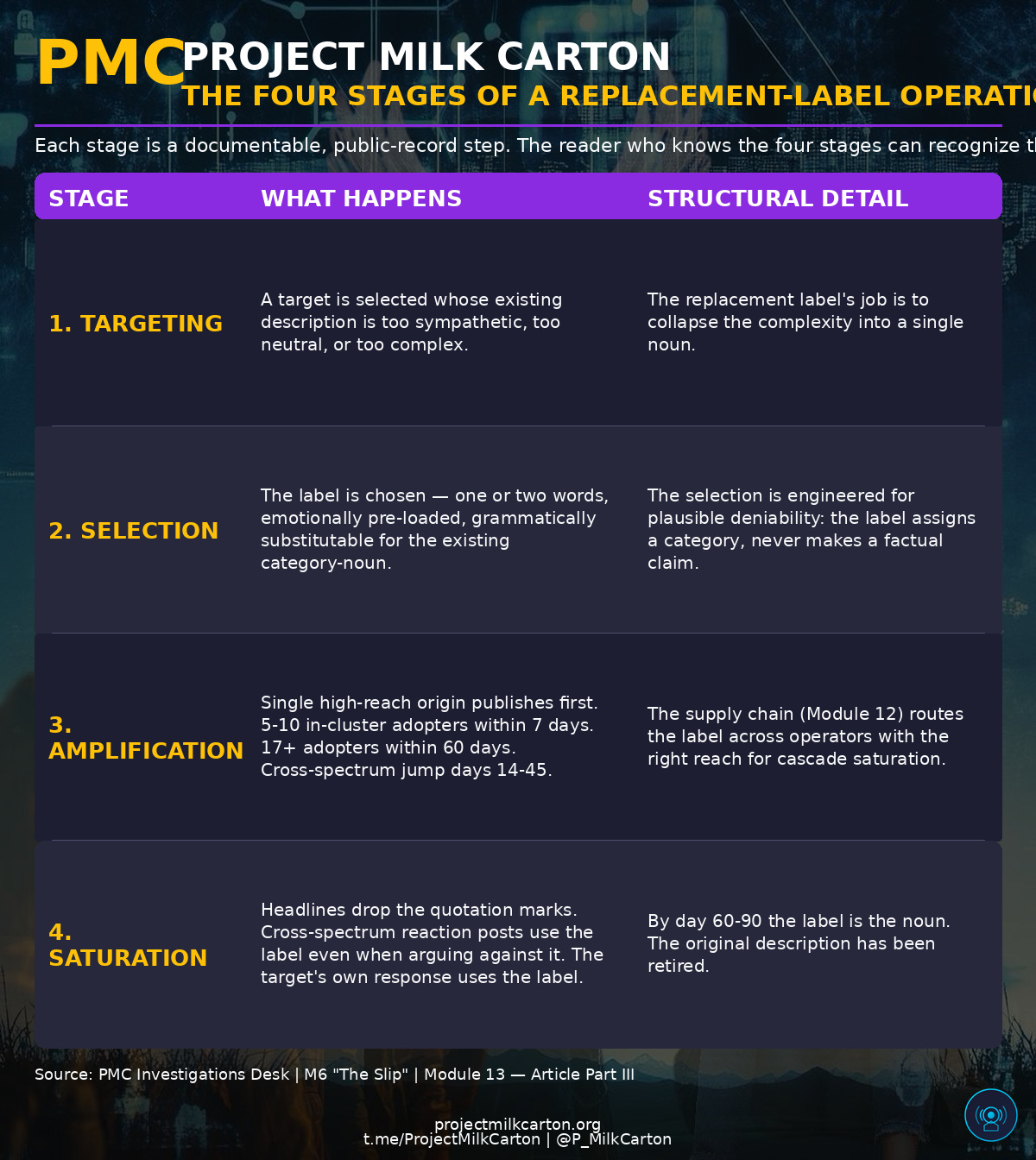
Each stage is a documentable, public-record step. The reader who knows the four stages can recognize them in real time, without needing to wait for the cascade to finish.
Stage 1 — Targeting
A target is selected. Not at random. The selection criteria are observable across documented cascades:
The target’s existing description is too sympathetic. They have been a victim, a public servant, a recognized expert, or a popular figure. The current vocabulary for the target loads the reader’s brain with positive or neutral associations.
The target’s existing description is too neutral. They are categorized in a way that does not push the reader emotionally — candidate, researcher, journalist, organizer, official.
The target’s existing description is too complex. Their actual record is multi-faceted. No single sentence collapses them into a clean response.
The replacement label’s job is to collapse the complexity. The producing organization selects targets whose complexity is currently working against the producer’s strategic objective. Replacing the description with a label removes the obstacle.
Stage 2 — Selection

The label itself is selected, not coined. The selection criteria are documentable in the editorial layer’s working notes (when those notes are ever surfaced — usually they are not):
Length. One or two words. Three at most. Anything longer fails to substitute in casual speech.
Emotional valence. Pre-loaded with negative association. The reader’s brain reaches for the negative response without conscious processing.
Existing semantic field. The label sounds like a word the reader already knows. New coinages fail; recombinations of existing negative terms succeed.
Substitutability. The label can grammatically replace the target’s existing category-noun in a sentence. “[Target] is a [old category]” becomes “[Target] is a [replacement label].” The grammar must hold.
Plausible deniability. The label does not assert a specific factual claim. It assigns a category. That distinction is the legal armor — covered in Part VI.
Stage 3 — Amplification
The supply chain (Module 12) routes the label through a documentable cascade:
A single high-reach origin publishes the label first. Origin reach is typically in the seven-to-eight-figures range — a podcaster, a high-follower account, a cable opinion show, a syndicated op-ed.
Within seven days, five to ten secondary operators in the same political cluster have adopted the label.
Within twenty-one days, the label appears in cluster-internal headlines without quotation marks. The label is now functioning as a noun, not a coinage.
Within forty-five days, cross-spectrum operators have begun using the label — initially in critique or ridicule, but the label propagates regardless of valence. Adopters who attack the label still use the label.
Within sixty days, the label has crossed into mainstream casual conversation. The Sunday-afternoon scene in Part I is the artifact of this stage.
Stage 4 — Saturation
By day sixty to ninety, three things happen:
Headlines drop the quotation marks. The label appears as a regular word.
Cross-spectrum reaction posts adopt the label. Opponents argue against the label, which propagates the label further. Every defense of the target now uses the label as the thing being defended against.
The target’s own response uses the label. The target either denies it, accepts it, or reframes it — but uses it. Once the target uses the label, the label is the noun. There is no longer a competing description.
The label is now part of public vocabulary. Removing it from the public conversation requires deliberate, organized counter-effort. Most readers will continue using it indefinitely.
Four stages. Sixty days. One word. The reader’s vocabulary changed.
Part IV — How the Replacement-Label Operation Gets Funded
A replacement-label operation runs on money.
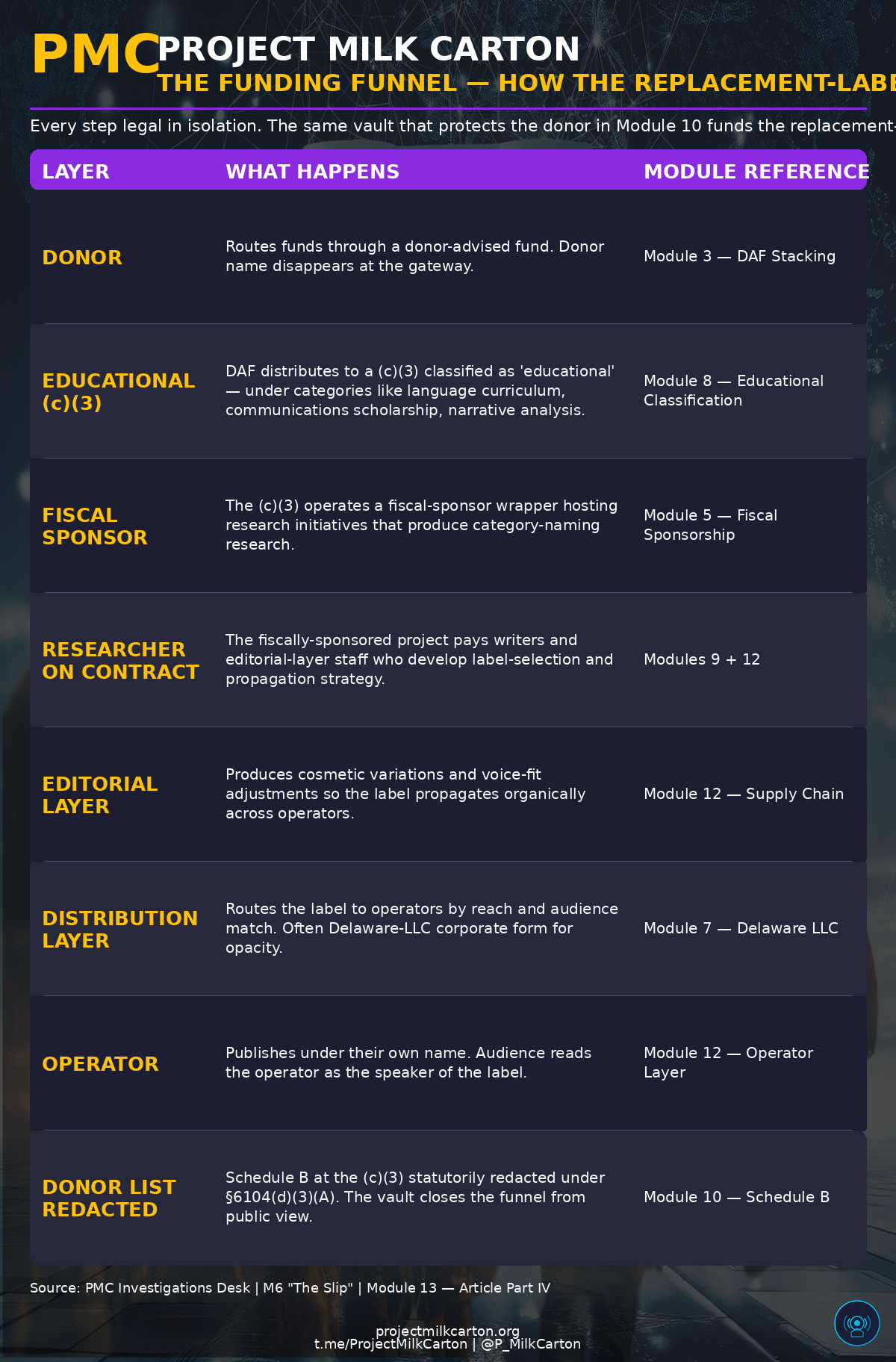
Writers cost money. Editorial-layer staff cost money. Distribution-layer routing costs money. Operators cost money to keep on or near payroll. The eight financial moves the reader walked across Modules three through ten apply to this floor as cleanly as they applied to designation systems in Module eleven and the supply chain in Module twelve.
The donor’s name disappears at the donor-advised fund layer. The path is distributed across (c)(3), (c)(4), and 527 layers. The destination operates inside a fiscal-sponsor wrapper. The activity is classified as educational — under categories like language curriculum, civic discourse research, communications scholarship, political-rhetoric analysis. The operators rotate across the (c)(3), the (c)(4) sister, and affiliated political action committees. The donor list at the (c)(3) is statutorily redacted under §6104(d)(3)(A).
The end of that chain is a researcher on contract at a fiscally-sponsored project of an educational (c)(3), publishing scholarship that selects target categories and tests label candidates. The scholarship is not advocacy; it is communications-strategy research. The operators who later deploy the labels are downstream of the research and never appear in the same documents.
The Schedule B vault that protects the donor in Module 10 funded the designation system in Module 11, funded the supply chain in Module 12, and funds the replacement-label operation in Module 13. Same vault. Same opacity. New product class. The donor is anonymous. The researcher is invisible. The operator is the only visible link. The audience reads the operator using the label. The label is now in the audience’s mouth.

That is the funnel. Every layer is legal in isolation. The funnel produces specific replacement labels that arrive in the citizen’s mouth as if they were native vocabulary.
Part V — The Live Pattern
A documentable replacement-label propagation, structurally:

Single high-reach origin. A platform-coded operator with reach in the seven-to-eight-figures range publishes the label first. The earliest publication is timestamped and screenshot-able by anyone who quote-searches the phrase on the origin platform.
Cascade window: sixty days. From earliest publication to seventeen or more independent adopters across both political clusters. The cascade timeline is consistent across documented cases.
Adopter pattern: seventeen-plus accounts. Combined reach in the high seven figures to low eight figures. The adopters cluster in the originating political cluster first (days zero through fourteen), bridge to the cross-spectrum cluster (days fourteen through forty-five), and enter mainstream usage (days forty-five through sixty). The bridge is the structural marker — once the cross-spectrum adopters are using the label, the label is no longer cluster-coded; it is the noun.
Substitution rate. By day sixty, the percentage of cluster-internal posts about the target that use the new label exceeds forty percent. By day ninety it exceeds seventy percent. By day one hundred eighty the original description has effectively been retired in cluster-internal vocabulary. The reader who formed an opinion about the target before the cascade is now in the minority of speakers; the reader who formed an opinion after the cascade has only the new label available.
The article does not name the label. It does not name the target. It does not name the origin. The pattern is the story. The pattern is documentable on any cluster the reader chooses to audit — and, once the reader has the four-stage framework and the cascade timeline, the audit takes fifteen minutes on the reader’s own feed.
That is the prosecution case for the technique, structurally.
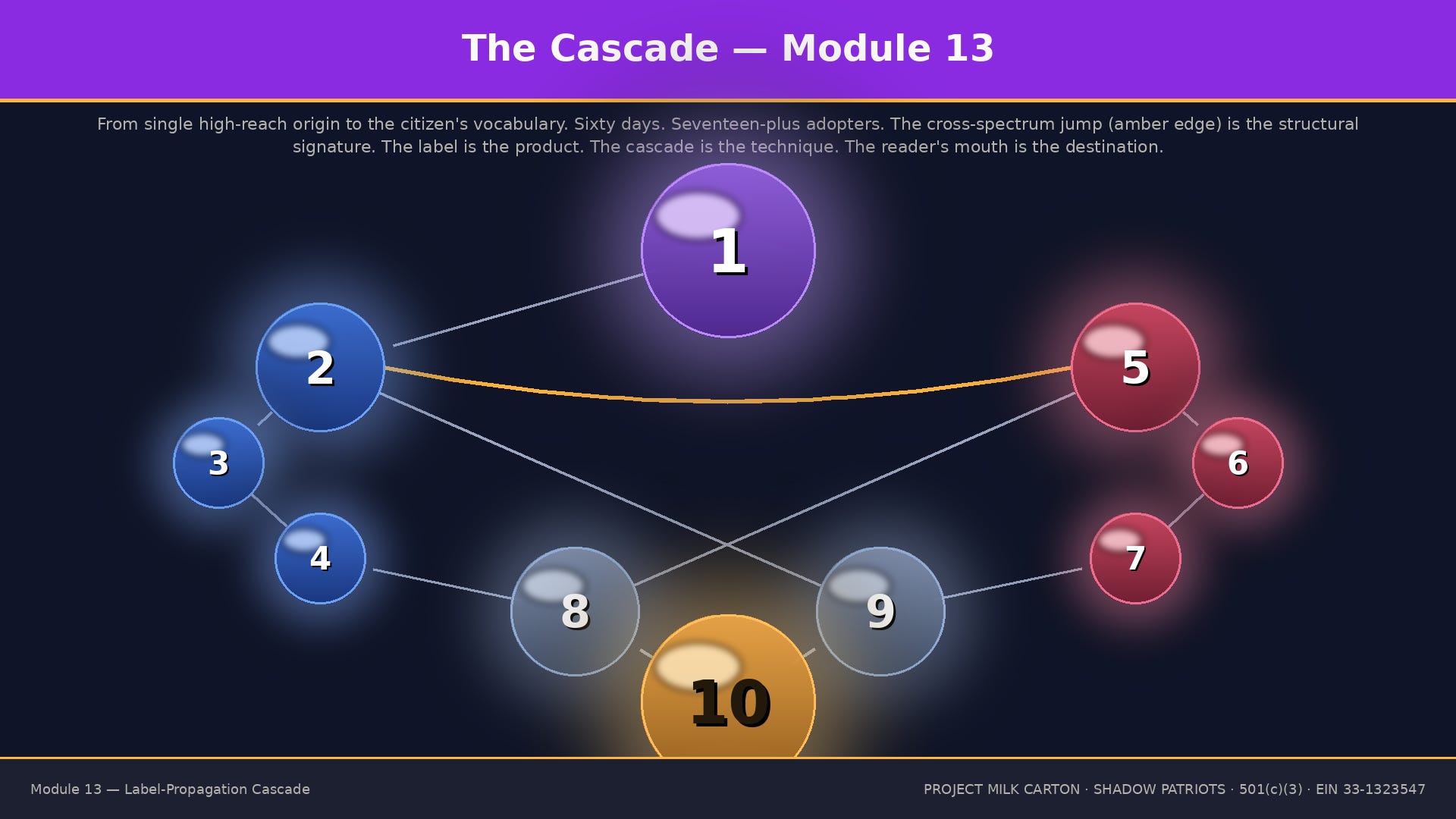
1 — Purple, large. High-Reach Origin (T+0). The single account, podcast, op-ed, or cable opinion show that publishes the replacement label first. Reach in the seven-to-eight-figures range. The cascade starts here.
2 — Blue, medium. Early In-Cluster Adopter (days 0-7). One of the first 5-10 secondary operators in the same political cluster as the origin. Picks up the label within the first week.
3 — Blue, small. In-Cluster Adopter (days 7-14). One of the next wave that brings the cluster’s adopter count to 12+. Label appears in cluster-internal headlines.
4 — Blue, small. In-Cluster Adopter (days 14-21). Cluster saturation. Substitution rate inside the cluster crosses 25%.
5 — Red, medium. Cross-Spectrum Adopter (days 14-21). The first opposing-cluster operator to use the label. The structural signature of a cascade. This is what distinguishes engineered propagation from organic linguistic drift.
6 — Red, small. Cross-Spectrum Adopter (days 21-35). Cross-cluster cascade continues.
7 — Red, small. Cross-Spectrum Adopter (days 35-45). Cross-cluster saturation. The label is no longer cluster-coded; it is the noun.
8 — Gray, medium. Mainstream Operator (days 45-60). Reporters, op-ed columnists, ordinary social-media users adopt the label. Headlines drop the quotation marks.
9 — Gray, medium. Mainstream Operator (days 45-60). Same wave; same window.
10 — Amber, large. Citizen Vocabulary. The destination. By day 60, the label is in the citizen’s mouth at the kitchen table on Sunday afternoon. The cascade is complete.
Legend — Edges
Gray lines (top, in-cluster). Standard cascade propagation. The label moves through the origin’s political cluster in the first 21 days.
Amber line (curved, between 2 and 5). Cross-spectrum jump. The first time the label appears in an opposing-cluster operator. Days 14-45 of the cascade. This is the structural signature that distinguishes a documented replacement-label cascade from organic linguistic drift. Drift does not cross the spectrum on this window.
Gray lines (bottom). Mainstream entry. The label moves from cluster operators (both sides) into mainstream usage by day 45-60.
Gray lines (final). Citizen adoption. The label arrives in the citizen’s vocabulary through the mainstream operators they routinely consume.
How to Read This
Read the diagram in three time bands. Top band (orbs 1, 2) — origin and first-week adoption inside the originating cluster. Middle band (orbs 3, 4, 5, 6, 7) — cluster saturation followed by the cross-spectrum jump (the amber edge between orbs 2 and 5). The cross-spectrum jump is the moment the label stops being political coinage and becomes the noun. Bottom band (orbs 8, 9, 10) — mainstream entry by day 45-60, ending in the citizen’s vocabulary by day 60. The cascade is the technique. The technique is older than the platform. The platform reduced the friction. Module 13 walks you through the operation that produces what arrives in your mouth on a Sunday afternoon.
The defense case is also at full strength. Some labels carry a legitimate framing claim — legal categories that are accurate (an indicted person can be called defendant, a convicted person can be called convicted); public-record categories that the target has earned (a registered lobbyist can be called lobbyist); historical categories that the target has occupied (a former cabinet officer can be called former cabinet officer). The line between description and substitution is not always crisp. The reader has to evaluate.
Both readings are available. The reader holds them. The article does not pick the verdict for any specific case. The reader runs the audit on their own feed and decides which labels in their own vocabulary they keep, which they retire, and which they replace with description.
Part VI — Substitution Is Not Description
Here is the legal-and-psychological hinge that protects the technique.
Description is journalism. “A candidate who endorses [policy] and has [history].” “A public figure with [record].” “A group that advocates for [position].” Description preserves the target as a complex entity the reader can evaluate. The reader can argue with each clause. The reader can verify each fact. The reader can hold or change their opinion based on the description.
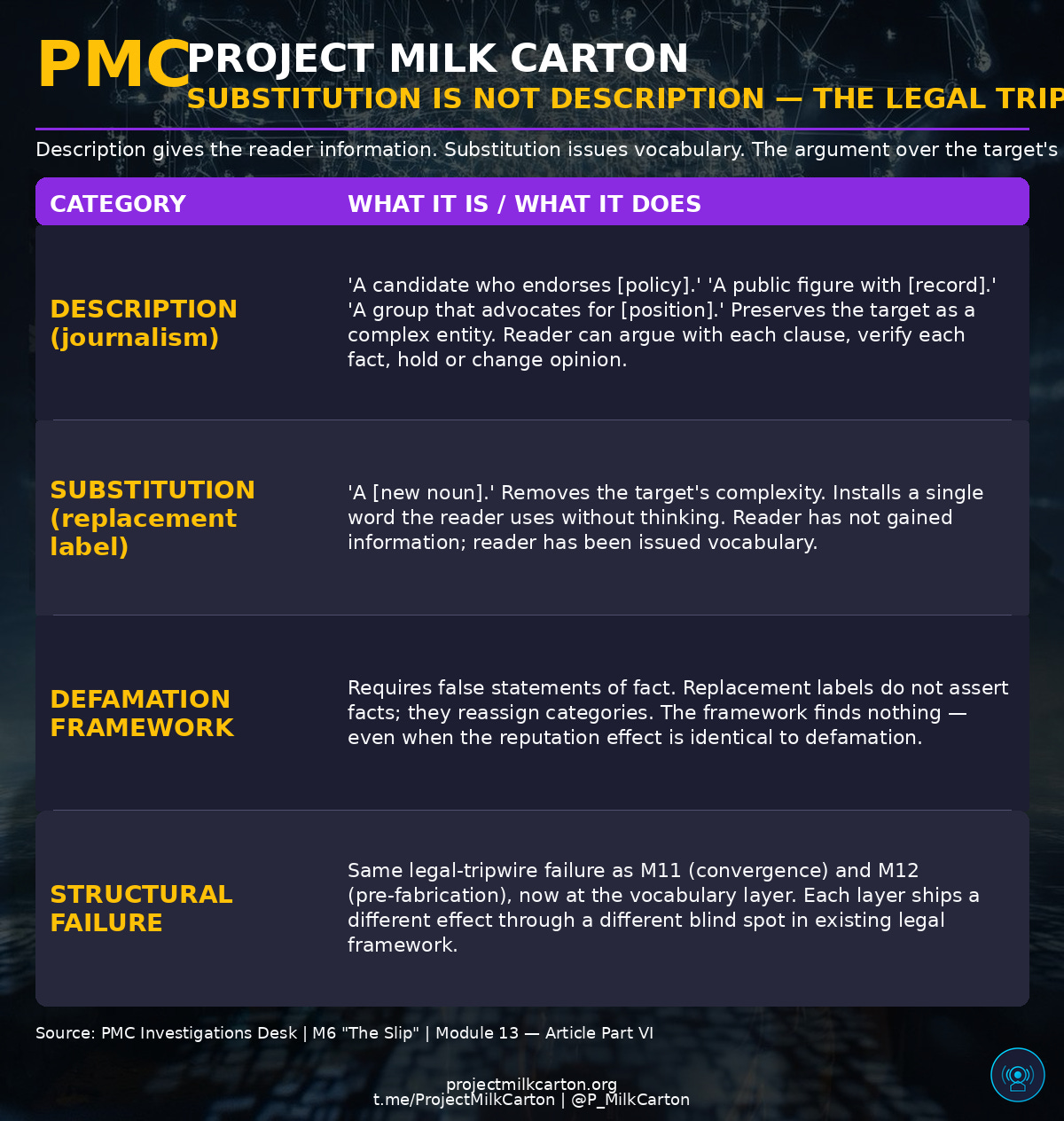
Substitution is something else. The replacement label removes the target’s complexity and installs a single noun the reader uses without thinking. The reader has not gained information; the reader has been issued vocabulary. The argument over the target’s reputation is over before it begins, because the noun being used has already pre-loaded the reader’s response.
The framework that polices defamation requires false statements of fact. Replacement labels do not assert facts. They reassign categories. No specific accusation is made. No single statement can be sued. The label simply replaces the prior word for the target, and the target’s reputation is processed through the new word from that point forward.
This is the same legal-tripwire failure Modules 11 and 12 named, viewed at the vocabulary level. Convergence produces the cross-spectrum effect the coordination framework cannot detect. Pre-fabrication produces the supply-chain effect the coordination framework cannot detect. Substitution produces the reputation effect the defamation framework cannot detect. Each layer ships a different effect through a different blind spot in the existing legal framework.
The framework is not lying. The framework was built when the technique it now misses did not exist. A reader who knows that the framework misses substitution can no longer rely on “there has been no defamation suit” as evidence that no harm was done. The harm is real. The framework cannot reach it. The literacy is what reaches it.

Part VII — Replacement Labels Before the Algorithm
The technique is older than the platform. The platform reduced its friction. The cascade window narrowed. The reach scaled. The mechanism is the same.
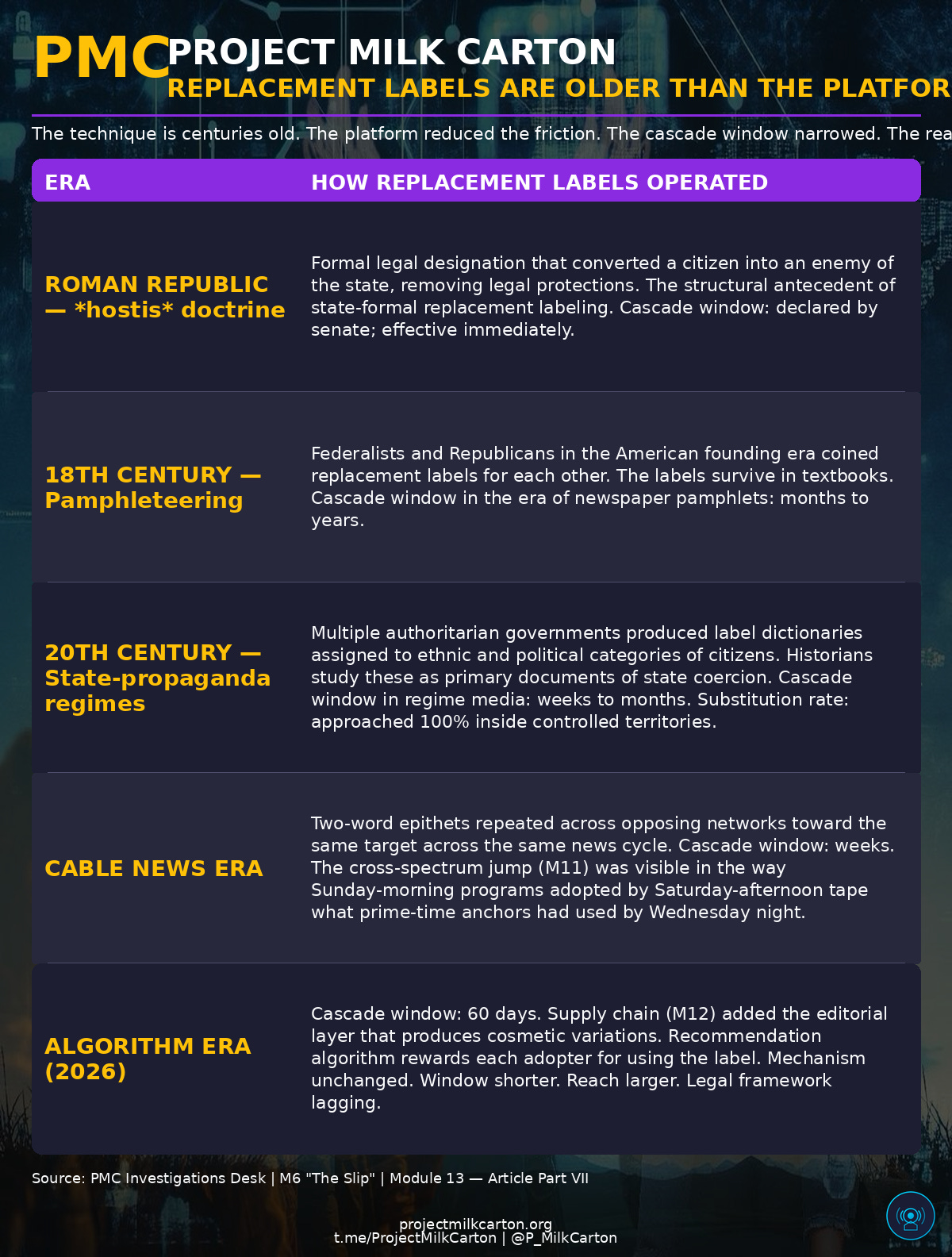
Roman Republic. Hostis — the formal designation that converted a citizen into an enemy of the state, removing legal protections. Roman jurists wrote on the doctrine. The label did not need to be argued. Once the senate declared hostis, the citizen was no longer a citizen. The category had been replaced. Modern historians treat hostis as the structural antecedent of state-formal replacement labeling.
Eighteenth-century pamphleteering.

Federalists and Republicans in the American founding era coined replacement labels for each other. The labels survive in textbooks. The labels are still in use, in some cases, against contemporary political factions. The cascade window in the era of newspaper pamphlets was measured in months and years; the technique nonetheless propagated.
Twentieth-century state-propaganda regimes. Multiple authoritarian governments in the twentieth century produced label dictionaries assigned to ethnic and political categories of citizens. Historians study these dictionaries as primary documents of state coercion. The cascade window in state-controlled media was measured in weeks and months. The substitution rate in regime-controlled vocabulary approached one hundred percent inside the territories the regimes controlled.
Cable news era. Two-word epithets repeated across opposing networks toward the same target across the same news cycle. The cascade window narrowed from months to weeks. The cross-spectrum jump (as Module 11 named it) was visible in the way Sunday-morning programs adopted by Saturday-afternoon tape what the prime-time anchors had used by Wednesday night.
Algorithm era. The platform reduced the cascade window from weeks to sixty days. The supply chain (Module 12) added the editorial layer that produces the cosmetic variations. The recommendation algorithm (Module 11) rewards each adopter for using the label. The mechanism is the same. The window is shorter. The reach is larger. The legal framework has not been updated.
The article cites the historical lineage structurally — the eras, the regimes, the practices — without quoting any specific epithet from any era. The labels themselves remain sealed. The technique is named. The instances are not. This is the discipline the doctrine requires, because reproducing the labels inside the analytical critique re-fires the operation.
Part VIII — What the Citizen Can Do
Module 13’s citizen-action move is the Replacement-Label Trace Audit. Fifteen minutes. Public tools. Your own feed.

The reader picks one label they have noticed in their own vocabulary recently — a single word or two-word phrase the reader has caught themselves using to describe a public figure. The label should be specific enough that random independent speakers would not all converge on it by accident. The reader quote-searches the label on the platform where they first encountered it, sorts the results from oldest to newest, finds the earliest matching post, walks forward through the adopter cascade, and observes — in real time, on their own screen — the propagation pattern.
The reader does not name the label publicly. The reader does not amplify the audit by sharing the screenshots widely. The audit is for the reader. The audit produces literacy, not content.
The detailed step-by-step audit lives in this module’s Shadow Patriots citizen-action card, “The Edit — How to Trace a Replacement Label on Your Own Feed in Fifteen Minutes.” The card is short. The card is executable. The card teaches the reader to recognize the four stages of replacement-label production by hand, on a label of their own choosing, with screenshots they capture themselves.
The product of the audit is the citizen who runs it. The next time a label moves through the citizen’s vocabulary, the citizen will recognize the technique. The reflex becomes a literacy. The literacy is the only thing the supply chain cannot route around.
Part IX — How Replacement Labels Operate Inside the Four Layers
Module 13 is not a fifth architectural layer. The architecture remains four layers wide.
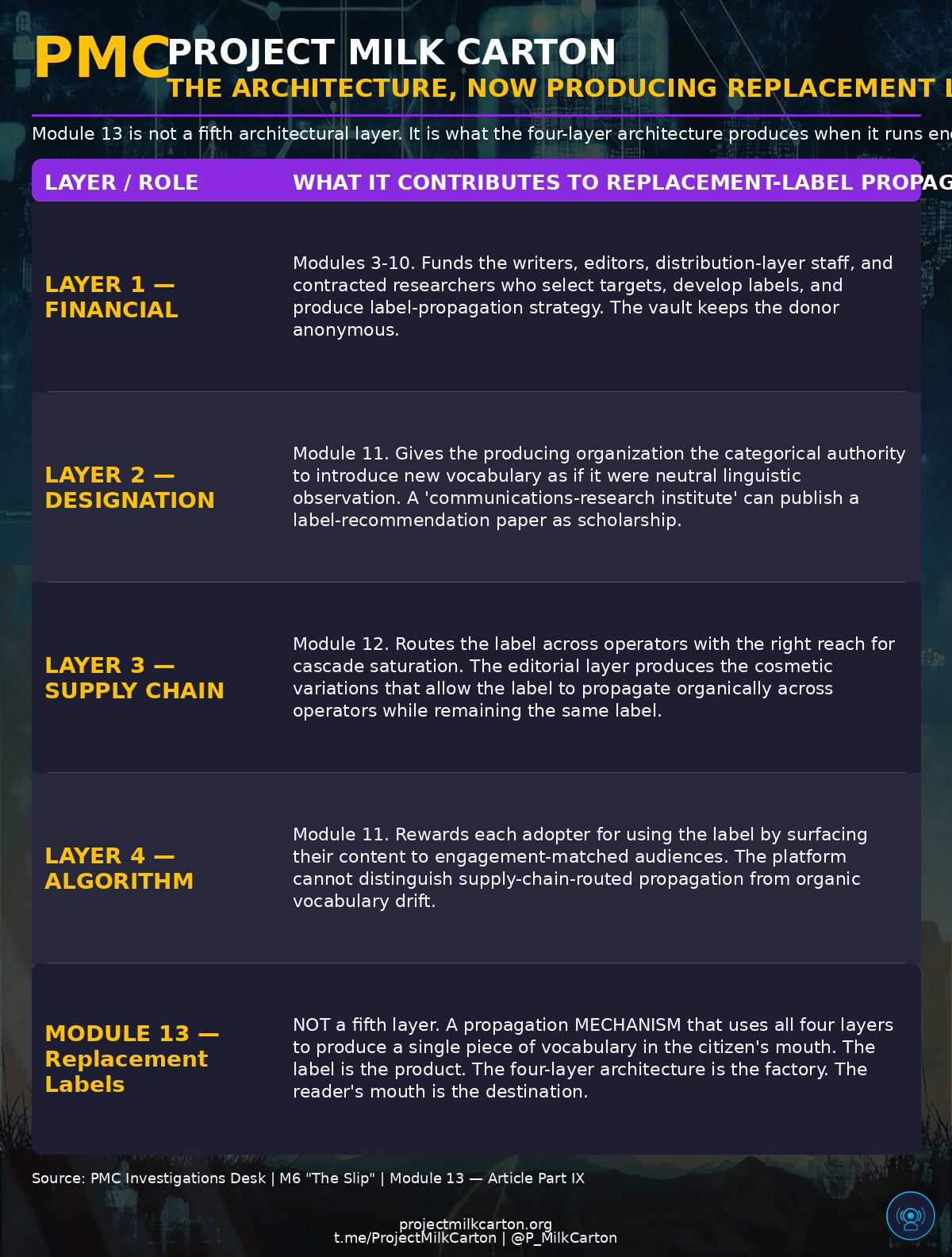
Replacement labels are a propagation mechanism that uses all four existing layers to produce a single piece of vocabulary in the citizen’s mouth:
Layer one — financial architecture. Funds the writers, editors, distribution-layer staff, and contracted researchers who select targets, develop labels, and produce label-propagation strategy. The vault keeps the donor anonymous. The donor’s investment is in the citizen’s vocabulary; the vault prevents the citizen from ever knowing who paid for the words they are now using.
Layer two — designation architecture. Gives the producing organization the categorical authority to introduce new vocabulary as if it were neutral linguistic observation. A “communications-research institute” can publish a paper recommending category-substitution language and have it received as scholarship. The organization’s authority is the laundering layer for the label.
Layer three — supply-chain architecture. Routes the label across operators with the right reach for cascade saturation. The editorial layer produces the cosmetic variations (different sentence structures around the label, different photos, different framing) that allow the label to propagate organically across operators while remaining the same label.
Layer four — algorithm distribution. Rewards each adopter for using the label by surfacing their content to engagement-matched audiences. The platform’s recommendation algorithm cannot distinguish between organic linguistic drift and supply-chain-routed label propagation. The propagation looks like the drift. The drift propagates the label.
A replacement label is what the four layers produce when they run end-to-end at the vocabulary level. The label is the product. The four-layer architecture is the factory. The reader’s mouth is the destination.

The methodological lesson stands: pattern coherence across the four layers, ending in a documented vocabulary cascade, is a documentable analytical finding. The reader who can see the cascade is no longer governable by the labels the cascade produces. That reader becomes a citizen the architecture cannot quietly metabolize.
Part X — The Next Move

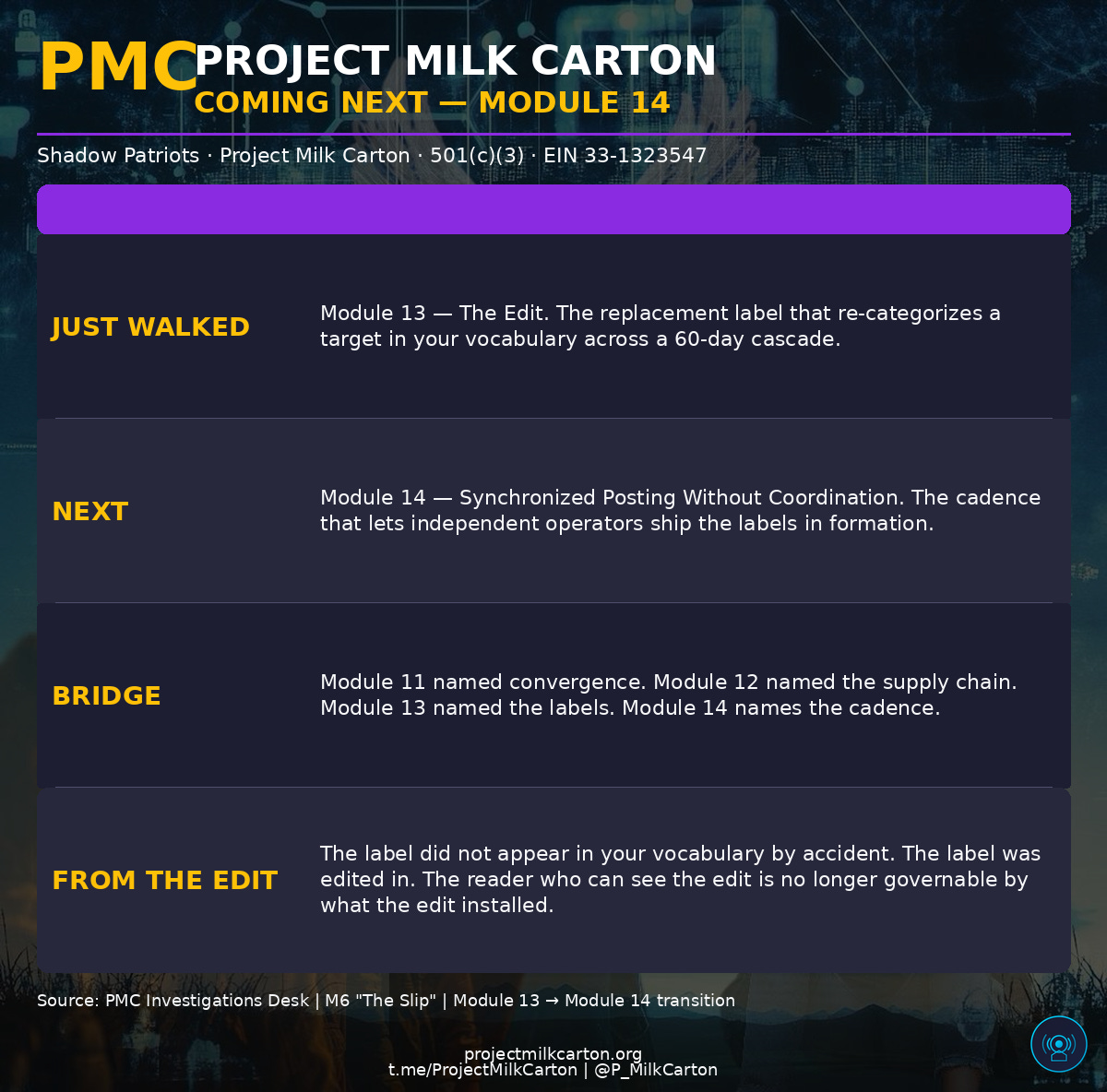
Module 14 — Synchronized Posting Without Coordination — opens next. Module 11 named convergence. Module 12 named the supply chain. Module 13 named the labels the supply chain ships. Module 14 names the cadence at which independent operators post the labels in formation, producing the coordination effect from non-coordinating actors. The technique is older than the platform. The cadence is newer than the technique. The combination is what the legal framework cannot reach.
The label did not appear in your vocabulary by accident. The label was edited in. The reader who can see the edit is no longer governable by what the edit installed. That reader is the only product Module 13 is building. The rest is up to you.
A single Sunday afternoon. A single word from a person you trust. Sixty days of cascade upstream of that moment. Seventeen adopters. One editorial layer. One donor at the top of the funnel. You just walked the operation. Module 14 names the cadence that lets the operation run without anyone breaking the law.
Sources and Citations
NAACP v. Alabama ex rel. Patterson, 357 U.S. 449 (1958) — foundational associational-privacy precedent. The Schedule B vault Module 13 names as funding the replacement-label operation rests on this doctrine.
Americans for Prosperity Foundation v. Bonta, 594 U.S. 595 (2021) — contemporary application. The architecture Module 13 maps exists in the constitutional space the Bonta majority left untouched.
Module 10 — “The Vault” — Schedule B Black Hole — closer of Part II. The financial architecture’s eighth move; the donor opacity Module 13 references in Part IV.
Module 11 — “Two Rooms, No Door, One Voice” — Part III opener. Convergence as the cross-spectrum effect the coordination framework cannot detect.
Module 12 — “Off The Rack” — Part III second module. The supply chain that pre-fabricates the frames Module 13’s labels propagate through.
Roman hostis doctrine — formal legal designation that converted a citizen into an enemy of the state. Cited as the structural antecedent of state-formal replacement labeling. Treatment in Roman jurisprudence; modern historical scholarship in Cicero studies and Roman political-rhetoric analysis.
Eighteenth-century American pamphleteering — Federalist–Republican replacement-labeling exchanges. Cited as named historical structure without specific labels reproduced. Standard treatment in The Federalist Papers scholarship and counter-Federalist analysis (Cornell, The Other Founders; Wood, Empire of Liberty).
Twentieth-century authoritarian state-propaganda regimes — multiple regimes produced label dictionaries assigned to ethnic and political categories. Cited as named historical structure without specific epithets reproduced. Standard treatment in propaganda-history scholarship including Klemperer, The Language of the Third Reich; Snyder, Bloodlands; and Soviet propaganda studies.
Defamation law’s false-statement-of-fact requirement — New York Times Co. v. Sullivan, 376 U.S. 254 (1964) and progeny. The doctrinal floor that replacement labels are structurally engineered to operate beneath.
The DISARM framework — open-source taxonomy of disinformation techniques. Referenced as one example of a designation system whose methodology is publicly auditable. PMC uses DISARM analytically; citation does not constitute endorsement.
The cascade pattern referenced in Part V is documented at PMC’s internal research bench. This article describes the pattern structurally — by reach, cascade timeline, adopter count, substitution rate, and historical lineage — without naming any specific cascade, label, target, or origin operator, in keeping with the editorial doctrine outlined in the introduction.
Shadow Patriots · Module 13 · Project Milk Carton · 501(c)(3) · EIN 33-1323547
Module 13: CITIZEN ACTION CARD — The Edit
MODULE 13: SERIES SONG — “THE EDIT”

This article is the third in Part III — The Information Moves — of the Shadow Patriots civic-investigations series. It opens directly against Module 12’s closing image. Part III’s job is to teach the citizen what the end-run looks like, mechanism by mechanism, so that the citizen can identify the mechanism in operation on their own vocabulary in real time.
Editorial discipline (Two-Tier Naming Doctrine, locked 2026-04-24, binding throughout Module 13): No named human IO actors appear in this article. No handles. No surnames. No nation-state identifiers. No specific replacement-label text — not in quotation marks, not in footnotes, not as examples. No specific target names. No specific origin-operator names. No specific producing-organization names. No specific funder names. Actors are described by reach, cascade timeline, adopter count, and structural role only. Labels are sealed. The label is the information-operations payload; reproducing the label inside the analytical critique re-fires it for the operator. We map the technique. The labels stay in the dossier where they belong.
Methodological note: pattern coherence across decision nodes, ending in a documented vocabulary cascade, is a documentable analytical finding. The framework’s discipline is to name the technique without reproducing the labels. The methodology is the product. Specific labels and specific cases are the citizen’s, audited on the citizen’s own evidence.
Evidence standard: every factual claim in this article is verifiable through Supreme Court opinions, named historical scholarship, the publicly available DISARM framework, and published reporting on cable news editorial cadence. PMC does not allege misconduct by any individual or organization. PMC describes the architecture in which 2026 citizens live and equips citizens with the literacy to identify it themselves.
Bipartisan firewall: Replacement-label operations are non-partisan. Both political clusters fund them, run them, and publish through them. The cascade pattern described in Part V is a structural shape observable across the politically-coded media ecosystems on both sides of the spectrum. The mechanism is the story. The party is not.