
Due Process for Sale
How Federal Adoption Incentives Put a Price Tag on Parental Rights and Turned the Fourteenth Amendment Into a Funding Mechanism


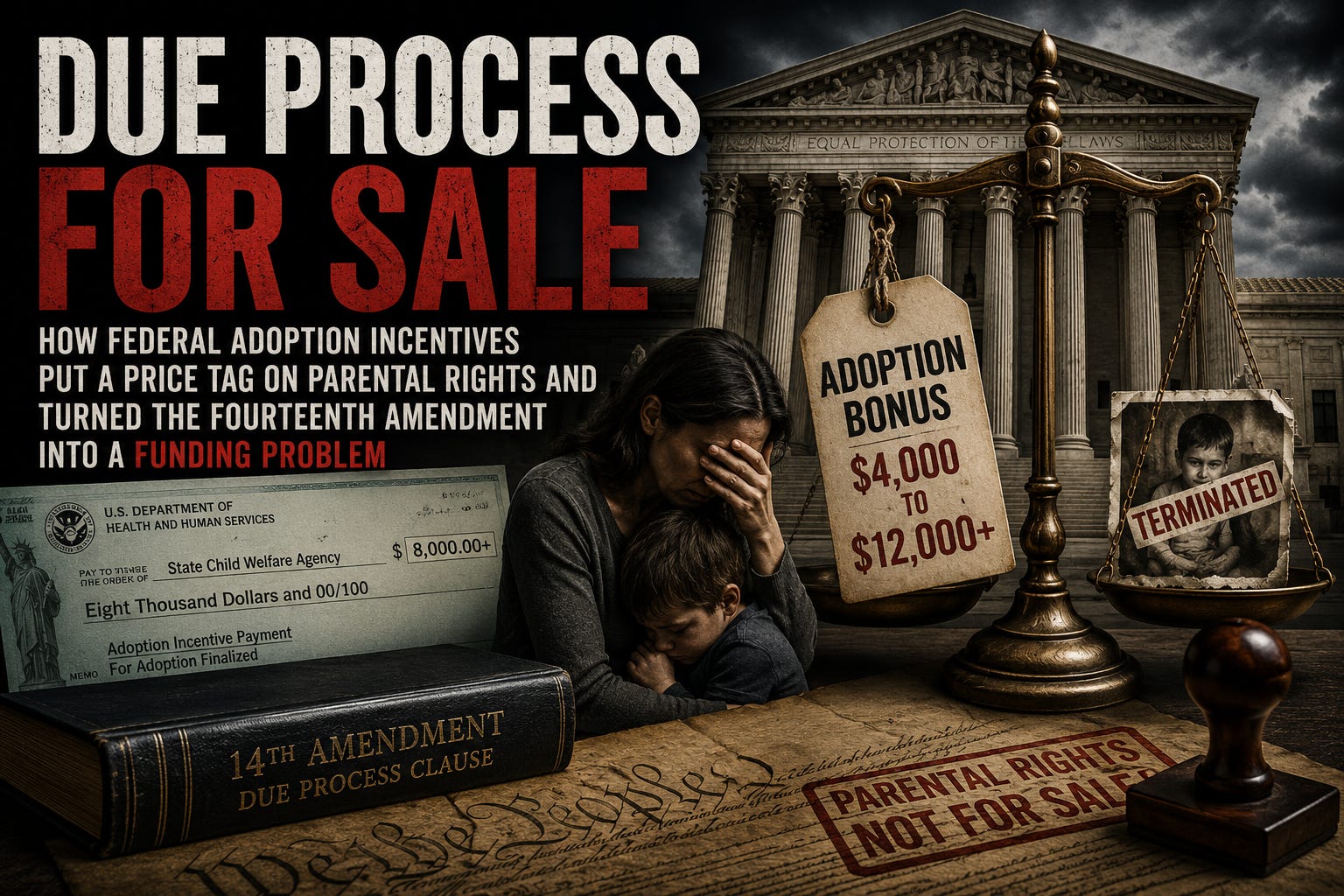
There is a moment in every termination-of-parental-rights case when the machinery of the state stops sounding abstract and becomes brutally personal. A parent sits in a courtroom while lawyers, caseworkers, agency representatives, guardians, and judges discuss whether the government should permanently erase the legal bond between parent and child. The language is clinical. The file is thick. The timelines are formal. The state says it is acting in the best interests of the child. But beneath the procedure sits one of the oldest and most protected liberty interests in American constitutional law: the right of a parent to raise their child without the government destroying the family unless it can meet the highest civil standard of proof. The Supreme Court has said this bond is not ordinary property, not a benefit, not a privilege granted by the state, and not something the government may sever merely because officials believe another home might be better. It is a fundamental liberty interest protected by the Due Process Clause of the Fourteenth Amendment.
That is the constitutional promise. The child welfare incentive system tells a different story. For more than a quarter-century, the federal government has paid states adoption bonuses under a structure created by the Adoption and Safe Families Act of 1997, commonly known as ASFA. The program was designed to move children out of foster care and into permanent adoptive homes, a goal that sounds humane and politically unassailable when stated in isolation. But the architecture of the law created a dangerous conflict: states receive financial rewards when adoptions are finalized, while the legal gateway to many foster-care adoptions is termination of parental rights. The faster a state moves children through foster care, into termination, and then into adoption, the more the state can appear to satisfy federal permanency goals and, in some cases, qualify for federal adoption incentive dollars. In theory, the constitutional standard remains untouched. In practice, the system creates institutional pressure in exactly the place where constitutional law demands the most restraint.
The investigation underlying this reporting frames the issue bluntly: ASFA’s financial incentives create systemic constitutional risk because states can receive thousands of dollars per adoption finalized while parents are supposed to receive individualized due process before their rights are terminated. The constitutional standard is clear and convincing evidence of parental unfitness. The funding structure rewards adoption volume. Those two facts can exist in the same legal universe only if the system has strong safeguards preventing financial incentives from influencing removal, reunification, termination, and adoption decisions. The problem is that the safeguards have never matched the power of the incentive. Courts have repeatedly identified constitutional violations in individual child welfare cases, but Congress has never rebuilt the financial architecture that creates pressure toward those violations. The result is a system where due process may remain intact on paper while being undermined by timelines, quotas, funding formulas, institutional bias, and political pressure.
To understand why this matters, readers have to understand what parental rights are under American law. The constitutional protection of the parent-child relationship is not a recent invention or a sentimental slogan from family advocacy groups. It traces through a century of Supreme Court doctrine. In Meyer v. Nebraska in 1923, the Court recognized that the liberty protected by the Fourteenth Amendment includes the right of parents to establish a home and bring up children. In Pierce v. Society of Sisters in 1925, the Court held that children are not mere creatures of the state and that parents have the right to direct their education and upbringing. In Prince v. Massachusetts in 1944, the Court recognized family privacy while also acknowledging that the state may regulate when child welfare requires it. In Stanley v. Illinois in 1972, the Court made clear that a father’s parental rights could not be terminated without a hearing. Across decades, the doctrine developed around a basic premise: government can intervene to protect children, but it cannot casually override the constitutional status of the family.
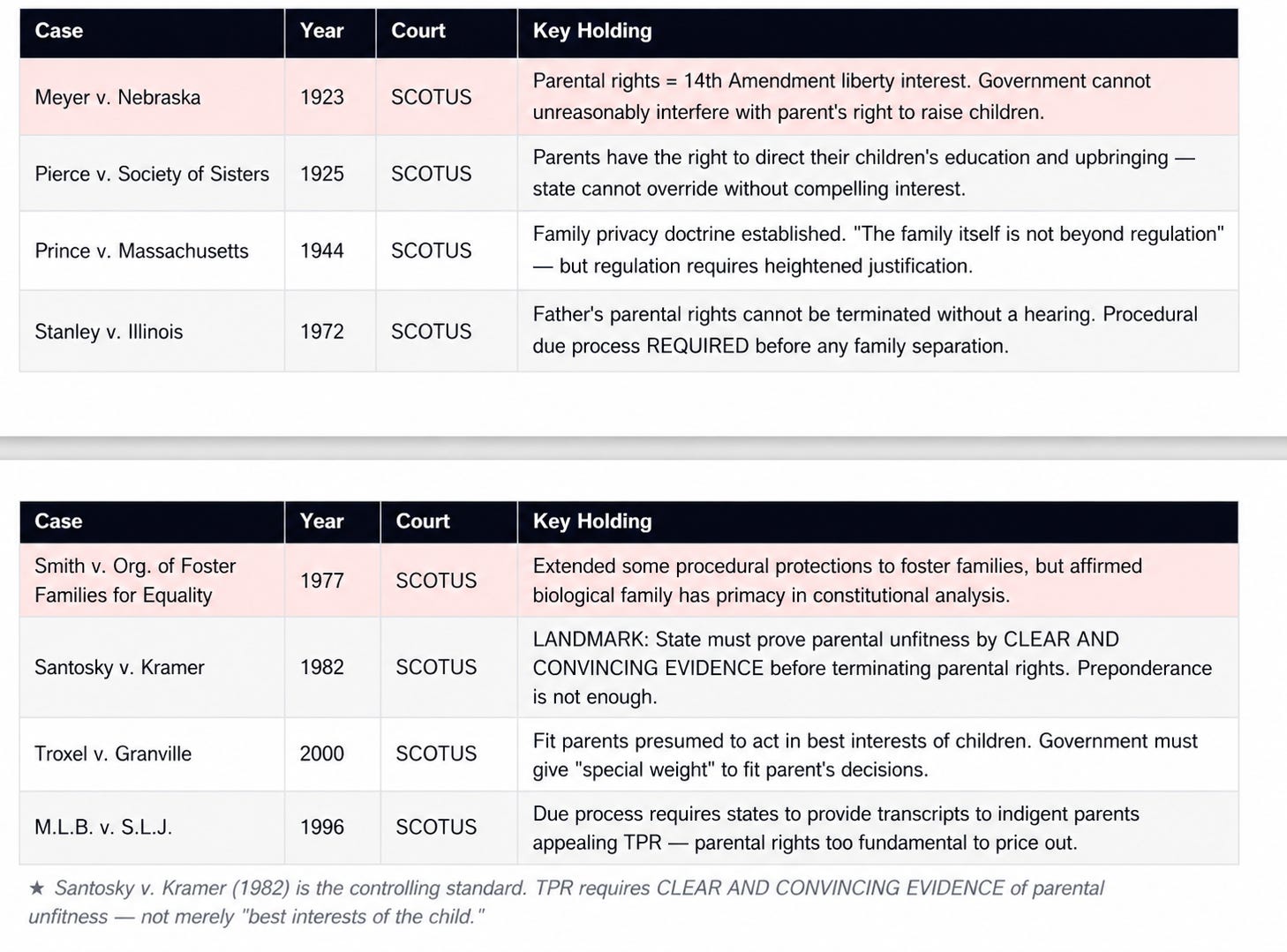
The cornerstone is Santosky v. Kramer, decided by the Supreme Court in 1982. Santosky held that before the state can terminate parental rights, it must prove parental unfitness by clear and convincing evidence. A mere preponderance of the evidence is not enough. That distinction may sound technical, but it is one of the most important safeguards in family law. A preponderance standard asks whether something is more likely than not. Clear and convincing evidence requires a much stronger level of certainty because the consequence is permanent severance of family bonds. The Court understood that termination of parental rights is uniquely devastating. Once rights are terminated, the parent is no longer the child’s legal parent. The child’s inheritance rights, custody rights, legal identity, and formal family connection can be destroyed. The state is not merely changing placement. It is erasing a legal relationship.
Justice Blackmun’s majority opinion in Santosky made the point with extraordinary force. Until the state proves parental unfitness, the child and parent share a vital interest in preventing erroneous termination. That sentence should govern every child welfare courtroom in America. It means that before the state proves unfitness, the child’s interests are not presumed to be opposed to the parent’s interests. The child has an interest in not having the parent-child bond wrongly destroyed. The parent has an interest in not being wrongly severed. The state may have a legitimate interest in protecting children, but that interest does not eliminate the risk of error. The Constitution requires the state to carry a heavy burden before it permanently breaks the family.
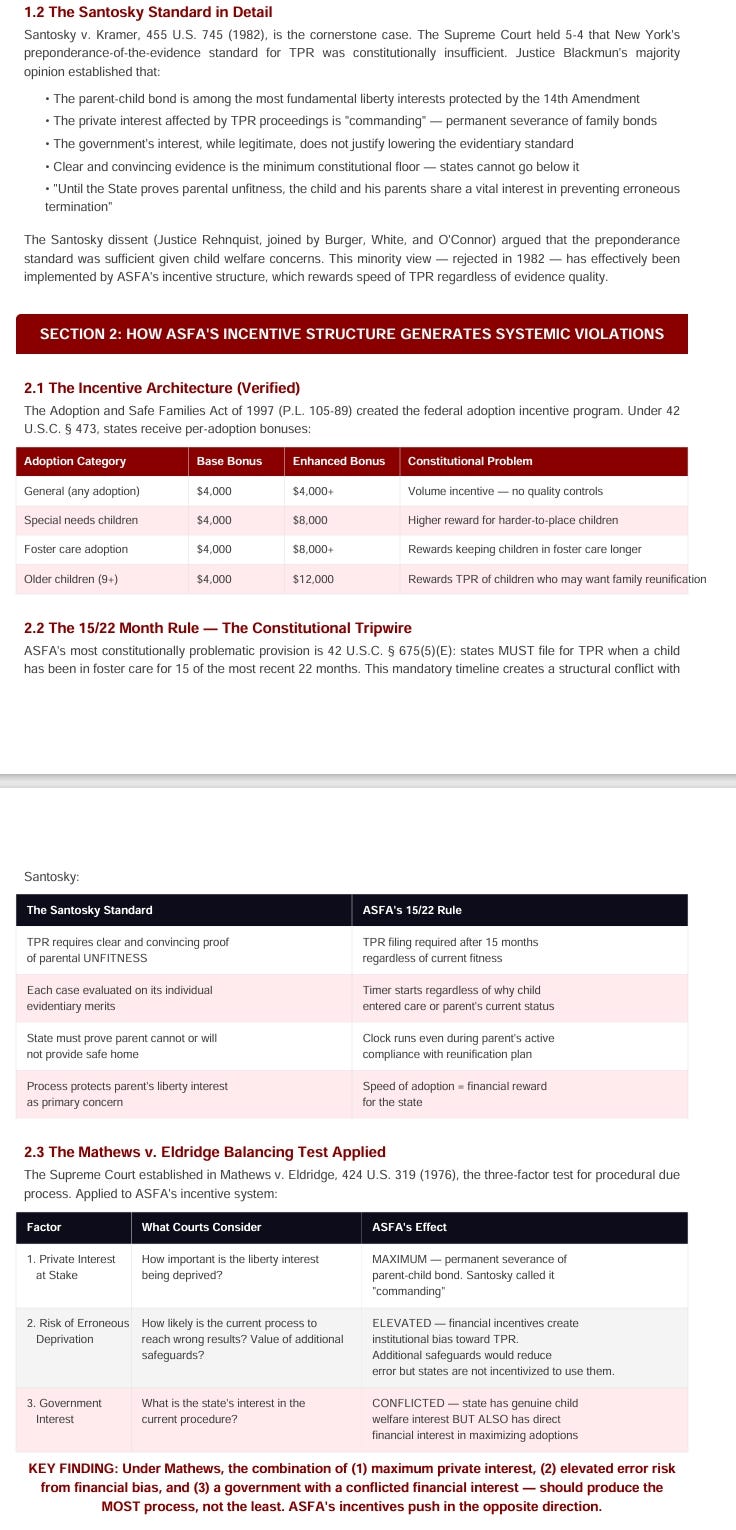
ASFA did not repeal Santosky. Congress could not repeal Santosky by ordinary statute even if it wanted to, because constitutional due process is the floor beneath federal legislation. But ASFA changed the practical environment in which Santosky operates. It created adoption incentive payments and imposed the famous 15-of-22-month rule, under which states generally must file for termination of parental rights when a child has been in foster care for 15 of the most recent 22 months, unless exceptions apply. The rule was designed to prevent children from drifting in foster care indefinitely. That goal was not irrational. Children do need stability. But the constitutional danger is that a timeline can begin to substitute for individualized proof. A parent may be working services, waiting on housing, fighting poverty, navigating addiction treatment, recovering from domestic violence, seeking mental health care, or struggling against agency delay, but the clock keeps running. When the clock matures, the system leans toward termination.
This is the constitutional tripwire. Santosky requires proof of unfitness. ASFA requires filing for termination after a time threshold unless exceptions are used. Those are not identical standards. A child can be in care for 15 months for reasons that do not prove the parent is currently unfit by clear and convincing evidence. A parent can be poor, delayed, unsupported, disabled, overburdened, or trapped in a broken service system without being constitutionally unfit. A state can contribute to delay by failing to provide timely services and then later use the passage of time to justify termination. The clock does not ask why the child remained in care. It simply counts.
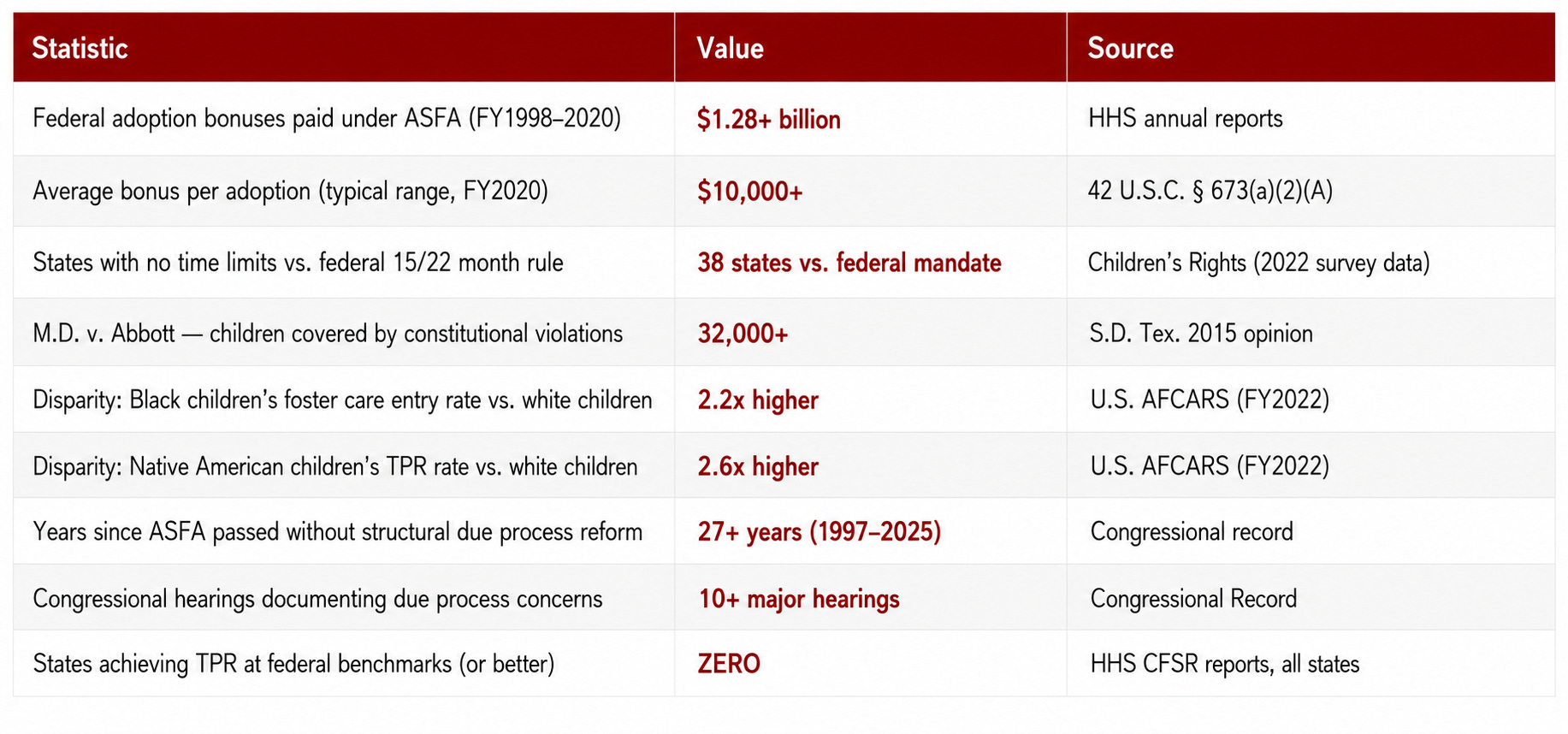
The financial incentive makes the timeline more dangerous. Under the federal adoption incentive structure identified in the investigation, states may receive bonuses tied to finalized adoptions, with higher amounts for categories such as special-needs children, foster-care adoptions, and older children. The brief identifies base and enhanced bonus ranges that can reach thousands of dollars per adoption, with older-child categories described at higher levels. The purpose is to encourage states to find permanent homes for children who might otherwise remain in foster care. But because adoption often requires termination first, the incentive can create institutional pressure to move cases toward TPR even when the constitutional evidence should demand caution. A state does not need a villain in the room for the structure to matter. Institutions respond to what is measured, funded, praised, and penalized.
This is the most important point for readers to grasp: constitutional violations in child welfare do not always appear as obvious corruption. They often appear as normal case processing. A caseworker with too many files may push toward a permanency goal because the deadline is approaching. A supervisor may emphasize adoption metrics because the agency is under federal review. A state agency may prioritize TPR filing because delayed permanency affects performance measures. A court may accept agency narratives because the parent has already been framed as noncompliant. A parent’s poverty may be described as instability. A parent’s missed appointments may be described as lack of commitment without fully examining transportation, disability, work schedule, trauma, or service accessibility. By the time TPR is filed, the system may have converted social failure into legal unfitness.
The Supreme Court’s due process framework helps expose why this is so dangerous. In Mathews v. Eldridge, the Court established a three-factor test for procedural due process. Courts consider the private interest at stake, the risk of erroneous deprivation under the existing procedure, and the government’s interest. Applied to termination of parental rights under an incentive-driven system, the result should be obvious. The private interest is maximum because permanent severance of the parent-child relationship is among the most severe civil deprivations the state can impose. The risk of erroneous deprivation is elevated when the same system responsible for protecting children also has institutional incentives to move cases toward adoption. The government’s interest is conflicted because the state has a legitimate child protection interest but also a financial and performance interest in adoption outcomes. Under Mathews, that combination should produce more procedural protection, not less.
Instead, the system often moves in the opposite direction. The parent most at risk of losing a child is often poor, traumatized, underrepresented, and dependent on appointed counsel who may be overworked and underfunded. The agency has lawyers, caseworkers, records, contractors, service providers, and institutional familiarity with the court. The parent may not understand the legal significance of each hearing until it is too late. The child may be represented by a guardian or attorney whose position may not align with preserving family ties. The judge may be operating under crowded dockets and statutory deadlines. The process appears formal, but formal process is not the same as meaningful process.
The investigation correctly identifies M.L.B. v. S.L.J. as another essential case because the Supreme Court held that a state could not effectively price an indigent parent out of appealing a termination decision by denying access to transcripts based on inability to pay. The principle is straightforward: parental rights are too fundamental to be lost because a parent is poor. But poverty still shapes nearly every stage of the modern child welfare case. Poor parents are more likely to be investigated, more likely to lack private counsel, more likely to struggle with compliance burdens, more likely to lack transportation, more likely to live in housing conditions misread as neglect, and less able to pay for expert witnesses, evaluations, or appeals. Due process cannot be meaningful if only those with money can fully use it.
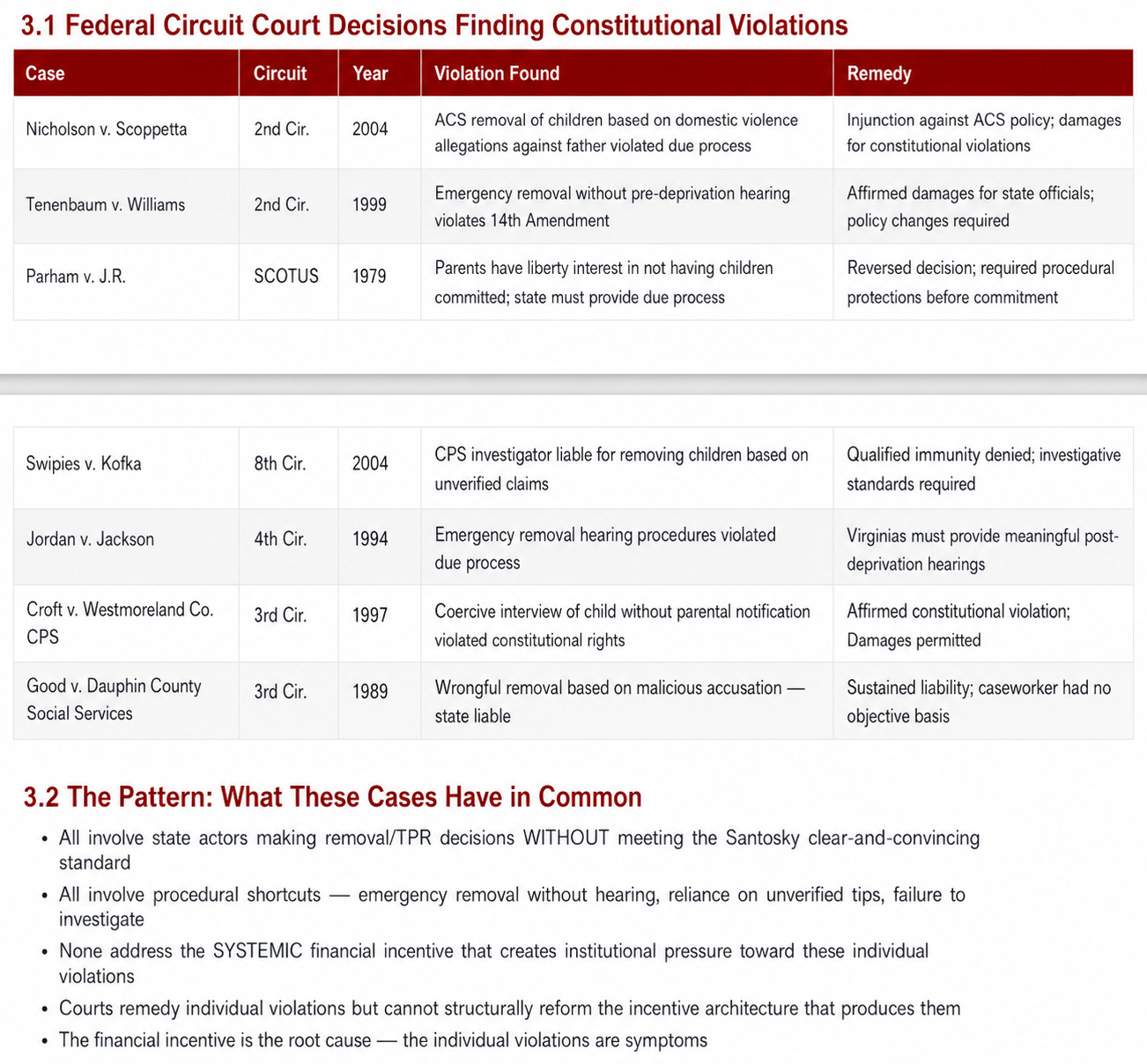
Federal courts have seen pieces of this problem for decades. Nicholson v. Scoppetta exposed how New York City’s child welfare agency removed children from mothers who were themselves domestic violence victims, treating exposure to domestic violence as evidence against the victimized parent without sufficient proof of unfitness. Tenenbaum v. Williams addressed emergency removal without adequate pre-deprivation process when immediate danger was not present. Croft v. Westmoreland County recognized constitutional concerns around coercive state action against families. Good v. Dauphin County Social Services involved wrongful removal based on unreliable accusations. Other cases have challenged emergency removals, inadequate hearings, and child welfare actions unsupported by sufficient investigation. These cases differ in facts, jurisdiction, and remedy, but they share a common theme: state actors can and do violate constitutional rights when they remove children or pursue family separation without adequate evidence, investigation, or process.
What these cases usually do not reach is the larger incentive architecture. Courts can remedy an individual violation. They can award damages, deny qualified immunity, order procedural changes, or approve consent decrees. But the constitutional injury may be produced by a system far larger than one caseworker’s bad decision. If the funding model rewards adoption throughput, if the timeline pressures TPR filing, if agency leadership is evaluated on permanency metrics, if courts are trained to treat deadlines as child-centered urgency, and if parents lack robust counsel, then individual violations are symptoms of a deeper design. The case law identifies sparks. The funding system supplies the dry forest.
That is where Monell liability becomes important. In Monell v. Department of Social Services, the Supreme Court held that municipalities and local government entities can be sued under 42 U.S.C. § 1983 when constitutional violations result from official policies, practices, or customs. The doctrine does not allow liability simply because an employee did something wrong. Plaintiffs must show that the policy or custom itself caused the constitutional violation. In a child welfare context, Monell theory could be used to argue that an agency’s practices, training failures, quota pressures, investigation shortcuts, or termination policies created a predictable pattern of due process violations.
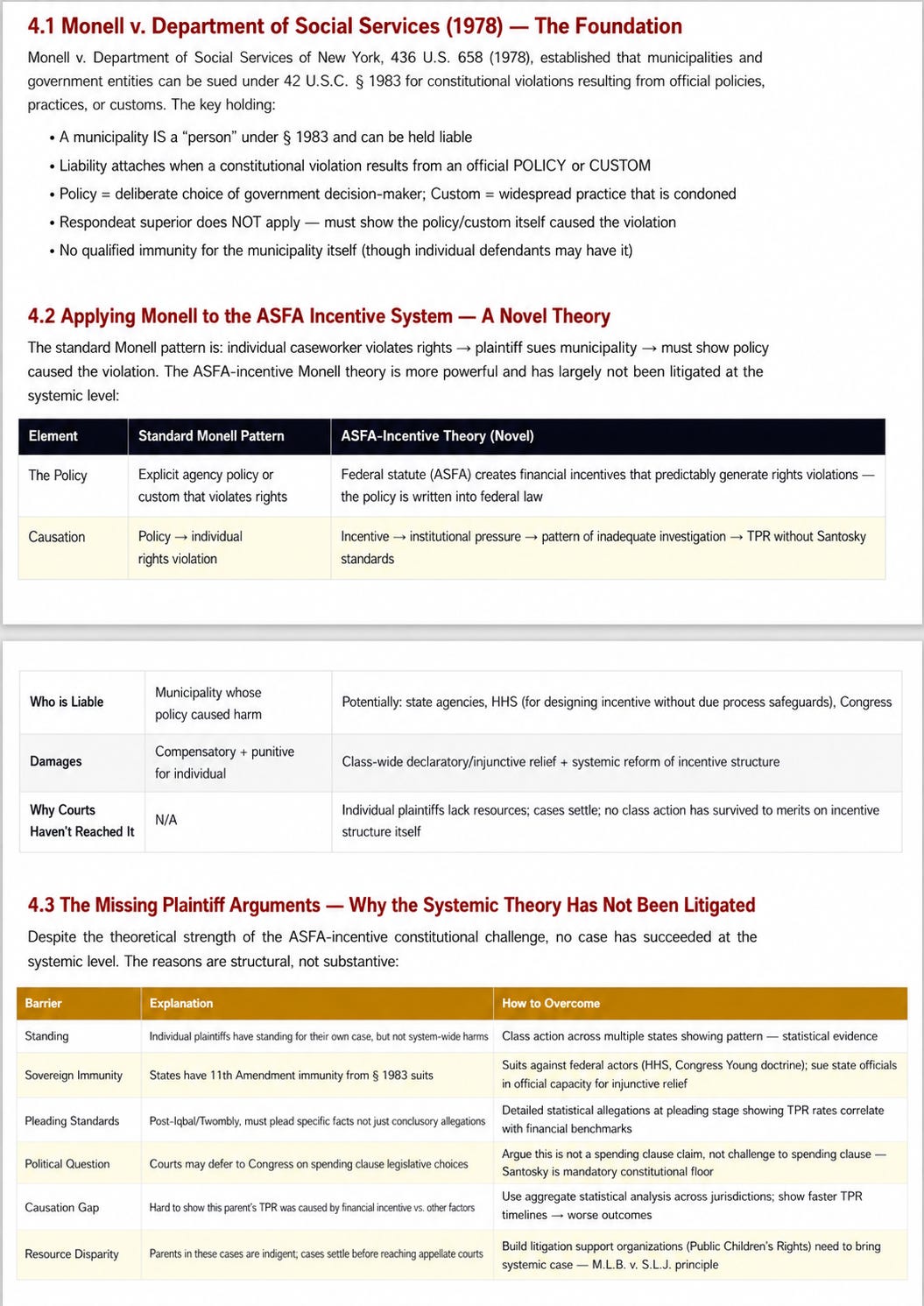
The investigation pushes that logic further by identifying a largely unlitigated systemic theory: the ASFA incentive structure itself may function as the policy architecture that predictably generates constitutional violations. This is not the standard Monell pattern where one caseworker violates rights and the plaintiff points to a county custom. The broader theory is that federal incentives and state implementation create institutional pressure toward premature TPR, inadequate reunification, and adoption-oriented decision-making before Santosky’s constitutional standard has been truly satisfied. It is an ambitious theory, but not a frivolous one. If government funding predictably distorts the procedures protecting a fundamental liberty interest, courts should at least have to confront whether the structure is constitutionally adequate.
The reason this theory has not succeeded at scale is not because the constitutional issue is imaginary. The barriers are procedural and practical. Parents facing TPR are often indigent and emotionally overwhelmed. They are fighting to keep their children, not building national impact litigation. Cases settle. Appeals are expensive. Standing doctrine makes it difficult for one parent to challenge an entire funding system. Sovereign immunity protects states from many damages claims in federal court. Pleading standards require specific facts before plaintiffs can access discovery. Courts may resist challenges that appear to attack federal spending legislation. Causation is difficult because the state will argue that any specific TPR was based on child safety, not money. These barriers protect the system from judicial review even when the underlying theory deserves serious examination.
The litigation pathway would require a carefully built class action with named plaintiffs from multiple jurisdictions, statistical evidence showing relationships between incentive maximization, TPR timing, reunification failures, and adoption outcomes, and claims focused on prospective injunctive relief rather than retrospective damages. Plaintiffs would need to frame the case as a procedural due process challenge under Mathews and Santosky, not merely as a disagreement with Congress’s spending policy. They would also need to show that additional safeguards, such as mandatory Santosky compliance audits, stronger counsel rights, active-efforts requirements, and case-by-case judicial review before timeline-based TPR filing, would reduce the risk of erroneous termination.
There is precedent for systemic foster care litigation, even if not yet for the exact incentive-structure claim. M.D. v. Abbott in Texas is one of the most significant examples. In 2015, federal district Judge Janis Graham Jack found that Texas’s long-term foster care system violated children’s Fourteenth Amendment substantive due process rights. The case involved roughly 32,000 children and findings that included children sleeping in offices, hotels, and cars, unmanageable caseworker caseloads, children being victimized in state custody, and state officials showing deliberate indifference to known constitutional violations. The case did not directly decide the ASFA incentive theory, but it established something crucial: foster care systems can violate the Fourteenth Amendment at a systemic level.
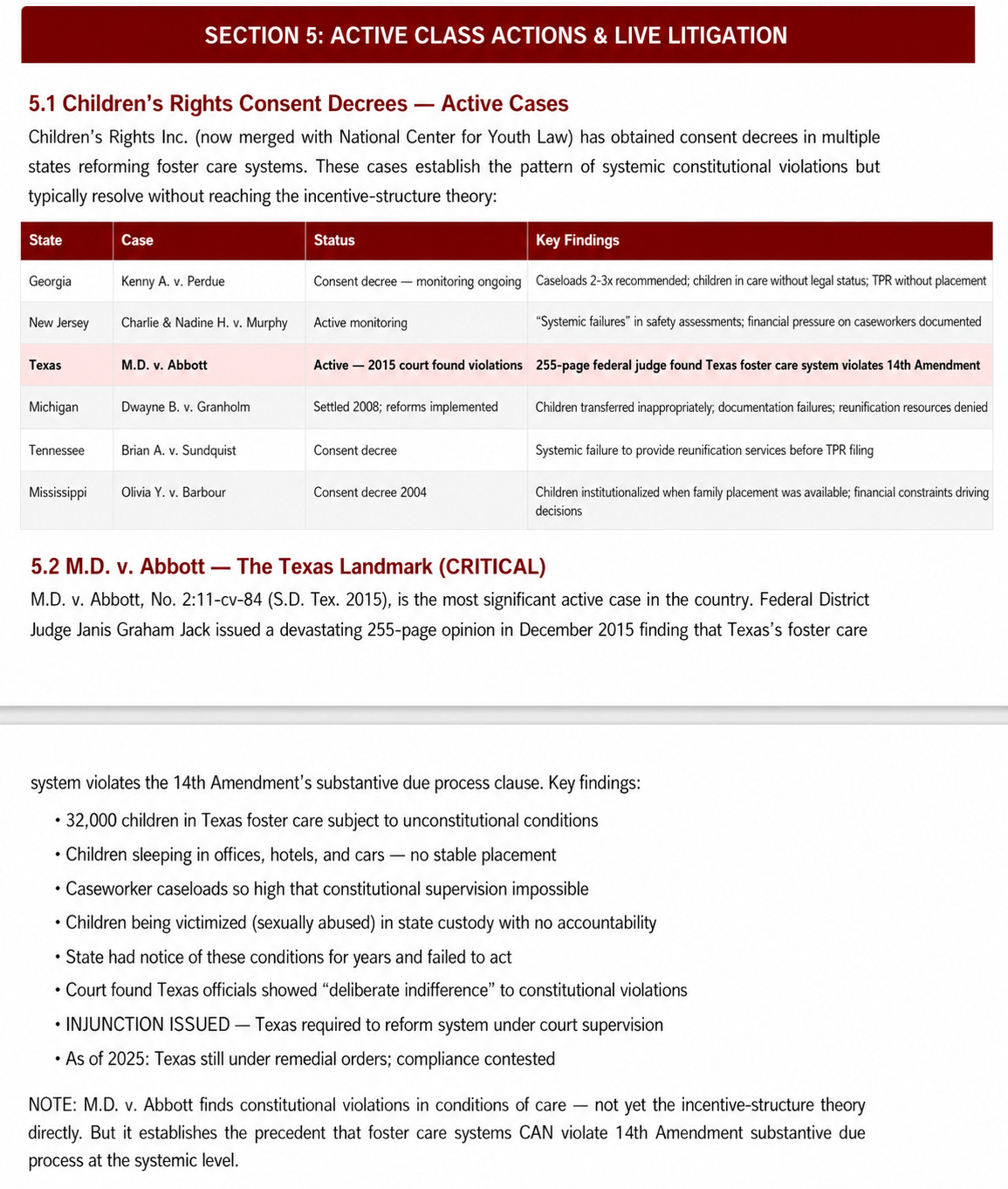
That principle matters because it breaks the excuse that child welfare constitutional violations are always isolated case errors. M.D. v. Abbott showed that systemic conditions of care can become constitutional violations when the state takes custody and then exposes children to unreasonable danger or inadequate protection. If systemic placement failures can violate children’s substantive due process rights, then systemic procedural failures leading to wrongful termination of parental rights should also be capable of constitutional scrutiny. The Constitution does not stop at the caseworker’s desk.
Children’s Rights and related advocacy litigation have produced consent decrees in multiple states, including Georgia, New Jersey, Michigan, Tennessee, Mississippi, and others, often involving high caseloads, inadequate services, unsafe placements, lack of permanency, and systemic child welfare failures. These cases prove that courts and litigators can identify statewide patterns. But consent decrees often stop short of the deepest financial question. They can reform caseloads, monitoring, placement standards, and services, but they typically do not dismantle the federal incentive structure that rewards adoption finalization while leaving due process safeguards underpowered.
The racial dimension makes the constitutional problem even more severe. The investigation cites federal and advocacy data showing that Black and Native American children enter foster care at far higher rates than white children, spend longer in care before reunification, experience higher TPR rates, and are less likely to be adopted after termination. The brief’s table identifies Black children entering foster care at approximately 2.5 times the rate of white children and Native American children at even higher rates, with Native and Black children less likely to reunify and more likely to become legal orphans after TPR. These disparities are not incidental. They are a direct challenge to the claim that the child welfare system applies neutral standards in neutral ways.
Poverty, race, surveillance, and child welfare are deeply intertwined. Families in poor communities are more visible to mandated reporters because they interact more frequently with public systems, including schools, shelters, hospitals, public benefits offices, and social services. Conditions associated with poverty, such as inadequate housing, unstable childcare, transportation barriers, and lack of medical access, are often reinterpreted as neglect. Black and Native families have long histories of state surveillance and family separation. When adoption incentives and termination timelines are layered on top of these disparities, the constitutional concern becomes both due process and equal protection.
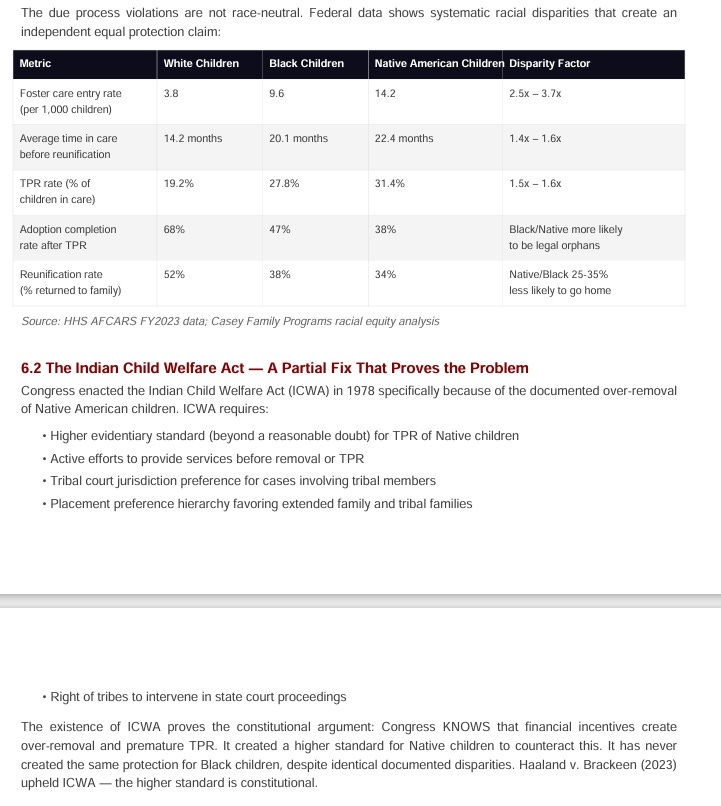
The Indian Child Welfare Act, or ICWA, is critical because it proves Congress already knows that ordinary child welfare standards can produce mass family separation when applied to vulnerable communities. Congress enacted ICWA in 1978 after finding that Native children were being removed from their families and tribes at devastating rates. ICWA requires heightened protections, including active efforts to prevent removal or breakup of the Indian family, placement preferences favoring family and tribal connections, tribal intervention rights, and a higher evidentiary standard for termination in many circumstances. In Haaland v. Brackeen, the Supreme Court upheld ICWA against broad constitutional attack.
ICWA is often discussed as a specialized statute for Native children, which it is, but it is also proof of concept for broader child welfare reform. Congress recognized that when state systems are biased, coercive, or structurally prone to over-removal, ordinary procedures are not enough. Active efforts are stronger than reasonable efforts. Placement preferences preserve family and community identity. Higher evidentiary standards reduce wrongful severance. Tribal participation prevents state courts from treating children as isolated individuals detached from collective identity. These protections exist because history proved they were necessary. The question is why similar protections do not exist for other communities facing documented disparities, especially Black families disproportionately subject to investigation, removal, and TPR.
The investigation argues that ICWA’s existence strengthens the broader constitutional argument because it shows Congress can design safeguards against over-removal when it chooses to. The problem is not that Congress lacks authority. It is that Congress has not extended comparable due process protections across the child welfare system despite decades of evidence that racial disparities, poverty-based removals, and premature TPR remain widespread. If the Constitution requires meaningful process before family destruction, then protections should not depend on whether a family falls within one statutory category.
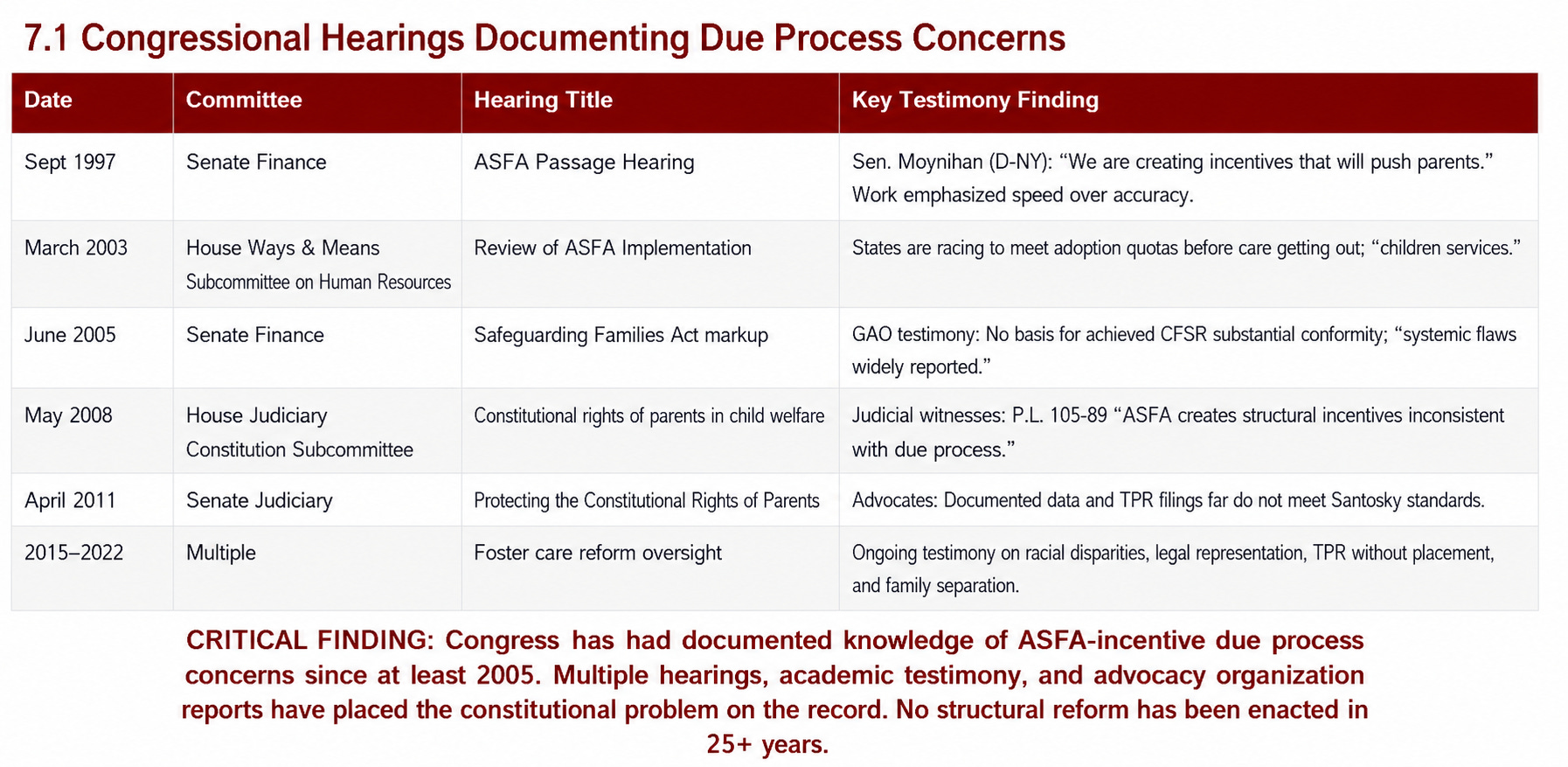
Congress has known about these issues for decades. During the original ASFA debates in 1997, Senator Daniel Patrick Moynihan warned that the law risked creating incentives that would punish poverty. Later hearings documented concerns that states were racing to meet adoption goals before completing reunification services, that no state had achieved full CFSR conformity, that TPR filings could fail to satisfy Santosky, and that racial disparities and legal orphanhood persisted. Academic experts, civil rights advocates, and child welfare reform organizations have repeatedly warned that timelines and incentives can override individualized justice. The record is not silent. The silence is in the remedy.
This is the pattern throughout the foster care incentive system. Congress hears warnings, agencies issue guidance, courts correct individual abuses, advocates document disparities, and the funding architecture remains largely intact. The political appeal of adoption makes reform difficult because no politician wants to appear anti-adoption or soft on child abuse. But criticizing the incentive structure is not anti-adoption. It is pro-due-process. Adoption can be lifesaving and beautiful when it follows lawful, careful, child-centered procedure. It becomes constitutionally dangerous when the financial system rewards the state for reaching adoption while underfunding the safeguards that determine whether TPR was justified in the first place.
The legislative fixes are not mysterious. Congress could decouple adoption bonuses from TPR speed and adoption volume, instead basing incentives on long-term family stability, child well-being, and the prevention of unnecessary removal. It could require a Santosky compliance audit before federal dollars reward adoptions flowing from TPR cases, forcing states to document that clear and convincing evidence of unfitness was actually established and not merely assumed from time in care. It could extend ICWA-like active-efforts protections to all families, requiring states to prove robust family preservation efforts before termination. It could guarantee appointed counsel for all parents in dependency and TPR proceedings as a condition of federal funding. It could replace the 15-of-22-month mandatory filing rule with individualized judicial review that asks why the child remains in care, whether the parent is currently unfit, whether services were adequate, and whether termination is truly the least restrictive path.
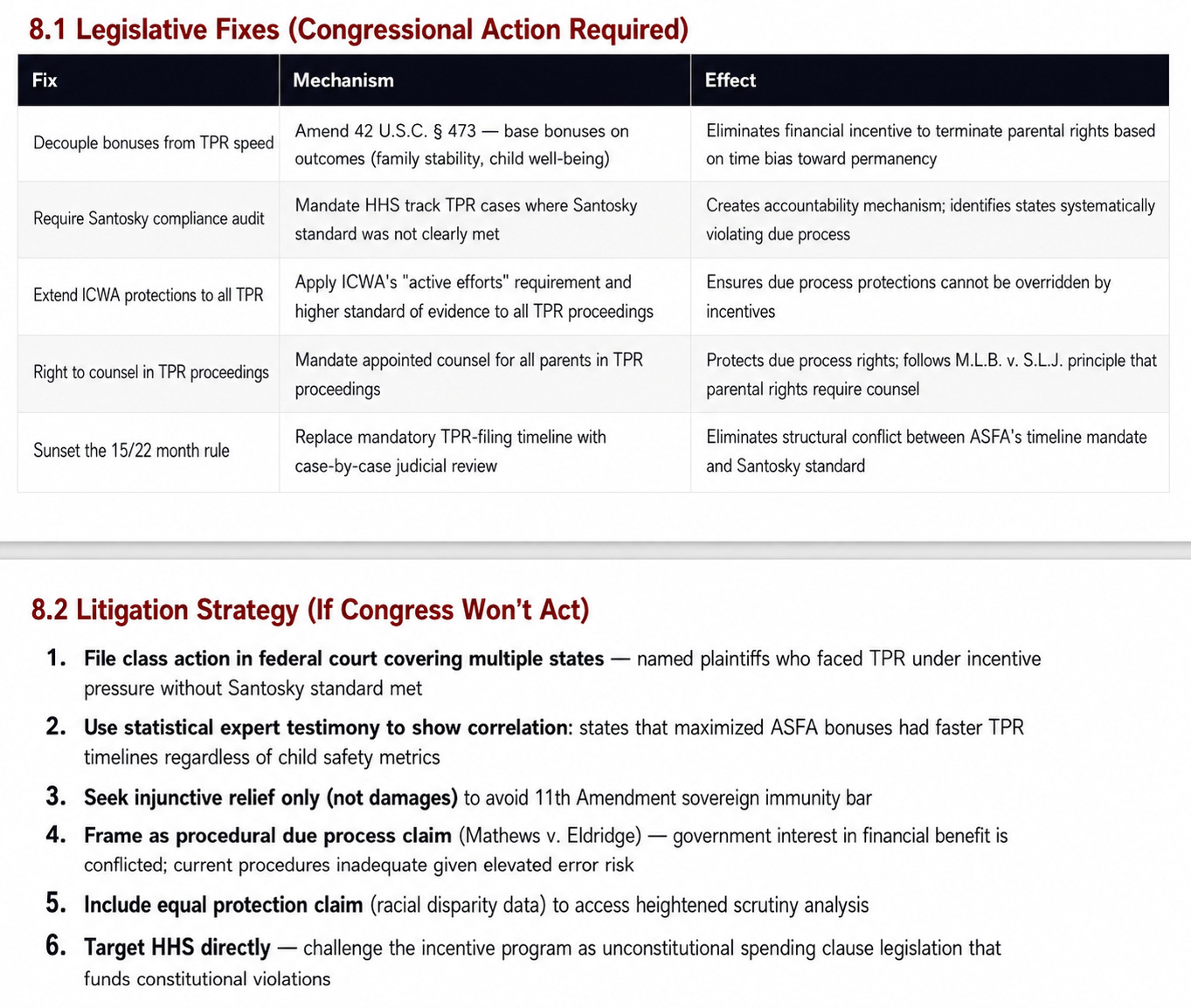
The right-to-counsel issue deserves particular urgency. A parent facing the permanent loss of a child should not enter court with less practical legal support than a defendant facing a minor criminal charge. TPR is civil in form but catastrophic in consequence. The state comes armed with lawyers and institutional expertise. Parents often come with appointed counsel who may meet them minutes before hearings, carry crushing caseloads, lack investigative support, and have no funding for experts. Meaningful due process requires more than a warm body with a bar card. It requires competent, resourced, early, continuous representation.
A Santosky compliance audit would also change the battlefield. Right now, the phrase “clear and convincing evidence” can appear in court orders without meaningful external review of whether the evidence actually met that standard. A federal audit mechanism could require states to track the factual basis for TPR, the services offered, the parent’s compliance, the reasons reunification failed, the availability of kinship options, the child’s wishes when age-appropriate, whether an adoptive placement existed, and whether poverty-related conditions were improperly treated as unfitness. Such an audit would not eliminate judicial discretion, but it would make patterns visible. If a state’s TPR filings spike near timeline deadlines, or if certain counties terminate far more aggressively than others, or if racial disparities persist after controlling for safety factors, federal reviewers and civil rights litigators would have evidence.
Replacing the 15-of-22-month rule does not mean returning to indefinite foster care drift. That is the false choice used to defend the current structure. Children should not languish in uncertainty while adults fail to act. But the solution to drift cannot be a mechanical clock that pushes toward family destruction without adequate inquiry into why reunification has not occurred. A better system would require judges to conduct a searching review at permanency milestones, asking whether the state provided meaningful services, whether barriers were poverty-related and remediable, whether relatives were supported, whether the parent is currently unfit, whether the child is bonded to family, and whether adoption is realistic. The timeline should trigger scrutiny, not automatic escalation.
The deeper philosophical issue is whether America treats poor families as families or as raw material for state-managed permanency outcomes. Middle-class parents are allowed to struggle, relapse, seek therapy, survive domestic violence, lose jobs, move homes, and make imperfect decisions without immediately facing permanent family destruction. Poor parents often experience those same struggles under the surveillance of mandated systems and courts. When the child welfare system overlays financial incentives for adoption onto that surveillance imbalance, it risks creating a pipeline where poverty becomes neglect, neglect becomes foster care, foster care becomes timeline pressure, timeline pressure becomes TPR, and TPR becomes an adoption incentive event.
This does not mean the state should ignore abuse. No serious reformer argues that children should remain in dangerous homes. The question is whether the current incentive system reliably distinguishes danger from poverty, unfitness from hardship, and parental incapacity from state service failure. Santosky was designed to prevent the state from making irreversible errors in precisely this space. The clear-and-convincing standard exists because the cost of a wrong termination is intolerable. But a standard is only as strong as the system that applies it. If the system is financially and administratively tilted toward termination, then the standard can become ceremonial.
The title “Due Process for Sale” is not an accusation that individual judges auction children from the bench or that every adoption is tainted. It is a charge against a policy architecture that places money and constitutional rights in dangerous proximity. When the state can receive financial rewards tied to adoption outcomes, and when the path to those outcomes often runs through termination of parental rights, due process requires extraordinary safeguards. The government cannot be allowed to profit, even indirectly, from a process it also controls, unless the process is insulated from financial bias with ruthless seriousness. That insulation has not been built.
The public should demand a simple rule: no federal dollar should reward an adoption that rests on a constitutionally defective termination. No state should receive adoption incentive credit unless it can prove that TPR was supported by clear and convincing evidence of current unfitness, that reunification services were meaningful and accessible, that poverty was not treated as neglect, that relatives were explored, that the child’s legal severance did not merely create a legal orphan, and that the adoption produced durable permanency rather than a temporary statistical success. If the government wants to pay for permanency, it must define permanency as a stable life for the child, not a finalized transaction.
The families caught in this system are not abstractions. They are mothers who survived domestic violence and were punished for the violence committed against them. Fathers who were never given meaningful hearings. Parents who completed services but lost children because the timeline had matured. Grandparents who were not properly considered. Children who wanted to go home but were told adoption was the plan. Black and Native families who entered a system already shaped by surveillance and historical separation. Teenagers whose parents’ rights were terminated only for them to remain in foster care anyway. These are the human beings behind constitutional doctrine.
The Fourteenth Amendment does not enforce itself. Santosky does not enforce itself. Mathews does not enforce itself. A constitutional right can exist in a law book and still be violated in practice if the institutions charged with honoring it are rewarded for moving too quickly, measuring the wrong outcomes, and treating family destruction as a step toward administrative success. That is the danger at the heart of ASFA’s incentive system.
America does not have to choose between child safety and parental rights. That choice is a lie. The Constitution requires the state to protect children without abandoning due process. A system that cannot do both is not a child protection system. It is a family separation system with a funding formula.
Due process is not a luxury for parents who can afford private lawyers. It is not an obstacle to child safety. It is not a technicality that should yield to adoption targets or federal performance metrics. Due process is the constitutional line between lawful protection and government overreach. When the state seeks to permanently sever a family, that line must be guarded with the highest seriousness because once it is crossed, the damage cannot always be repaired.
For twenty-seven years, America has operated a foster care incentive structure that pays states to finalize adoptions while relying on underpowered safeguards to ensure the terminations behind those adoptions were constitutionally sound. Courts have seen the violations. Advocates have warned Congress. Data has exposed racial disparities. ICWA has shown that stronger protections are possible. Still, the core architecture remains.
That is the scandal. Not that adoption exists. Not that dangerous parents are sometimes terminated. Not that states seek permanency for children. The scandal is that the government built a financial machine around one of the most sacred constitutional relationships in American life and then failed to build the safeguards necessary to keep that machine from leaning on the scales of justice.
If parental rights are fundamental, they cannot be subordinated to adoption metrics. If clear and convincing evidence is the constitutional floor, then timelines and incentives cannot be allowed to drag courts below it. If the state wants to destroy a family, it must prove what the Constitution requires, not what the funding system rewards.
Due process is not for sale. Congress should stop pricing it like it is.
If you enjoyed this work and feel encouraged by independent investigations like this, please consider becoming a paid subscriber to The Constitutional Republic on Substack.
Your support helps us continue:
investigative reporting
public records research
educational transparency projects
community outreach
and future investigations like this series
Most importantly, please share this article.
Independent journalism survives when ordinary people help spread information powerful institutions would prefer remain ignored, misunderstood, or buried beneath complexity.
Because silence protects systems.
Informed communities protect children.
ALL paid subscriptions are tax deductible Project Milk Carton | 501(c)(3) | EIN: 33-1323547
CITATIONS & SOURCES
• Santosky v. Kramer, 455 U.S. 745 (1982)
• Meyer v. Nebraska, 262 U.S. 390 (1923)
• Pierce v. Society of Sisters, 268 U.S. 510 (1925)
• Stanley v. Illinois, 405 U.S. 645 (1972)
• Troxel v. Granville, 530 U.S. 57 (2000)
• M.L.B. v. S.L.J., 519 U.S. 102 (1996) • Mathews v. Eldridge, 424 U.S. 319 (1976)
• Monell v. Department of Social Services, 436 U.S. 658 (1978)
• Nicholson v. Scoppetta, 344 F.3d 154 (2d Cir. 2004)
• M.D. v. Abbott, No. 2:11-cv-84, 2015 WL 9320183 (S.D. Tex. Dec. 17, 2015)
• Haaland v. Brackeen, 599 U.S. 255 (2023) (upholding ICWA)
• Adoption and Safe Families Act, P.L. 105-89 (1997), codified at 42 U.S.C. §§ 671, 673, 675
• Indian Child Welfare Act, P.L. 95-608 (1978), 25 U.S.C. §§ 1901–1963
• HHS AFCARS FY2023 Annual Report — Racial Disparity Data
• HHS CFSR Round 3 Performance Profiles — All 52 Jurisdictions
• Kenny A. v. Perdue, No. 1:02-cv-1686 (N.D. Ga.) — Active consent decree
• Congressional Record, Senate Finance Committee, Sept. 1997 — ASFA passage hearings
• Prof. Martin Guggenheim, NYU Law — Congressional testimony, May 2008
• Casey Family Programs, Racial Equity in Child Welfare (2023)
• Children's Rights Inc./NCLR — Active Litigation Tracker (2024)
Project Milk Carton projectmilkcarton.org | 501(c)(3) EIN: 33-1323547